Equine Reproduction FAQ
The Equine Theriogenology Service at the Purdue University Equine Hospital helps owners, breeders, and referring veterinarians with reproductive care for mares and stallions.
These answers are intended to help you understand common equine reproduction questions and decide when to contact the service. They are not a substitute for veterinary care or case-specific medical advice.
Call us at 765-494-8548 to request an appointment or discuss next steps.
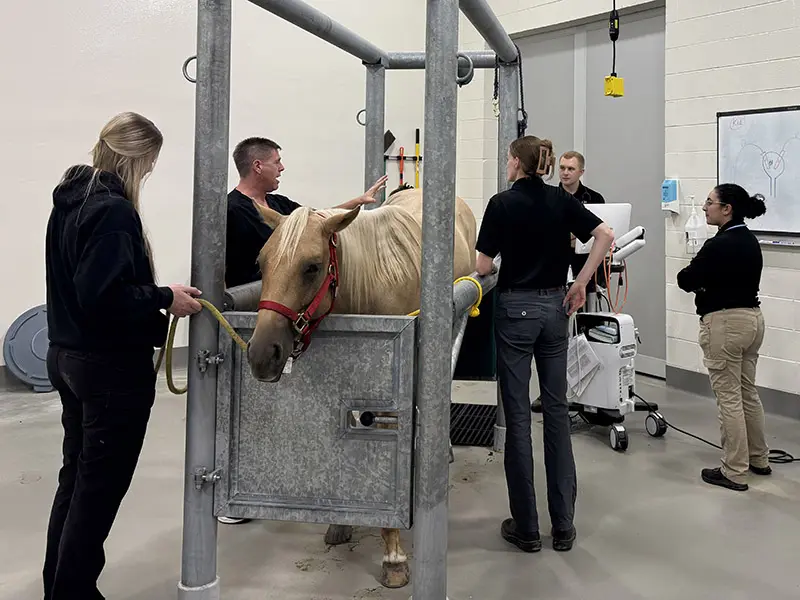
Breeding season planning
Contact the Equine Theriogenology Service before breeding season or before ordering semen when possible. Early planning gives the team time to review the mare’s history, discuss the breeding plan, and coordinate timing for cooled or frozen semen.
Helpful information may include your mare’s age, breed, use, prior breeding history, pregnancy history, planned stallion, semen type, expected semen shipment timing, and any records from your veterinarian. You do not need to have every detail before calling. The team can help identify what information may be needed.
Breeding management helps coordinate the mare’s reproductive cycle, ovulation timing, semen handling, and follow-up pregnancy evaluation. Horse breeding is not simply a matter of giving medication and choosing a breeding date. It requires monitoring, timing, technical skill, and veterinary decision-making.
Owners may call the Equine Theriogenology Service directly. Referring veterinarians are also welcome to contact the service to discuss mare or stallion reproductive cases. If your horse is already working with a veterinarian, sharing records can help the team understand the history and next steps.
Mare breeding and artificial insemination
Yes. The Equine Theriogenology Service provides artificial insemination as part of mare breeding management, including cases using cooled or frozen semen. Timing is important, so owners should contact the service before ordering semen when possible.
Cooled semen is collected, processed, shipped, and used within a shorter time window. Frozen semen is cryopreserved and stored for later use. Both require planning, but frozen semen often requires especially careful timing around ovulation and insemination.
Artificial insemination must be coordinated with the mare’s reproductive cycle, ovulation, semen handling, and semen arrival. Monitoring helps the team make timing decisions based on the mare’s individual reproductive status.
No. Reproductive medications may be part of a breeding plan, but they are not guaranteed and do not replace monitoring, examination, and veterinary decision-making. The best approach depends on the mare’s reproductive status, timing, semen type, and breeding goals.
A mare that did not conceive may benefit from a reproductive evaluation before another breeding attempt. The Equine Theriogenology Service can evaluate mares with fertility concerns and help owners and referring veterinarians plan next steps.
Problem mares and infertility
A “problem mare” is a common term for a mare that has had difficulty conceiving, maintaining pregnancy, or progressing through a breeding plan as expected. The term does not point to one diagnosis. It usually means the mare may need a more detailed reproductive evaluation.
A mare may benefit from infertility evaluation if she has not conceived after previous breeding attempts, has a history of pregnancy loss, has suspected reproductive tract concerns, or needs a more detailed plan before another breeding season.
Many factors may affect a mare’s ability to conceive, including timing, semen factors, uterine health, breeding-associated infection, reproductive tract changes, seasonal influences, and individual health history. A veterinary evaluation can help identify which factors may be relevant.
A uterine biopsy can provide information about the uterine lining and may help guide reproductive planning. It is one part of a broader reproductive evaluation and should be interpreted by a veterinarian in the context of the mare’s history and examination findings.
Hysteroscopy allows the veterinarian to examine the inside of the uterus using specialized equipment. It may be recommended when a mare’s history, examination, or breeding outcome suggests that a closer uterine evaluation is needed.
No. The ovaries are not the cause of all behavior issues. If a mare has behavior concerns, a reproductive evaluation may help determine whether reproductive factors are involved, but other causes may also need to be considered with your veterinarian.
Embryo transfer and embryo freezing
Yes. The Equine Theriogenology Service at the Purdue University Equine Hospital provides equine embryo transfer services. Call us at 765-494-8548 to discuss planning, timing, and what information the team will need.
Yes. The Equine Theriogenology Service provides embryo freezing as part of its equine reproductive services. Embryo freezing requires planning, timing, and coordination, so owners should contact the service early when possible.
Contact the service before breeding season or before ordering semen when possible. Embryo transfer requires reproductive monitoring, timing, and coordination. Early communication can help the team understand the mare’s history, breeding goals, semen source, and scheduling needs.
Helpful information may include the mare’s age, reproductive history, prior pregnancies, planned stallion, semen type, breeding goals, and records from your veterinarian. The team can help determine what else may be needed after reviewing the case.
No reproductive procedure is appropriate for every mare or every breeding goal. The Equine Theriogenology Service can help evaluate the mare’s history and discuss whether embryo transfer planning may be appropriate.
Costs can vary depending on the mare’s reproductive status, monitoring needs, semen type, timing, procedures, and follow-up care. Contact the service to discuss your situation and what planning may involve.
Stallion semen collection, freezing, and storage
Yes. The Equine Theriogenology Service at the Purdue University Equine Hospital provides stallion semen collection services. Owners can call us at 765-494-8548 to discuss scheduling, collection history, breeding goals, and next steps.
Yes. The Equine Theriogenology Service provides stallion semen freezing, also called semen cryopreservation. Semen freezing can help preserve stallion genetics for future use and requires collection, evaluation, processing, and storage planning.
Yes. The Equine Theriogenology Service provides semen storage for frozen stallion semen. Owners should contact the service to discuss storage needs, records, and next steps.
Phantom training helps a stallion learn to safely and calmly participate in semen collection using a phantom mare. It may be useful for stallions that are new to collection or need additional training before collection is practical.
Yes. The Equine Theriogenology Service provides stallion reproductive evaluation and can help investigate fertility concerns. A stallion evaluation may be useful before breeding season, before semen freezing, or when pregnancy results have not been as expected.
Helpful information may include the stallion’s age, breed, use, breeding history, collection history, prior semen evaluation results, fertility concerns, current breeding goals, and whether semen freezing or storage is being considered.
Yes. The Equine Theriogenology Service provides post-mortem gamete preservation for stallions when circumstances allow. Because timing is important, call 765-494-8548 as soon as possible to discuss whether this may be an option.
Pregnancy ultrasound, twin management, and high-risk pregnancy care
Pregnancy can be detected by ultrasound as early as 11 days after ovulation. Your veterinarian can help determine the appropriate timing for pregnancy checks and follow-up monitoring.
Yes. The Equine Theriogenology Service at the Purdue University Equine Hospital provides pregnancy ultrasound and pregnancy monitoring for mares.
Yes. The Equine Theriogenology Service provides twin management and twin reduction when appropriate. Twin pregnancies can be time-sensitive, so owners and referring veterinarians should contact the service promptly if twins are suspected or confirmed.
High-risk pregnancy hospitalization provides hospital-based monitoring or care for mares with pregnancy concerns. Whether hospitalization is appropriate depends on the mare’s condition, pregnancy status, history, and veterinarian recommendations.
The Equine Theriogenology Service provides foaling out for high-risk pregnancies. It is not a routine foaling-out service for uncomplicated pregnancies.
A newborn foal needs colostrum, the mare’s first milk. If a foal is not nursing, contact your veterinarian or an emergency clinic immediately.
If you think your mare is experiencing an emergency, contact your veterinarian or an emergency clinic right away. For urgent needs involving the Purdue University Equine Hospital, call 765-494-8548.
Referrals and appointments
A veterinarian may contact the Equine Theriogenology Service for mare or stallion reproductive concerns, including infertility evaluation, breeding management, embryo transfer, embryo freezing, semen services, pregnancy monitoring, twin management, and high-risk pregnancy care.
Helpful records may include breeding history, pregnancy history, recent ultrasound findings, semen type used, uterine culture or biopsy results, treatment history, current medications, and the current reason for referral.
Helpful records may include breeding history, prior semen evaluation results, collection history, semen freezing or storage history, fertility concerns, and current breeding or semen preservation goals.
Some reproductive cases are time-sensitive, including semen shipment, ovulation timing, twin management, post-mortem gamete preservation, and high-risk pregnancy concerns. Call 765-494-8548 as soon as possible to discuss the situation.
Call us at 765-494-8548 to request an appointment with the Equine Theriogenology Service at the Purdue University Equine Hospital.
Request an appointment
The Equine Theriogenology Service helps owners, breeders, and referring veterinarians with reproductive care for mares and stallions.
Call us at 765-494-8548 to request an appointment or discuss next steps.