
How much sand in a horse's colon is too much, and can veterinarians predict when sand colic will require surgery? New research involving Purdue Veterinary Medicine is helping answer these questions by identifying factors associated with sand colic and exploring why some horses need surgery while others recover with medical treatment. Learn what researchers discovered and what horse owners can do to help reduce the risk of sand colic.
As most horse owners know, horses can colic for virtually any reason: impacted feed, an inopportune gas bubble, a displaced piece of bowl, a change in the weather, or the phase of the moon. Accumulations of sand in the large colon can lead to painful stretching and even obstruction of the colon. This can result in anything from mild and chronic colic, diarrhea, and weight loss to sudden and severe episodes of colic. Many horses can resolve with medical management (namely being administered large quantities of psyllium and kept hydrated while the accumulated sand clears) but some require surgery to remove the sand. Both treatment options have an excellent prognosis, but the cost and recovery time are much higher with surgical sand colics. Despite the fact that sand colics make up around 5% of all colic cases (potentially much higher in regions with sandy soil), little information exists to help veterinarians predict whether a horse diagnosed with sand colic will respond to medical management or require surgery.
This was a challenge that Dr. Camilla Jamieson faced regularly during her time as a senior veterinarian at the Equine Veterinary Medical Center (EVMC) in Qatar. With most of her patients living in the desert or extremely sandy pastures, sand accumulated in the colon was a common finding in colicing horses. But how much sand was too much? What factors predicted if a horse truly had sand colic or an incidental accumulation? Most importantly, what factors predicted an individual sand colic’s need for surgery? So, Dr. Jamieson started collecting data: every horse that came to her hospital had abdominal radiographs (the gold-standard for identifying colonic sand) with the depth and distribution of sand recorded for each animal. These results were then compared to the horses age, breed, sex, body weight, and final diagnosis (non-colic, non-sand colic, and sand colic). Then the project was shelved while she moved back to the United States and joined the team at Purdue University College of Veterinary Medicine. Final analysis completed early in 2026 with collaborators form Purdue, the EVMC, and even some input from an equine hospital in Ireland.
Unsurprisingly, horses ultimately diagnosed with sand colic had much more sand in their colons, with a 2% increase in the odds ratio of being diagnosed with sand colic for every millimeter of sand present. Body weight and distribution also played a major part, with smaller horses (as well as younger horses) and horses with sand in the front part of their colon being more likely to be diagnosed with sand colic. However, while older horses were slightly more likely to require surgical removal of their sand accumulations, no other factors reliably predicted whether an individual horse would need surgery. These results were published in the Journal of the American Veterinary Medical associated and will help veterinarians around the world to interpret sand on abdominal x-rays more confidently. It also allows veterinarians to prepare owners that the only way to predict if their horse will need sand removal surgery is to see if their horse can stay comfortable and rapidly clear the sand accumulation in response to medical management. Read the full article.
Obviously, the best way to manage sand colic is to avoid it! Feeding hay and grain on mats instead of directly on the ground, providing enrichment and frequent meals throughout the day so horses do not try to eat dirt out of boredom or hunger, and feeding a psyllium-based sand-removal supplement for one week out of every month may help to reduce your horse’s risk.
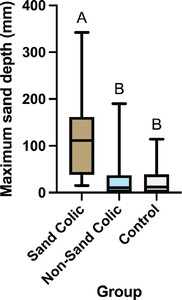
The box-and-whisker plot compares maximum sand depth, measured in millimeters (mm), across three groups: Sand Colic, Non-Sand Colic, and Control.
The vertical axis ranges from 0 to 400 mm.
- Sand Colic (A): Has the highest median sand depth, approximately 110 mm, with values extending from about 15 to 345 mm.
- Non-Sand Colic (B): Has a median sand depth near 10 mm, with values extending from approximately 0 to 190 mm.
- Control (B): Has a median sand depth near 10 mm, with values extending from approximately 0 to 115 mm.
The letters above the groups indicate statistical comparisons. The Sand Colic group is labeled A, while the Non-Sand Colic and Control groups are both labeled B, indicating that the Sand Colic group differs statistically from the other two groups, which do not differ significantly from each other.
Key takeaway: Horses in the sand colic group had substantially greater maximum sand depths than horses in the non-sand colic and control groups.


