
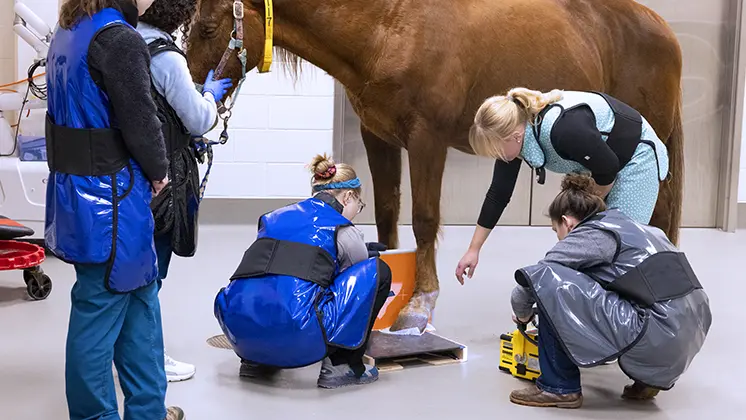
Who takes care of your animal when you visit Purdue's Veterinary Hospital or meet our team during a farm call? From veterinary students and interns to board-certified specialists, veterinary technicians, and support staff, it takes a team with many different skills to provide exceptional care. Learn who's who, what each person does, and how your animal's care helps train the next generation of veterinary professionals.
It takes a lot of different jobs and skill sets to keep a teaching hospital running smoothly and while also teaching the next generation of exceptional veterinarians and specialists!
Veterinary Students
Veterinary students that you interact with both at the hospital and during farm calls are in their fourth and final year of veterinary school. Like most veterinary schools, students at Purdue spend the entirety of their fourth year working with veterinarians in our large and small animal hospitals as well as at veterinary hospitals around the country. Students help with taking histories, providing basic patient care and owner updates, observing and assisting with procedures, and compiling medical paperwork while learning as much as they can from every case.
Interns
Interns are veterinarians who have recently graduated and have chosen to pursue specialized training at the start of their careers, usually in their first year or two after completing veterinary school. Purdue’s large animal internship program rotates new veterinarians through surgery, internal medicine, reproduction (theriogenology), and equine field service to give them hands-on experience in advanced case management and procedures under the guidance of specialists and residents in each area. If you call the hospital’s emergency line out of hours, you’ll most likely speak to an intern who will take all the necessary history and information about your case and get our team prepared to best help your animal.
Residents
Residents are veterinarians who have completed one or more internship and were accepted into a competitive program consisting of three years of intensive training in one specific field. Residents manage cases, perform procedures, and teach students under the direct supervision of senior clinicians. After completing residency, passing two phases of specialty boards exams, and publishing a peer-reviewed original research paper, residents will obtain board certification in their specialty and go on to work at private specialty hospitals and other teaching hospitals around the world. Purdue has residency programs in large animal internal medicine and large animal surgery as well as many other fields like ophthalmology, diagnostic imaging, anesthesiology, clinical and anatomic pathology, and many small animal specialties.
Senior Clinicians
Senior clinicians are veterinarians who have completed internship and residency programs and earned board certification in their area of expertise. In addition to leading procedures, case management, and student teaching on clinics, they also teach first through third year veterinary students in labs and lectures and perform cutting edge research.
Technicians
Technicians are the veterinary equivalent of nurses. Vet techs have completed a 2-4 year training program and have obtained specialized credentials. Vet techs prepare for and assist with a range of surgical and medical procedures, perform many parts of patient care and medication administration, and perform a range of specific procedures including catheter placement and obtaining radiographs (x-rays). Purdue’s College of Veterinary Medicine also has a veterinary technician program so you may meet tech students on clinical rotation as well as veterinary students.
Assistants
Assistants help prepare for and assist with a range of procedures and keep all the advanced equipment at Purdue clean and running smoothly. They also help with day-to-day patient care. However, they do not have specific credentials and have a narrower range of roles around the hospital compared to technicians.
Barn Staff
Barn staff keep our patients’ stalls clean and comfortable, our feed rooms stocked, and our hospital spotless.
Reception Team
Reception team keep our appointments and bills in order and field emergency calls during business hours.
Student Handlers
Student handlers are undergraduate and pre-clinical veterinary students who help restrain during exams and procedures and move patients in to, out of, and around the hospital.
Every member of our hospital team plays an important role in providing exceptional care for our patients while helping train the next generation of veterinarians and veterinary professionals. Whether you're visiting the hospital or meeting our team during a farm call, you can be confident that a dedicated group of people is working together to provide the best possible care for your animal. We appreciate the trust you place in our team and the opportunity to make your animal's care part of our students' learning experience.


