
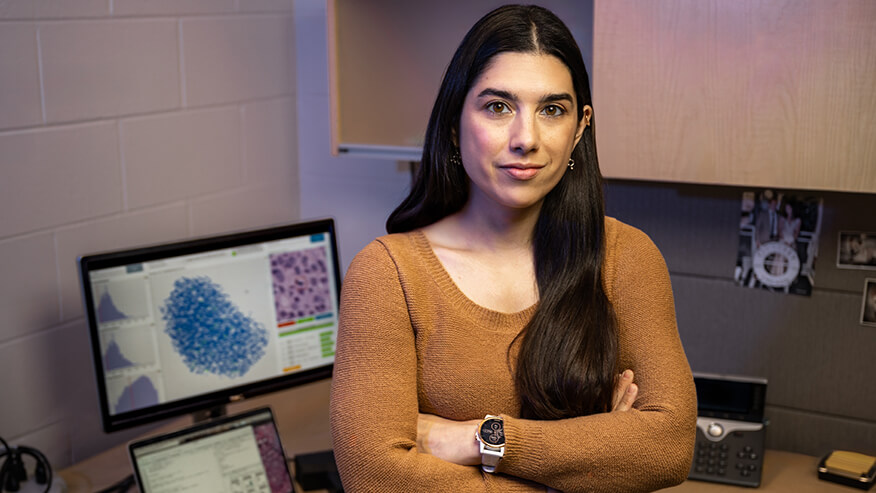
With recent advances, cancer research now generates vast amounts of information. The data could help researchers detect patterns in cancer cells and stop their growth, but the sheer volume is just too much for the human mind to digest. Enter Nadia Lanman, whose expertise in computational biology helps researchers at Purdue University distill solutions from the sea of numbers.
A research associate professor in the College of Veterinary Medicine’s Department of Comparative Pathobiology and at the Purdue Institute for Cancer Research, Lanman works with vast amounts of information ranging from the active genes in cancer cells to images of tumors in medical scans and the outcome of treatments. By applying advanced computational techniques, including AI, to these datasets, she helps researchers explore questions on everything from basic biological processes, such as development and cellular differentiation, to disease progression and how to target therapies and improve outcomes.
Lanman is a biologist — in fact, a botanist — at heart, but in visiting her lab, don’t expect to see white coats or even a test tube. In the Collaborative Core for Cancer Bioinformatics, which she manages, her primary tool is a computer.
“I’m a biologist, but my work leverages computational methods and algorithms to make sense of massive biological datasets,” said Lanman, who helped establish the core in 2015, the same year she earned her PhD from Purdue. “My goal is to understand disease processes and to leverage that knowledge to improve treatments. That’s what’s driving me.”
Since the Human Genome Project sequenced the 3.2 billion DNA base pairs in a full human genome, the speed with which researchers are able to obtain genetic data has shifted from years to weeks or even hours. Genomic data, or DNA sequencing, produces a record of the instructions for building and maintaining life as written in a sort of Morse code using four molecules.
Similar to DNA sequencing, researchers use a range of other techniques to understand what processes give rise to cancer and create an environment where it can thrive. They may track specific genes — each of which contains the instructions for proteins — that are activated at a given time, the proteins built from the activated instructions, interactions between those proteins, and thousands of molecules that life produces, such as fats, signaling molecules and vitamins. These techniques have given rise to a tsunami of information — genomic, transcriptomic, proteomic, metabolomic — collectively known as multiomic sequencing data.
It’s enough to give anyone a headache, which is why Lanman’s bioinformatics expertise is so critical. The one connection needed might be hidden among a thousand other interactions.
When she joins a project, Lanman might contribute to experimental design, run simulations to determine the optimal sample size needed, select among advanced data analysis techniques including the use of neural networks and AI, and perform the calculations. Her background in life sciences, as well as extensive training in computer science and statistics, enables her to apply computational methods to large biological datasets.
For example, in recent work with Purdue colleague Deborah Knapp, a canine cancer scientist and the Dolores L. McCall Professor of Veterinary Medicine and Distinguished Professor of Comparative Oncology, Lanman is combining many types of available data to create a “digital twin” model of bladder cancer that may be powerful enough to predict patient outcomes, including the probability of metastasis. The project builds on Knapp’s long-running study of dogs with bladder cancer, including Scottish terriers, a breed that develops bladder cancer at a rate 20 times higher than other dog breeds. By applying computer techniques to the available data, Lanman aims to create a virtual representation of bladder cancer and use it to simulate various scenarios. Researchers can then take promising leads back to the lab to test whether the results are borne out in real life.
“What we can learn is endless, but it has to be done through a marriage between bench science and computation,” Lanman said. “The highest impact comes from generating or testing a hypothesis computationally and then going back into the lab to validate the results and to identify mechanisms at play. And now that we can process these massive amounts of data, we have many, many targets to test with bench science.”
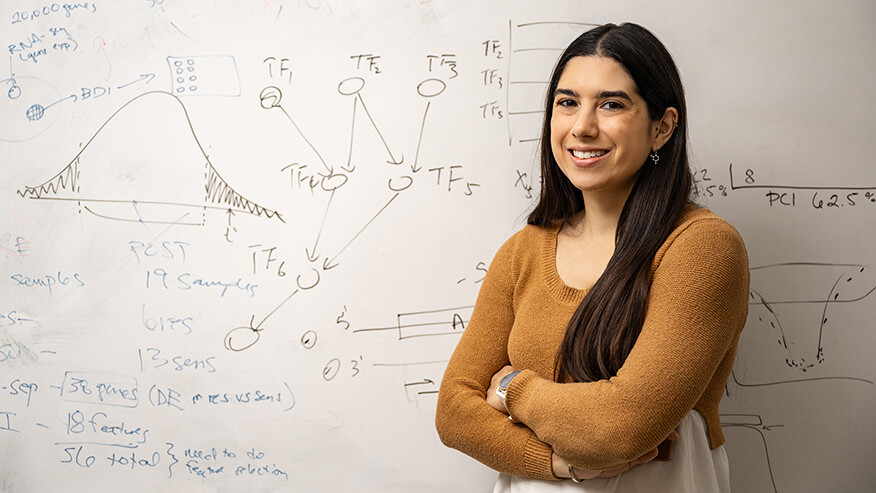
As the name of the bioinformatics core suggests, much of Lanman’s work is collaborative, adding her knowledge of data analysis to teams working on a range of questions related to cancer. Her work empowers a broad swath of cancer research, advancing basic science, like how immune cells are reprogrammed in a cancerous environment; improving data science methods for cancer research; and treating urologic diseases, which is her own primary research interest. But regardless of the data or the computational methods for digging into it, her interest is in helping people.
“If I develop a novel computational technique, what I really want is to use it to gain insight that will improve patients’ lives,” Lanman said.
The core supports research through the Purdue Institute for Cancer Research. The institute, the core and Lanman’s research are part of Purdue’s One Health initiative, which involves research at the intersection of human, animal and plant health and well-being. Computational biology is also a component of Purdue Computes, a comprehensive university initiative that emphasizes four key pillars of Purdue’s extensive technological and computational environment — computing departments, physical AI, quantum science and semiconductor innovation. Click here for a complete story that includes links to related research publications.
