
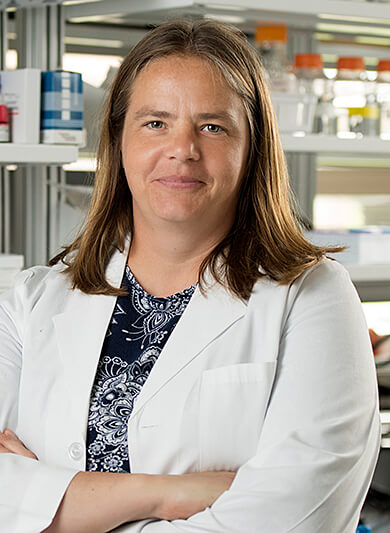
Dr. Dianne Little, an assistant professor in Purdue Veterinary Medicine’s Department of Basic Medical Sciences, knows first-hand about rotator cuff tears. A few years ago, when she was leading a horse around the corner of a barn, she was suddenly met by a piece of construction equipment with a tarp flapping heavily in the wind. The horse spooked, rearing up on its hind legs, and tried to head for the hills. Dr. Little held tight, refusing to lose control of the horse, but she left the barn that day with a partially dislocated shoulder and a torn rotator cuff.
Rotator cuff tears can happen in a split second, like Dr. Little’s did, or they can be caused by prolonged stress and degeneration over years or even decades, finally reaching a point of no return. It’s estimated that up to two million people in the United States visit their doctors because of a torn rotator cuff each year, with athletes and older active adults especially vulnerable.
Dr. Little, has been studying rotator cuff tears and how to repair them for several years. “Rotator cuff tears are a really debilitating injury because you can no longer do simple things like brush your hair or put your seat belt on,” she said. “Once it gets to that point, many tears need to be repaired surgically. But the problem is, there’s no way to do it that has guaranteed results. Depending on the patient population and on the size of the tear, up to 90 percent of tears repaired surgically fail, so there’s a big push to try and find better solutions.”
Current methods to repair rotator cuff tears involve stitching the torn tendon back to the bone, using a biomaterial made from human or animal tissue or doing a transfer using tendon from nearby to replace rotator cuff function. In some cases, a joint replacement may be necessary. But due to the high physical demands on rotator cuffs and the complex anatomy of tendon, re-tears after surgery are common.
Dr. Little wants to engineer tendon that would match the patient’s own rotator cuff. If surgeons were able to use tendon that matched that of the healthy tendon to repair it, they might be able to stimulate early regeneration, rather than scarring and fibrosis.
But there’s one big hurdle in the way of tendon engineering: researchers don’t fully understand what tendon is. “We know what tendon looks like and how it behaves, but we don’t really know what it is. There’s no marker that tells you, ‘This is tendon.’ There are certain markers for bone and cartilage, so when you see them, you know that’s what you’re looking at. But that’s not true for tendon because we don’t know enough about what tendon is,” Dr. Little said. “If you’re trying to grow new tendon, you need to know what it is before you know whether or not you’ve recreated it.”
A $2.5 million grant from the National Institutes of Health could help her toward a breakthrough in the field. For the next five years, Dr. Little will be trying to figure out what the rotator cuff tendon looks like at every level – from the proteins, fats and metabolites, to the genetic code that makes tissue turn into tendon.
For her study, she’ll use human tissue and stem cells from fat that aren’t suitable for transplantation to create new tendon. Then she’ll sequence all these levels and genetic factors of the engineered tendon and naturally occurring tendon to see how those profiles change. “We’ll be able to see if the new tendon ends up being the same as the existing tendon or if it’s different, and if so, how we could push it to become better tendon,” Dr. Little said.
This research aligns with Purdue’s Giant Leaps celebration, acknowledging the University’s global advancements made in health and longevity as part of Purdue’s 150th anniversary. This is one of the four themes of the yearlong celebration’s Ideas Festival, designed to showcase Purdue as an intellectual center solving real-world issues.
The project is supported by an award from the National Institute of Arthritis and Musculoskeletal and Skin Diseases. Dr. Little will collaborate with an interdisciplinary team, including a departmental colleague, Dr. Marxa Figueiredo, associate professor of basic medical sciences; Dr. Sarah Calve, assistant professor of biomedical engineering at Purdue; Dr. Uma Aryal and Dr. Jyothi Thimmapurum, researchers in Purdue’s Bindley Bioscience Center; and Dr. Grant Garrigues, of Midwest Orthopedics at Rush.
