The interior of a commercial poultry house is a high-density place where a single particle of an airborne respiratory virus can replicate quickly, infecting and sickening all the birds within days. Right now, when highly pathogenic avian influenza (HPAI) strikes, farmers have no choice but to depopulate their entire flock, and often those on neighboring farms as well, to halt the spread of the deadly disease.
Imagine, however, if poultry producers could deploy a device that cleanses the air and surfaces of their facilities with no harm to the chickens. As the birds feed and move through the litter, an automated system emits a fine, pressurized mist that blankets the facility at precise intervals, destroying HPAI virus particles before they can harm the birds’ respiratory tracts.
That’s a scenario that Dr. Ekramy Sayedahmed, assistant professor of poultry medicine in the Department of Comparative Pathobiology, hopes will come true one day. With support from a new $2 million grant from the USDA Animal and Plant Health Inspection Service, he’s collaborating with university and industry partners on an innovative technology. The team will test a novel antiviral fogging device using hydrogenated catmint oil, a natural compound, to target viral particles and keep them from propagating.
“Controlling the disease is not an easy step, especially something like highly pathogenic avian influenza. It’s not only a disease of birds; it’s a zoonotic disease, and it jumps from birds to other mammals,” says Dr. Sayedahmed, who is the lead investigator on the project. “It’s very dangerous not to make all the efforts to control this disease.”
The research partnership
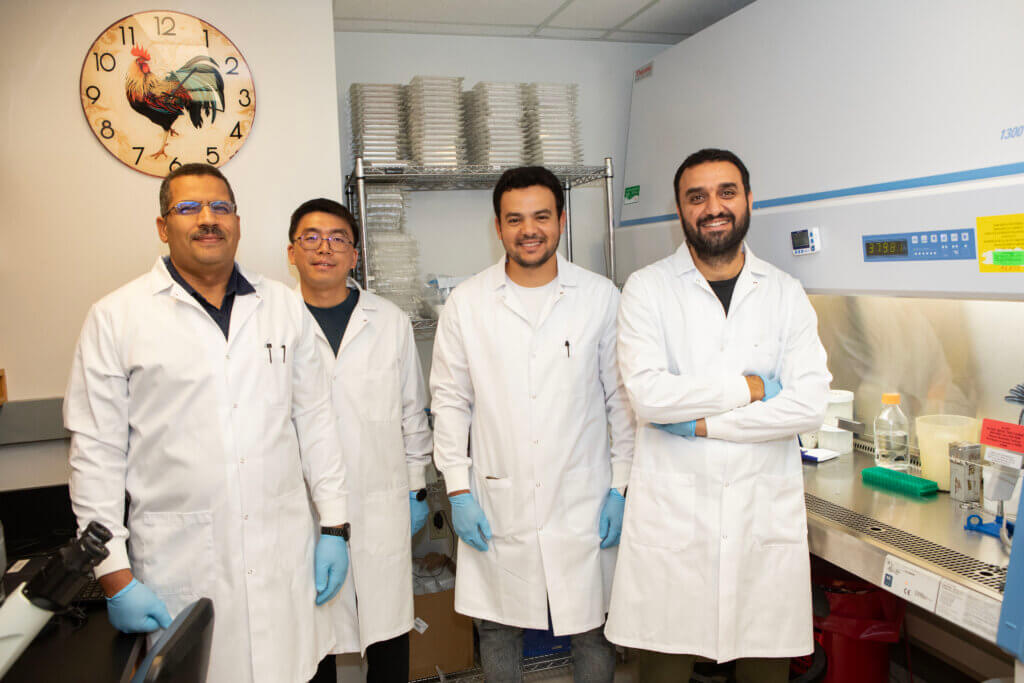
The initiative, led by the Purdue University College of Veterinary Medicine, is a collaborative effort with The Ohio State University, Entomol Products LLC and 1,4GROUP.
Entomol, a biotechnology and consumer goods company based in San Francisco, California, markets a proprietary plant-based insect repellent derived from hydrogenated catmint oil (Nepeta cataria), which repels mosquitoes and other biting insects with no harm to humans. 1,4GROUP is an agricultural technology company headquartered in Meridian, Idaho, with expertise in developing large-scale aerosolization and thermal fogging hardware.
Through controlled trials, Sayedahmed’s team will measure the effectiveness of the fogging system in reducing virus titers in the air, on surfaces and in the birds. Entomol researchers will coordinate the program and optimize the fogging parameters. The team at 1,4GROUP will design and develop the large-scale emitter systems for spraying the catmint oil. Ohio State researchers will assess the efficacy of testing for the highly pathogenic avian influenza virus in Biosafety Level 3 laboratory facilities.
A high-stakes crisis
Highly pathogenic avian influenza has devastated the poultry industry in recent years, affecting all 50 states in the United States and severely impacting producers in Europe, Asia and Africa. Between 2005 and 2024, global poultry losses have soared to over 633 million birds, both from infection and culling measures, according to the World Organisation for Animal Health.
That crisis has forced the global poultry sector to rethink traditional control methods like mass depopulation and pivot toward rigorous biosecurity methods to prevent viruses from entering farms. Now, Dr. Sayedahmed, who has deep experience in developing next generation avian influenza vaccines, is testing whether an environmental intervention could prevent the virus from spreading once it infects a farm, potentially saving millions of birds.
“Air filtration and biosecurity is great. It’s preventing 99.99% of viruses and other pathogens from entering the farm. But once one or two viruses enter the farm and infect the birds, it will replicate to hundreds or even millions of pathogen particles inside the birds, and it will spread to others,” he explains. “If we have something that can inactivate the virus in the environment before reaching the birds, this will be great,” he says.
The natural antiviral mist
The researchers will study the effectiveness of intermittent fogging – once every hour for 60 seconds, for example – to determine the optimal application intervals. As the foggers emit catmint oil into the air, it will circulate and settle onto surfaces like feeders and litter.
They will also test whether the compound provides an additional layer of antiviral protection once the birds inhale the oil into their upper respiratory tracts.
Already, proof-of-concept studies at low concentrations (0.1% to 0.2%) have shown that hydrogenated catmint oil effectively destroys the outer, mainly lipid membrane of the virus, keeping it from entering bird cells and replicating.
While catmint oil has not been tested in poultry before, Dr. Sayedahmed is optimistic about the team’s safety trials. “We have something already accepted from the FDA to be applied in human spaces and in human skin,” he notes.
Beyond basic avian health, the researchers will also study whether fogging affects production, tracking metrics such as weight gain and feed conversion rates for broilers, and egg production for layers.
Virus studies
Biosafety regulations limit researchers from studying foreign animal diseases, like HPAI, outside of high containment facilities. Therefore, to conduct a study in a commercial poultry environment, researchers will simulate the virus using the La Sota strain of Newcastle disease, a live attenuated (mild) virus strain that’s widely used in research. Because the strain mirrors the lipid outer layer of avian influenza but doesn’t cause severe illness in poultry, the researchers can safely use it to map the fogger’s live performance.
To test the mist against the actual HPAI virus, researchers will use scaled-down foggers in ultra-secure Biosafety Level 3 labs.
Hope for the future
If the research bears out and the technology is commercialized, farmers could one day deploy the foggers to fight not only HPAI but also coronaviruses, Newcastle disease and metapneumoviruses, Dr. Sayedahmed says. That, in turn, could dramatically reduce farmers’ reliance on antibiotics and emergency veterinary interventions.
Plus, he adds, “If we are able to link this technology with the vaccination, it will be a permanent control which will remove the avian influenza from the farms.”
With highly pathogenic avian influenza jumping to dairy cattle, sea mammals, cats and humans, there’s a global imperative to combat the deadly zoonotic disease. By marrying robust new biosecurity methods, vaccines and environmental interventions like fogging, farmers may one day be able to contain the spread of the virus without losing their entire flock.