
Texas Pet Owners Travel to Purdue Seeking Shockwave Therapy

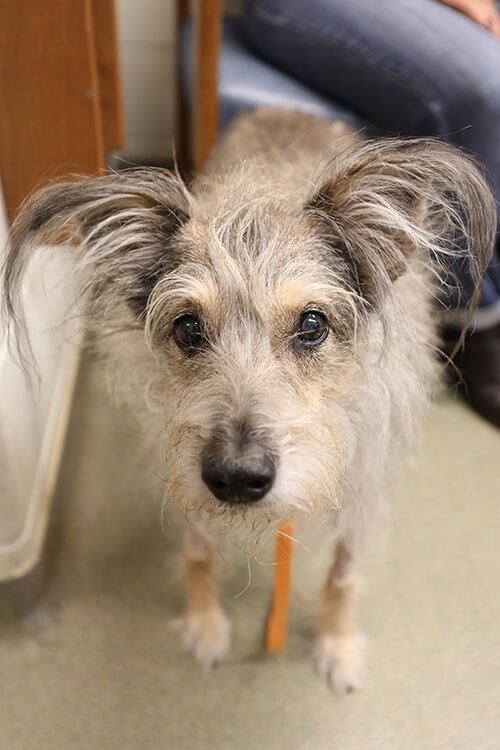
Honey, an 11-year-old mixed-breed dog from Plano, Texas, suffered from chronic urinary tract infections and kidney stones. Her owners traveled to the Purdue University Veterinary Teaching Hospital for a procedure called shockwave lithotripsy, which held promise for resolving her symptoms. The VTH is one of two animal hospitals in the country that perform this procedure.

Honey, an 11-year-old mixed-breed dog from Plano, Texas, suffered from chronic urinary tract infections and kidney stones. Her owners traveled to the Purdue University Veterinary Teaching Hospital for a procedure called shockwave lithotripsy, which held promise for resolving her symptoms. The VTH is one of two animal hospitals in the country that perform this procedure.

When “Honey” came to the Small Animal Hospital at the Purdue University Veterinary Teaching Hospital for treatment of a large kidney stone, her owners were relieved to find a minimally invasive treatment option for their pet. The 11-year-old scruffy-haired mixed-breed dog from Plano, Texas, had been suffering from chronic urinary tract infections and kidney stones for some time.

Honey’s veterinarian referred her owners first to the Texas A&M College of Veterinary Medicine & Biomedical Sciences. The veterinarians there directed them on to the Purdue University College of Veterinary Medicine for a procedure called shockwave lithotripsy that was adapted for small animals by PVM Professor of Small Animal Internal Medicine Larry Adams.

Before undergoing the shockwave procedure, and despite long-term treatment for the painful UTIs and kidney stones, Honey was withdrawn and uncomfortable. The stones were multiplying and required a procedure that would resolve the problem.

“We’ve had Honey for 11 years. We call her a rock star because of her wild hair,” said owners Gracie Elder and Dr. Howard Ash. “Dr. Adams is very well-known for this procedure, so we drove the distance for her.”

Shockwave lithotripsy is the most common treatment for kidney stones in the United States, for humans and animals alike. Doctors use this method of treatment for kidney stones smaller than two centimeters in diameter. The benefits of the shockwave treatment are many. For one, the shockwave machine is operated from outside of the body, which means no surgery is needed, and thus it is usually an outpatient procedure. Also, the shockwave crushes the kidney stones into smaller fragments that can pass in the urine. Dr. Adams says the procedure’s reduced risk and high recovery rate makes it ideal for veterinary patients. Dr. Adams and the Small Animal Internal Medicine team have treated dogs from 40 U.S. states, some as small as four pounds.
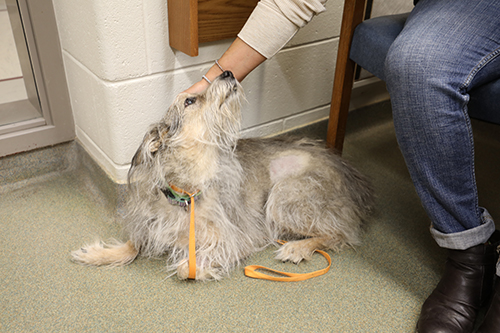
Honey gazes up at her owner while in an exam room in the Small Animal Hospital. Her prognosis was good for a full recovery after she underwent shockwave lithotripsy for kidney stones.

“The Purdue University Veterinary Teaching Hospital is one of two animal hospitals in the country that offer shockwave lithotripsy,” says Dr. Adams, who is co-section head of Small Animal Internal Medicine. “Shockwave is an older technology, but its advantage is that it’s a focused high-energy shockwave that delivers shockwaves through the body to the kidney stone. Shockwave is the less invasive treatment for kidney stones, compared to laser lithotripsy, which means complications, costs, risks, and recovery time are reduced.”

After her procedure, Honey travelled back to Plano, where, thanks to the procedure, she was expected to pass the remainder of her kidney stones over a period of a few weeks, yielding a resolution of her pain and discomfort.

Writer(s): Lauren Bruce | pvmnews@purdue.edu

Recent Stories

“Paws Up” – brought to you by the PVM Wellness Committee

Today we’re extending a huge Paws Up to Dr. Ana Aghili, clinical assistant professor of small animal emergency and critical care.

Two Purdue Veterinary Medicine Graduates Honored at WVC Annual Conference for Commitment to Food Animal Practice

At this year’s WVC Annual Conference in Las Vegas, two Purdue Veterinary Medicine alumni who graduated within the last five years received national recognition as recipients of the Dr. W. Bruce Wren Food Animal Incentive Awards (FAIA). Dr. Kayla Baird and Dr. Kallie Knott, of the Purdue DVM Classes of 2021 and 2025, respectively, were among just five total FAIA award recipients honored during the annual veterinary conference hosted by Viticus Group (formerly WVC). The event is considered one of the largest and longest-running veterinary education conferences in the U.S.

Equine Wellness Once Again Proves Popular as Topic of Annual Forum for Horse Enthusiasts

More than 150 people turned out in person and virtually for the perennially popular Equine Wellness Forum hosted by the Purdue University College of Veterinary Medicine recently at Lynn Hall, as the latter days of winter started to give way to thoughts of spring rides on horseback.  The all-day continuing education program for horse owners and equine industry professionals on Saturday, February 7, featured insightful presentations as well as engaging demonstrations.

New Intern Joins PVM Communications Team 

The Purdue Veterinary Medicine communications team is pleased to welcome a new intern, Caroline Keim, who started February 14. Caroline is a senior studying media and mass communications, as well as professional writing, through the Brian Lamb School of Communications in the College of Liberal Arts.

In Memory – Dr. Carole Ann Bolin (PU DVM ’82)

The Purdue Veterinary Medicine community is saddened to learn that a dedicated alumna, Dr. Carole Bolin, passed away Wednesday, February 12, in Lansing, Michigan, after a long and courageous battle with metastatic breast cancer. She was 67.

PVM Alumnus Kyle Shipman Named as New State Veterinarian

It’s official – Dr. Kyle Shipman (PU DVM 2015) is the new Indiana State Veterinarian. The decision to select Dr. Shipman to fill the vacancy was made by the 11 members of the Indiana State Board of Animal Health during their regular January meeting, which was followed by formal approval from the governor.

New Faculty Member Joins Comparative Pathobiology Department and Reed ADDL

The College of Veterinary Medicine’s Department of Comparative Pathobiology recently welcomed Dr. Rachel Soltys as clinical assistant professor of diagnostic microbiology. Dr. Soltys, who started January 20, also serves as section head of Bacteriology in the Willie M. Reed Animal Disease Diagnostic Laboratory (ADDL).

“Paws Up” – brought to you by the PVM Wellness Committee

Today we are happy to highlight Brittany Laflen, RVT, VTS (Neurology), who is a veterinary technician in Neurology / Small Animal Surgery.

College Appoints Experienced Agricultural Leader to Strengthen Constituent Relationships

Julia Wickard, a longtime agricultural leader in Indiana, was appointed as the college’s new constituent liaison and executive director of the Purdue Veterinary Alumni Association, effective Feb. 24. Wickard, of Greenfield, Indiana, previously served as the state executive director of the USDA Farm Service Agency . Her new position represents a homecoming for the Purdue alumna, who earned her BA degree in agricultural communications and political science.