
“Paws Up” for Brittany Laflen – brought to you by the PVM Wellness Committee
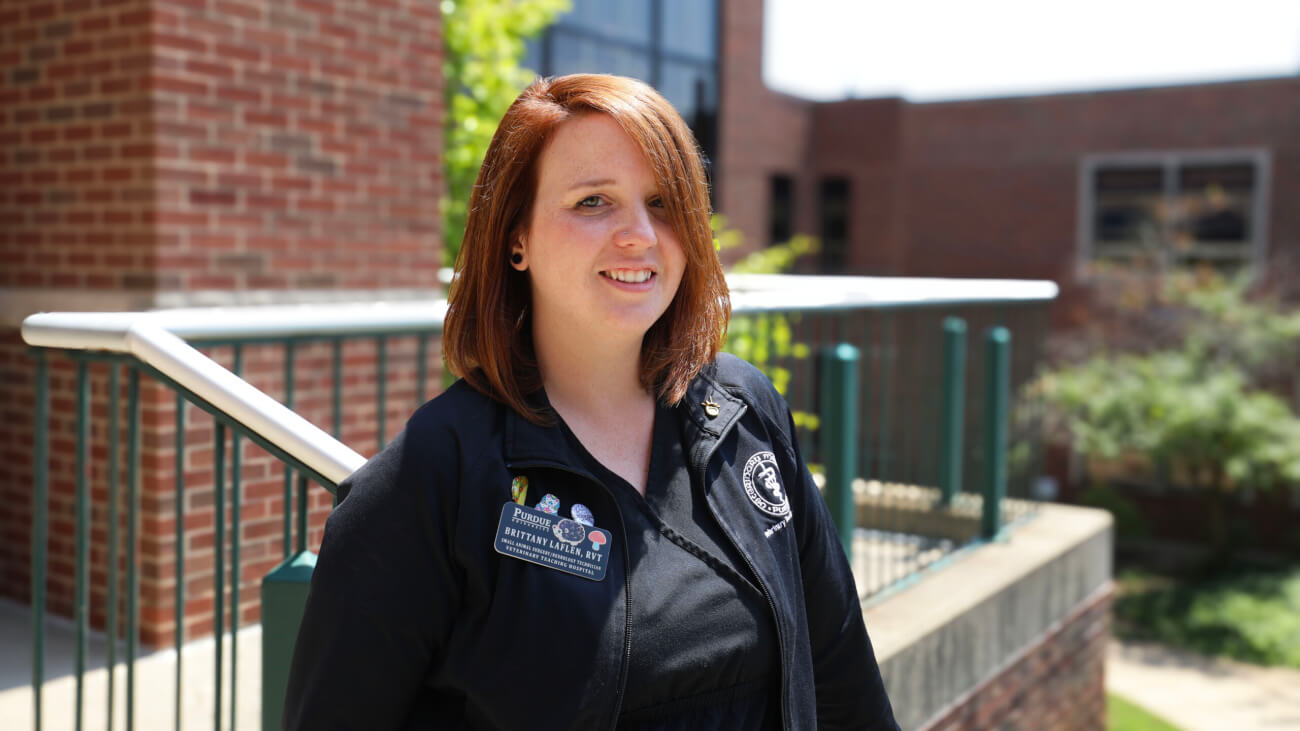
Brittany Laflen, RVT, VTS (Neurology)

Today we are happy to highlight Brittany Laflen, RVT, VTS (Neurology), who is a veterinary technician in Neurology / Small Animal Surgery. A faculty clinician shared, “Brit has been a solid force in the neurology service for over 10 years! She helps organize the day and has helped keep the service going despite frequent locums coming through the past two years. She has also been instrumental in training our new neuro tech, Aaron Rodriguez. During a holiday weekend, Brit anesthetized multiples cases for us and worked hard the entire weekend – Go Brit!”

Fostering a healthy work environment involves expressing appreciation and gratitude. Is there someone at PVM you would like to acknowledge today? It’s easy to make a Paws Up submission – just follow this link. Submissions are published anonymously and may be edited for style or length. Any PVM staff, faculty, student, or team may be nominated by anyone in our college. For more information, visit the PVM Wellness Committee website.

Writer(s): PVM Wellness Committee | pvmnews@purdue.edu

Recent Stories

Purdue Veterinary Medicine Fosters Learning and Engagement linking people, animals and agriculture at Indiana State Fair

In just more than two weeks’ time during the month of August, the 2026 Indiana State Fair served up an abundance of fun, food, and festivities, and in the midst of it all, faculty, staff and students from the Purdue University College of Veterinary Medicine were visible and vibrant participants. Purdue Veterinary Medicine representatives made a difference in a variety of ways, from providing veterinary care for the animals on the fairgrounds, to helping animal agriculture organizations as volunteers, to conducting veterinary checks on animals at the annual 4-H State Fair Dog Show and Cat Show.

“Paws Up” for Jennifer Danaher – brought to you by the PVM Wellness Committee

This week we express our gratitude to Jennifer Danaher, who is department secretary for Veterinary Clinical Sciences.

‘Purdue Pursuits’: A PVM angle on Purdue’s teaching and learning reading groups

Crafting meaningful and engaging course experiences has been at the top of Dielson Vieira’s mind ever since he joined the Purdue University College of Veterinary Medicine’s faculty in 2024. As a clinical assistant professor in the Department of Basic Medical Sciences, Vieira is already adept at applying innovative teaching practices to classroom environments, but that doesn’t stop him from seeking out new ideas, approaches and perspectives — insights he gains through outlets like Purdue’s teaching and learning reading groups.

Top tier biology journal publishes PVM study that unlocks secrets of a drug-resistant fungal pathogen, which causes serious infections in humans

Though the name “Candida auris” is far from a household term, public health experts know it well because the multi-drug-resistant fungal pathogen, which causes serious human infections, has been classified as an urgent threat by the U.S. Centers for Disease Control and Prevention (CDC) Antibiotic Threats Report (2019). Dr. Shankar Thangamani, Associate Professor of Microbiology and University Faculty Scholar in the Purdue University College of Veterinary Medicine’s Department of Comparative Pathobiology, is researching C. auris, aided by a 2.4 million grant from the National Institutes of Health (NIH). New research findings, just published in Nature Microbiology, show how C. auris adapts and evades the immune system.

In Print: ‘Translational Research Methods for Tauopathies’

A just-published 300-page volume edited by Jessica Fortin, Purdue assistant professor in the College of Veterinary Medicine’s Department of Basic Medical Sciences, provides a significant new resource for researchers studying a group of neurodegenerative diseases known as tauopathies. “Translational Research Methods for Tauopathies” provides detailed protocols intentionally selected to serve as a basis for research laboratories seeking to further treatments for such debilitating neurodegenerative diseases as Alzheimer’s and chronic traumatic encephalopathy (CTE).