
Service Dogs Receive Free Screenings by VTH Ophthalmology Team during Special Eye Exam Event

service dog eye exam pictured

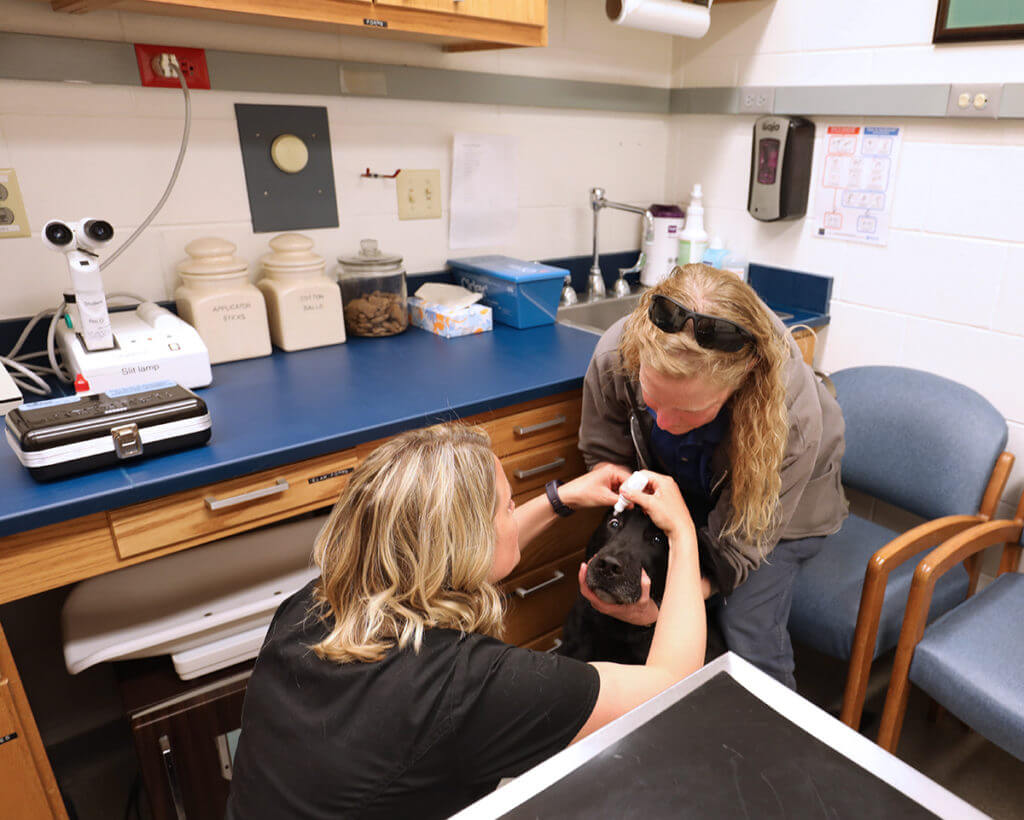
Veterinary Teaching Hospital Ophthalmology Technician Cassie Cords, RVT, dilates Falcon’s eyes in preparation for a formal eye exam. The VTH’s Ophthalmology service offered free screenings for service dogs during the annual ACVO/Stokes RX National Service Animal Eye Exam Day May 7.

Falcon’s eyesight is vital to his job as a service demonstration dog, which is why he received a free eye exam as part of a special event conducted for service dogs on May 7 by the Ophthalmology service at Purdue Veterinary Medicine’s Veterinary Teaching Hospital (VTH).

Each year, the ophthalmologists at the VTH donate their time and expertise as part of the annual National Service Animal Eye Exam Day, organized by the American College of Veterinary Ophthalmologists (ACVO) and Stokes Rx. Dr. Wendy Townsend, PVM associate professor of ophthalmology in the Department of Veterinary Clinical Sciences, conducted the free exam, screening for cataracts, glaucoma, and other ocular problems that could interfere with Falcon’s mission, and gave Falcon a clean bill of eye health.

“The goal is to ensure excellent ocular health for the service dogs,” Dr. Townsend said. “I love participating in this event because we are able to celebrate the wonderful bond between the dogs and their handlers. The services these dogs provide are amazing.”
Falcon the dog pictured

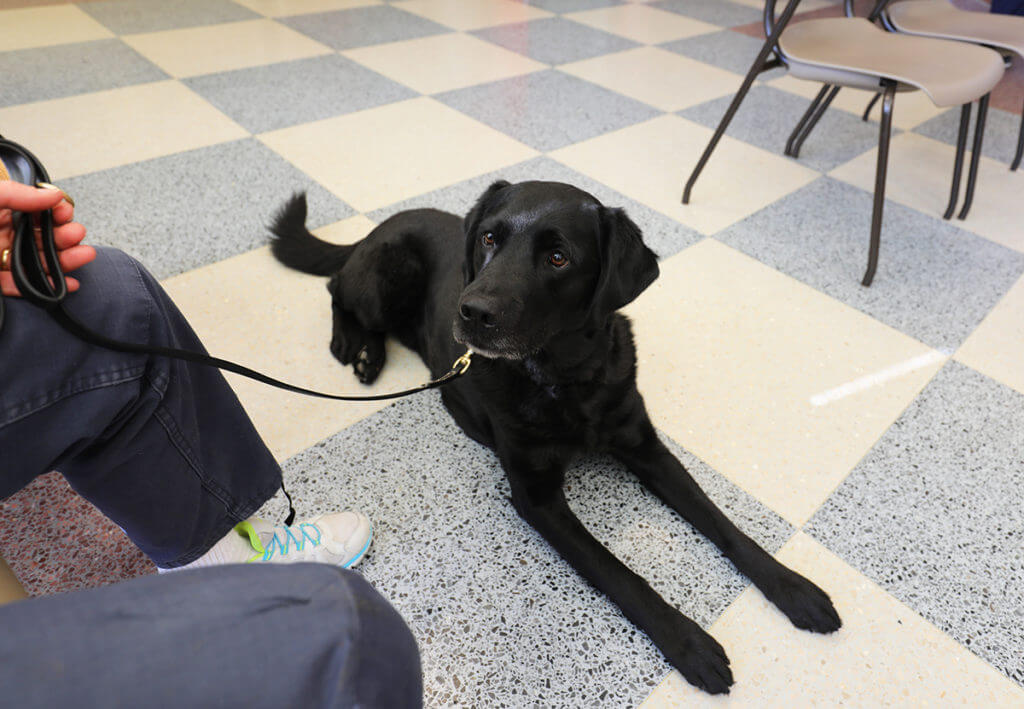
Falcon waits to receive his free eye exam as part of the Purdue VTH’s participation in the ACVO/Stokes RX National Service Animal Eye Exam Day. Falcon needs good vision to perform his work as a service demonstration dog.

Falcon works with his owner, Andrea Schaffer, as part of an organization called Paws with a Cause. This organization helps train and place service dogs with people in need of services, and engages in training and advocacy for the service animal industry. Schaffer is a field representative for the organization, and Falcon works with her to help her assess service dog clients and acclimate new clients to dog ownership. Some service dog clients have never owned dogs before, so Schaffer and Falcon train them on how to work as a team.

“These dogs are athletes. They must have good vision to perform their job functions,” Schaffer said. “Especially when the dog is helping you with mobility and balance, you are putting your safety in the dog.”

Nearly 8,000 service animals are examined for free every year nationwide as part of the National Service Animal Eye Exam Day. “This event gives us a chance to raise awareness of veterinary ophthalmology so that more owners know about the services we provide for their dogs and any other animals in their households,” Dr. Townsend said. “The dogs and their owners are wonderful.”

Writer(s): Lauren Bruce | pvmnews@purdue.edu

Recent Stories

Purdue Veterinary Medicine Welcomes New Clinical Residents and Specialty Intern

A new class of clinical residents arrived this summer at the Purdue University College of Veterinary Medicine to begin their specialty training. On July 16, 2026, the Department of Veterinary Clinical Sciences (VCS) held a welcome breakfast to introduce the new VCS residents to faculty and staff. The breakfast provided the opportunity for the new residents and a new specialty intern in neurology to meet current VCS residents, as well as the faculty and staff they will be working closely with during their time at Purdue.

American Board of Veterinary Toxicology Honors Purdue Professor and ADDL Senior Veterinary Toxicologist Steve Hooser

Dr. Steve Hooser, DVM, PhD, DABVT, professor of veterinary toxicology at the Purdue University College of Veterinary Medicine and senior veterinary toxicologist for the Indiana Animal Disease Diagnostic Laboratory (ADDL), has received the American Board of Veterinary Toxicology's (ABVT) 2026 Service Award.  Given in recognition of a career that has shaped the field of veterinary toxicology for more than four decades, the award was announced July 13 at the ABVT Annual Business meeting held in Anaheim, California, in conjunction with the AVMA Convention 2026.

New Class of Veterinary Hospital Interns and Pharmacy Resident Welcomed to PVM

A total of 13 new interns and a new veterinary pharmacy resident began their advanced training in the Purdue University Veterinary Hospital this summer. The group of interns includes nine veterinarians who are completing a small animal rotating internship and four who are doing a large animal rotating internship. In addition, a pharmacy school graduate began the one year Wasson Veterinary Pharmacy Residency program, which is jointly offered by the Purdue Colleges of Veterinary Medicine and Pharmacy.

“Paws Up” for Lilia Beal-Preston and Mikey Galvin – brought to you by the PVM Wellness Committee

This week, we’re proud to recognize DVM students Lilia Beal-Preston and Mikey Galvin, who received a Paws Up recognition from a client after caring for the client's dog at the Purdue University Veterinary Hospital.

“Paws Up” for Jennifer Danaher – brought to you by the PVM Wellness Committee

Today we are congratulating Jennifer Danaher, who is a department secretary for Veterinary Clinical Sciences, for being recognized as a helpful colleague in our college.

Boo the Miracle Dog: A Story of Bravery, Breakthroughs, and a Bond That Inspires

Our series of articles about animals and their owners who've found help and healing at the Purdue University Veterinary Hospital continues with the story of "miracle dog" Boo Davis. At 13 years old, Boo Davis is living proof of the power of persistence, expert veterinary care, and the unshakable love between a pet and her person. Affectionately known as Lisa’s “miracle dog,” Boo’s journey is one that not only has extended her life, but also has helped shape the future of cancer treatment for other pets, too.

Placating Pets to Help them COPE this Fourth of July

Despite the excellent tips experts provide each year for pet safety and welfare on the 4th of July, many pet families still run into trouble and lose their pets. What are we missing and how can we even better protect our animal companions? That question is answered in an article by Dr. Candace Croney, director of the Center for Animal Welfare Science.