
U.S. Residents’ Awareness of Animal Diseases
by Elizabeth Byrd (byrd12@purdue.edu), Dr. Nicole Olynk Widmar (nwidmar@purdue.edu) and Dr. John Lee (jlee1@purdue.edu)
Published by the Center for Animal Welfare Science at Purdue University
RP.2015-05 | August 2015 | © 2015 Purdue University
Executive Summary
Researchers in the Department of Agricultural Economics at Purdue University conducted an online survey of 825 U.S. residents to gauge their awareness and opinions about seven animal diseases. This information provides insight as to how well consumers understand animal disease prevention and treatment, which is one aspect of animal welfare. To assess consumers’ familiarity and interaction with animals in general, the study asked respondents about their pet ownership and visits to various animal-related facilities and farms. Of the diseases explored in the survey, respondents were most aware of rabies with 87 percent saying they had heard of it. Seventy-five percent of the respondents who had heard of bovine spongiform encephalopathy (BSE) or “mad cow disease” thought that all cattle carcasses should be tested for BSE before being released for human consumption. The majority of respondents, 68 percent, thought that a veterinarian should inspect domestic livestock before they are transported within or across state lines.
Keywords: animal disease, public awareness, food safety, livestock
Introduction
Researchers surveyed 825 U.S. residents about their awareness of seven animal diseases:
- Bovine Spongiform Encephalopathy (BSE)
- Porcine Epidemic Diarrhea virus (PEDv)
- Tuberculosis (TB)
- Chronic Wasting Disease (CWD)
- Leptospirosis
- Rabies
- Foot and Mouth Disease (FMD)
Animal disease awareness is significant because research has shown consumers care about how their food is produced, including the welfare of livestock animals raised for food (McKendree et al., 2013; Olynk, Tonsor and Wolf, 2010; Tonsor et al., 2005; Olynk, Wolf and Tonsor, 2009). Preventing and treating animal disease is one aspect of animal welfare (American Veterinary Medical Association, 2015). Disease and health is also arguably one of the most popular focus areas for consumers and residents, regardless of their interaction with animals, as it can potentially impact human health via transmission to people or through food supplies. Purdue researchers conducted this study to better understand the public’s awareness of animal diseases and sentiments toward veterinary inspections and testing.
Research Methods and Data
Survey Instrument
The research team used Qualtrics to administer the online survey in November 2014. The team utilized Global Market Insite (GMI), a panel provider, to identify and contact survey respondents, who had to be 18 or older to participate. GMI’s targeted sample of 825 U.S. residents was representative of the U.S. population based on the most recent census values for gender, age, household income, and region of residence.
Sample Summary Statistics and Demographics
Table 1 depicts the demographic makeup of the study’s respondents. The sample consisted of 51 percent females with a mean age of 47 and mean household income of $50,169.
| Variable Description | Survey Frequency (%) |
|---|---|
| Male | 49% |
| Education | |
| Graduated from high school | 97% |
| Attended college, earned bachelor’s degree or higher | 33% |
| Annual Household Pretax Income | |
| Less than $20,000 | 19% |
| $20,000-$39,999 | 30% |
| $40,000-$59,999 | 23% |
| $60,000-$79,999 | 12% |
| $80,000-$99,999 | 7% |
| $100,000-$119,999 | 3% |
| $120,000 or more | 6% |
| Region of Residence | |
| Northeast | 17% |
| South | 33% |
| Midwest | 27% |
| West | 23% |
| Visited an animal-related operation/farm in the past five years | |
| Dairy farm | 10% |
| Pig farm | 6% |
| Horse farm | 14% |
| Animal shelter | 31% |
| Deer farm | 5% |
| County fair | 25% |
| Beef farm | 11% |
The survey included questions about some diseases that pet owners choose or are required, by law or regulation, to vaccinate against. Rabies is considered a core vaccine for both dogs and cats; leptospirosis is classified as a non-core vaccine for dogs. Therefore, having a pet may increase a person’s awareness of some animal diseases. Thus, the survey asked respondents about their pet ownership. Forty-nine percent of households owned at least one dog, and 36 percent of households reported owning at least one cat. In total, 65 percent of households owned at least one dog or cat.
There are likely varying levels of animal awareness and interaction among residents, even for those who do not have any pets. To gauge these levels, the survey asked respondents when they last visited various types of animal-related operations. Those who visited farms, animal shelters or state/county fairs may be more aware of animal diseases and/or have different opinions based on their experiences. Respondents answered questions about dairy, pig, horse, deer and beef farms. More than half of respondents had never visited any of these operations. Ten percent of respondents had visited a dairy farm in the past five years, and 36 percent had been to a dairy farm more than five years ago. In the past five years, six percent of respondents had been to a pig farm; it had been more than five years for 24 percent. Horse farms had welcomed 14 percent of respondents in the last five years and 26 percent more than five years ago. Deer farms were the least frequently visited – 5 percent of participants in the past five years and 11 percent more than five years ago. In terms of beef farms, 11 percent of respondents had been to one in the past five years and 20 percent more than five years ago.
In addition to livestock/animal farms, respondents indicated if they had attended a state/county fair or visited an animal shelter/animal rescue organization. Thirty-five percent of respondents had been to a state/county fair in the past five years; however, almost the same amount, 34 percent, had never attended a fair. It had been more than five years since their last fair experience for 32 percent of participants. Thirty-one percent of respondents had visited an animal shelter in the past five years, and more than five years had passed for 29 percent. Forty-two percent had never gone to an animal shelter.
Results and Discussion
Awareness of Select Animal Diseases
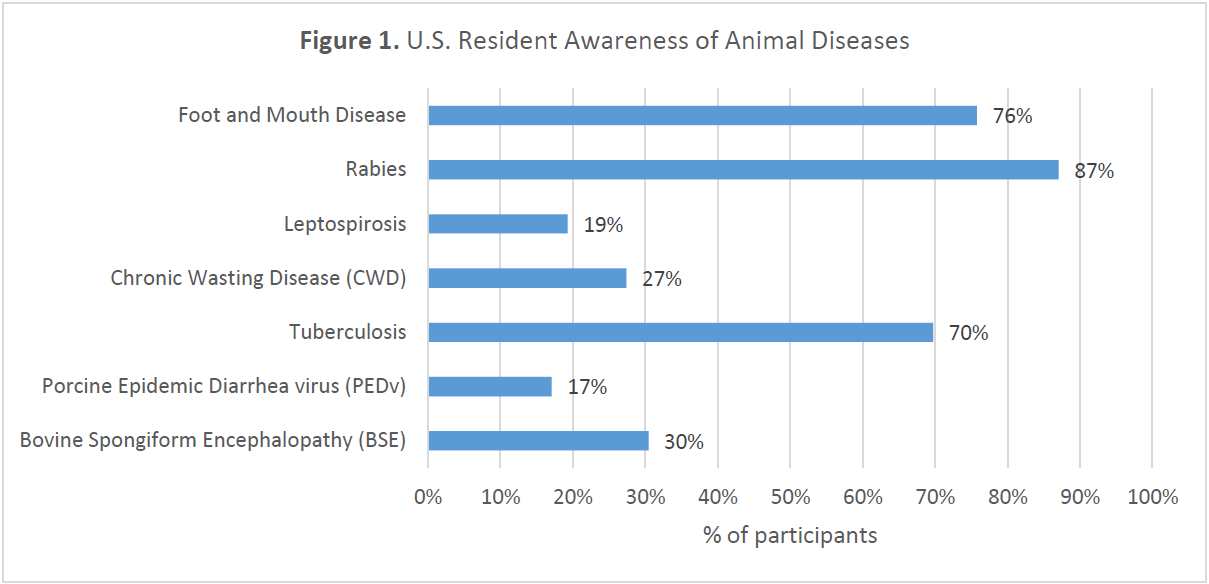
The survey asked participants if they had heard of seven animal diseases ranging from rabies to CWD. Figure 1 shows that 87 percent of respondents reported having heard of rabies. This is not surprising given that it is a required vaccine for cats and dogs, as well as horses in some areas. Seventy-six percent of respondents indicated familiarity with FMD.
| Disease | Awareness |
|---|---|
| Bovine Spongiform Encephalopathy (BSE) | 0.0691** |
| Porcine Epidemic Diarrhea Virus (PEDv) | 0.0589* |
| Tuburculosis (TB) | 0.0542 |
| Chronic Wasting Disease (CWD) | 0.0951*** |
| Leptospirosis | 0.1099*** |
| Rabies | 0.0322 |
| Foot and Mouth Disease (FMW) | 0.0086 |
The research team hypothesized that awareness of animal diseases could potentially be related to animal awareness in general, which included pet ownership. Pearson correlations between self-reported disease awareness and pet ownership are presented in Table 2. Pearson correlations allow researchers to assess the validity and strength of relationships between two variables; in this case, the variables are self-reported awareness of animal diseases and owning at least one dog or cat. The results indicated that owning a pet was positively correlated with being aware of BSE, PEDv, CWD and leptospirosis. Thus, pet ownership is related to awareness of some, but not all, animal diseases, evaluated in this work.
Farmed Deer and CWD
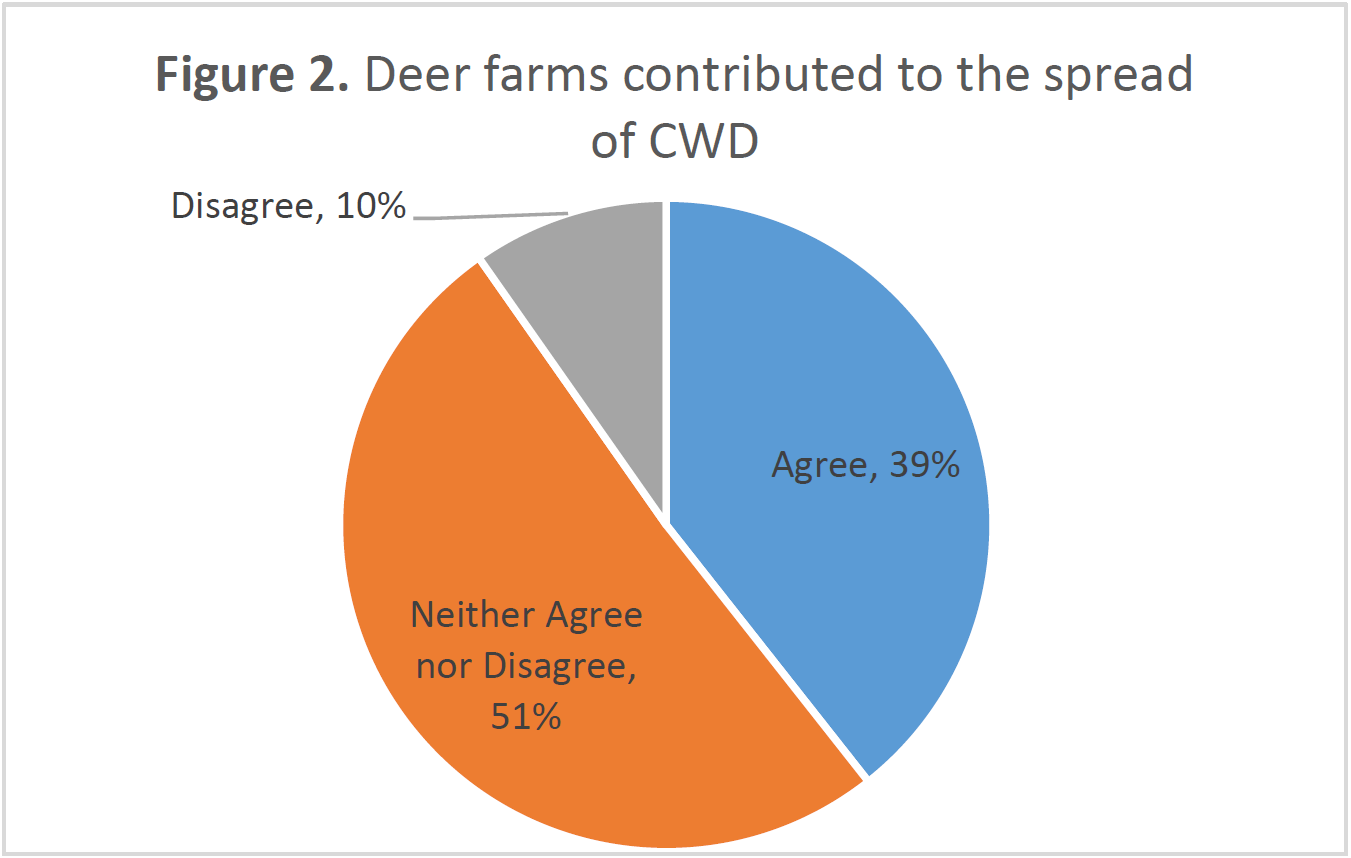
Recently, several states have discovered CWD in captive deer herds (Egan, 2014; Pennsylvania Game Commission, 2013; Sabalow, 2014). This survey asked respondents who had heard of CWD whether or not they agreed that deer farms contributed to its proliferation. Of those who had heard of CWD, 39 percent agreed; 10 percent disagreed; and 51 percent neither agreed nor disagreed (Figure 2).
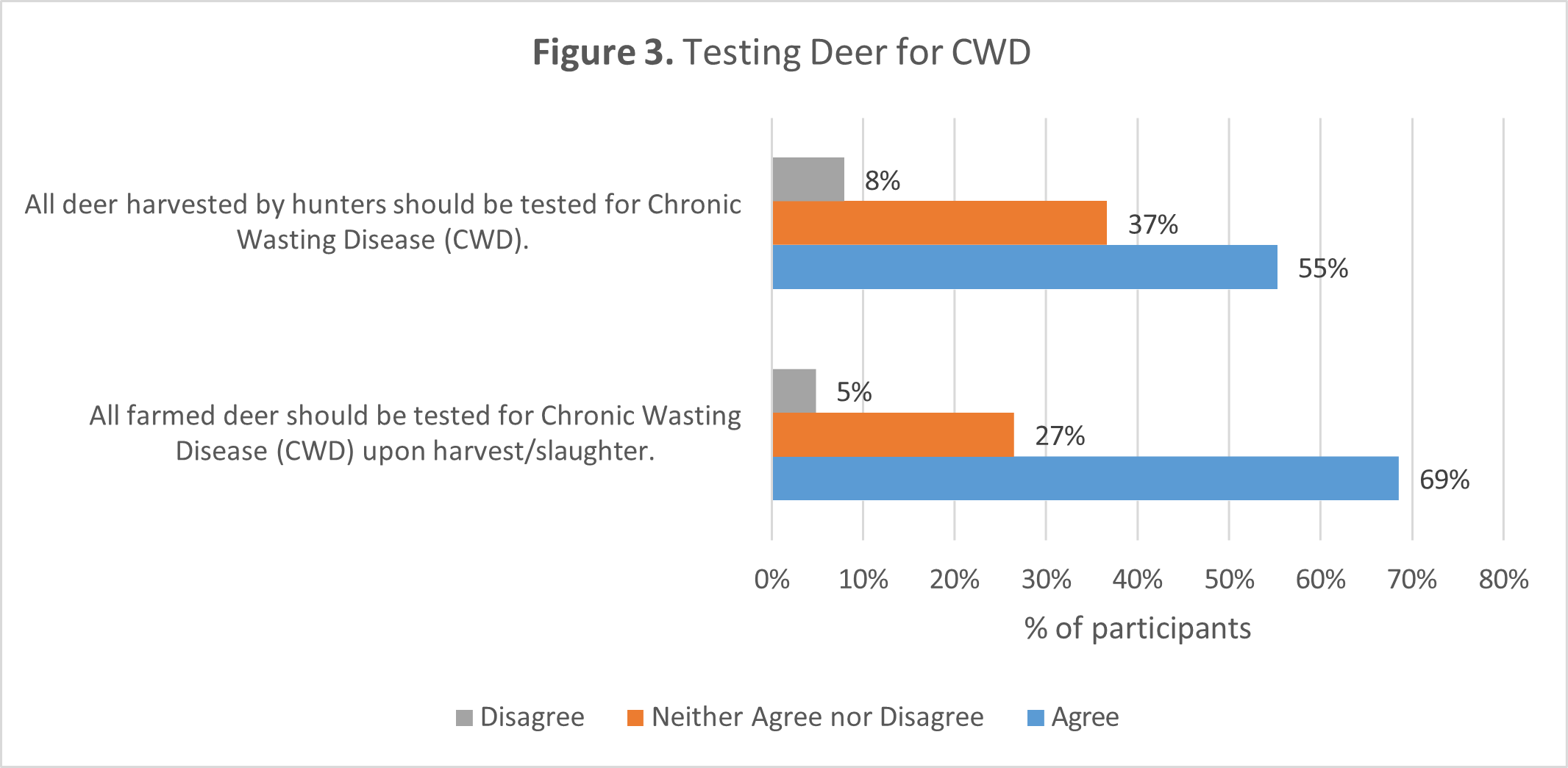
Those same respondents also indicated whether farmed or hunted deer should be tested for CWD upon slaughter. Figure 3 illustrates their responses. Fifty-five percent indicated deer harvested by hunters should be tested, and 69 percent thought farmed deer should be tested for CWD at slaughter. Thirty-seven percent neither agreed nor disagreed that hunted deer should be tested, but only 27 percent fell into that category for farmed deer.
Need for Veterinary Inspections
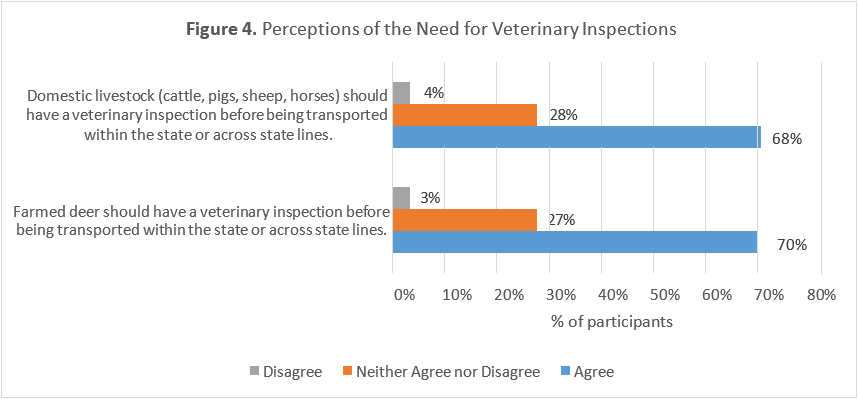
All respondents answered a question as to whether they felt domestic livestock and farmed deer should be inspected by a veterinarian before transportation within a state or across state lines. Figure 4 depicts their responses. Sixty-eight percent of participants agreed that domestic livestock should be inspected by a veterinarian before transportation, while 70 percent thought that farmed deer should be inspected.
Cattle Testing for BSE
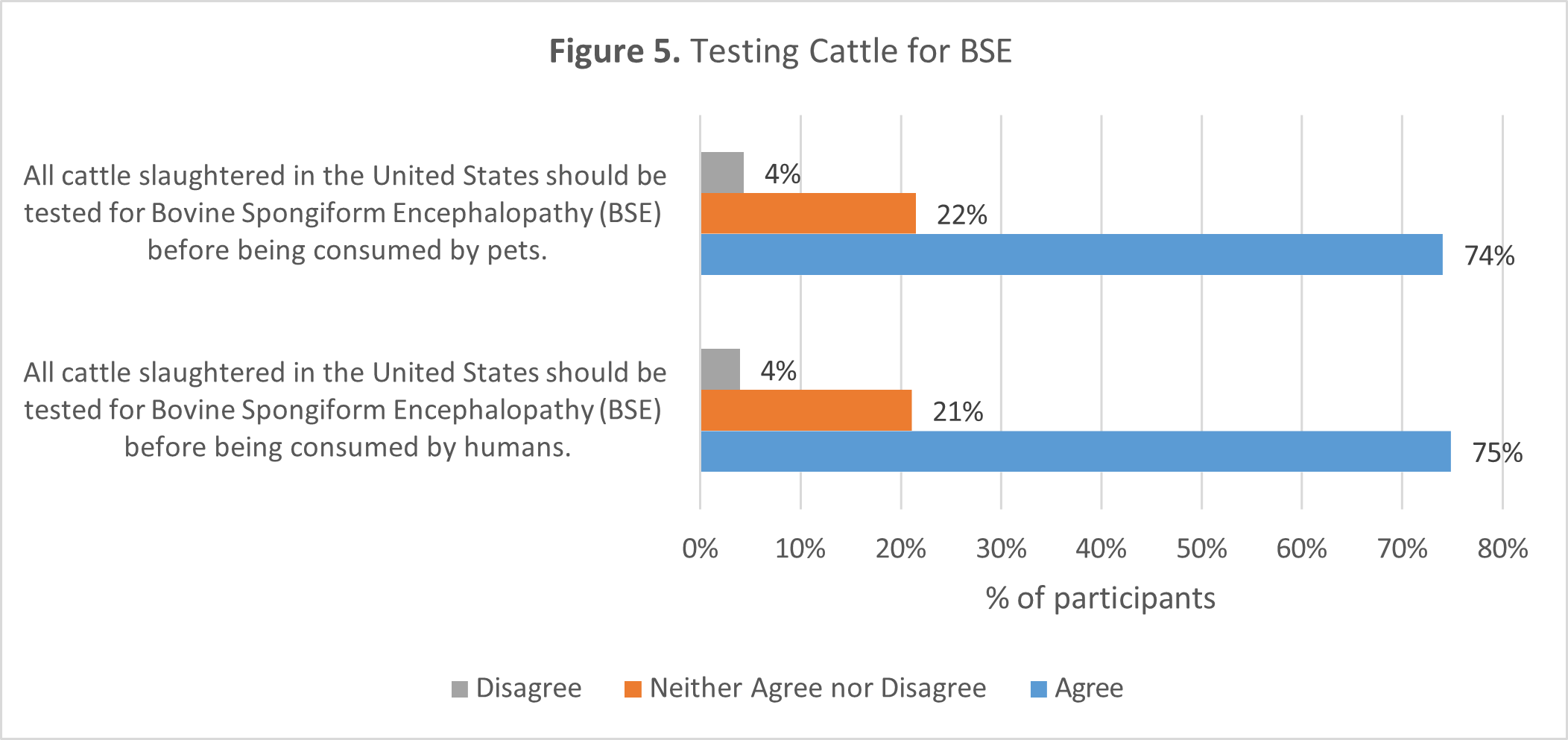
Respondents who had heard of BSE (n=251) indicated whether they felt cattle slaughtered in the United States should be tested for BSE before human or pet consumption. Figure 5 shows that 75 percent of those respondents felt cattle for human consumption should be tested and 74 percent wanted testing before pet consumption. A similar percentage, 4 percent, disagreed that cattle should be tested for BSE before pet or human consumption.
Conclusions and Implications
There is increasing interest in the health and welfare of food animals. Animal health, including disease treatment and prevention, is an important part of animal welfare, which receives a great deal of attention in the media. Researchers surveyed U.S. residents about their awareness of seven animal diseases and their thoughts on veterinary inspections and testing for diseases.
More than half of respondents said they were aware of FMD, rabies and tuberculosis. Fewer than 30 percent of participants indicated awareness of leptospirosis, CWD, PEDv and BSE. Of those who were aware of CWD, more than half said that deer should be tested for CWD whether harvested in the wild or raised on a farm. Sixty-eight percent of all respondents said that domestic livestock should have a veterinary inspection before being transported. Three-quarters of respondents said that all cattle slaughtered in the United States should be tested for BSE before being used for human consumption.
References
- American Veterinary Medical Association. 2015. “Animal Welfare: What is It” Available at: https://www.avma.org/KB/Resources/Reference/AnimalWelfare/Pages/what-is-animal-welfare.aspx
- Egan, D’Arcy. 2014. “Deer at Holmes County hunting preserve first to test positive for dreaded Chronic Wasting Disease.” Available at: https://www.cleveland.com/outdoors/index.ssf/2014/10/deer_at_homes_county_hunting_p.html
- McKendree, M. G. S. 2013. “Exploring consumer preferences for animal care and rearing practices across species and products.” MS Thesis, Purdue University.
- Olynk, N. J., Tonsor, G. T., & Wolf, C. A. 2010. Consumer willingness to pay for livestock credence attribute claim verification. Journal of Agricultural and Resource Economics 35(2):261-280.
- Olynk, N. J., Wolf, C. A., & Tonsor, G. T. 2009. Labeling of credence attributes in livestock production: verifying attributes which are more than “meet the eye”. Journal of Food Law and Policy (5):181-200.
- Pennsylvania Game Commission. 2013. “Chronic Wasting Disease” Available at: https://www.pa.gov/agencies/pgc/wildlife/wildlife-health/wildlife-diseases/chronic-wasting-disease
- Sabalow, Ryan. 2014. “Buck Fever: Massive disease outbreak hits Iowa deer farm.” Available at: https://www.indystar.com/story/news/2014/10/02/buck-fever-massive-disease-outbreak-hits-iowa-deer-farm/16587981/
- Tonsor, G. T., Schroeder, T. C., Fox, J. A., & Biere, A. 2005. European preferences for beef steak attributes. Journal of Agricultural and Resource Economics 30(2):367-380.
