
Virtual CAWS Symposium Focuses on Lessons Learned from COVID-19

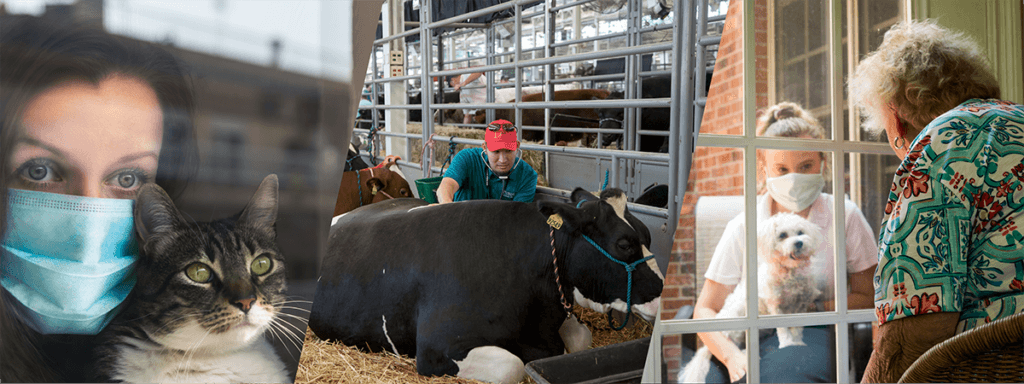
A collage of images showcasing people interacting with animals in various settings, including a woman wearing a mask with a cat, farm workers tending to cows, and a person visiting an elderly individual with a small dog.

With a focus on understanding how the COVID-19 pandemic has influenced perceptions about the human-animal bond, the 2021 CAWS Virtual Symposium, set to begin next Wednesday, May 19, has attracted more than 80 registrants from eight countries including the U.S. The two-day symposium is entitled, “One Welfare: What has COVID-19 taught us about balancing human and animal interests?”

Sessions offered during the virtual symposium will explore the effects of the pandemic on animal welfare, human health and well-being. “There have been relatively few animal behavior and welfare meetings lately because of COVID-19, especially ones that cover these topics,” said Dr. Candace Croney, director of the Center for Animal Welfare Science (CAWS) and a professor of animal behavior and well-being who holds a joint appointment in the College of Veterinary Medicine and the College of Agriculture at Purdue University. “The symposium is an excellent opportunity to bring together people with livestock interests and those with companion animal interests, as well as those focused on socio-ethical and economic considerations that warrant greater attention in discussions about animal welfare,” Dr. Croney said.

People who already have registered for the conference from abroad represent the countries of Australia, Canada, Germany, Japan, Mexico, the Netherlands and the United Kingdom.  Registration for the symposium will remain open until 12:00 p.m. Tuesday, May 18.  Information about the symposium, including the link for the event, will be sent early next week to those who have registered. Lectures will be available for 14 days on-demand after the initial date of the lecture for registered attendees to view.

Keynote speakers are Heather Fowler, the director of producer and public health at the National Pork Board, and Jennifer Applebaum, a sociology PhD student at the University of Florida. “The COVID-19 pandemic exacerbated many already-existing social inequalities, further disadvantaging marginalized populations,” Applebaum said. “These inequalities threaten the human-animal bond and carry very real consequences for the welfare of human and animal members of multispecies families.”

General admission for the symposium is $70, with special discounted rates available to students and CAWS members. Fees will support CAWS programming.

The symposium has been approved for eight hours of continuing education credits by the Registry of Approved Continuing Education (RACE) program’s certification process, provided by the American Association of Veterinary State Boards. Sixty-one jurisdictions and provinces accept RACE credits for veterinary medicine continuing education. Participants wanting to earn the event’s eight credits are encouraged to sign up for RACEtrack to expedite the process.

The Center for Animal Welfare Science is jointly supported by Purdue University’s College of Veterinary Medicine and College of Agriculture.

Writer(s): Ben Shepard | pvmnews@purdue.edu

Recent Stories

Annual Purdue Veterinary Conference draws veterinary professionals from across the country for learning and fun

The 2026 edition of the annual Purdue Veterinary Conference attracted attendees from around the U.S. for three days of educational sessions covering an array of topics.  With the overall theme of “One Health: Modern Veterinary Medicine,” the conference September 23-26 on the Purdue University campus drew more than 450 veterinarians and veterinary technicians, plus faculty, staff and students. Sessions taught by a total of 65 speakers, including many Purdue Veterinary Medicine clinicians and veterinary technicians/technologists, enabled conference-goers to earn up to 23 continuing education credit hours.

Significant Gift from Jordan Smelski Foundation will fuel Purdue Veterinary Medicine research on deadly brain eating amoeba

A researcher in the Purdue University College of Veterinary Medicine’s Department of Comparative Pathobiology has received a generous gift of more than $100,000 from the Jordan Smelski Foundation for Amoeba Awareness and Mr. Steve Smelski to support research of the deadly amoeba Naegleria fowleri. Christopher Rice, PhD, assistant professor of parasitology and principal investigator of the Rice Research Group, leads a research team seeking to discover and repurpose drugs against primary amoebic meningoencephalitis (PAM), a rare but typically fatal infection caused by Naegleria fowleri.

Purdue veterinary student receives Sir John D. Spurling Scholarship awarded by AKC Humane Fund

The AKC® Humane Fund, Inc.℠ has announced the 2026 recipients of the Sir John D. Spurling Scholarship, celebrating the human-canine bond, and one of the recipients is Purdue veterinary student Tiffany Chang of the Class of 2027. Chang is one of only five students chosen for the scholarships.

Purdue Veterinary Medicine Unites with Purdue United Way Campaign

With the goal of raising $700,000 by November 4 to support local nonprofit organizations that help individuals and families in Greater Lafayette, the Purdue United Way campaign took off September 23 with an official campaign launch on the front lawn of the Purdue Memorial Union. Purdue Veterinary Medicine, along with the university’s other colleges and units, will participate with the help of PVM faculty and staff ambassadors working to make it easy for people in the college to respond, whether by giving, or by indicating that they do not wish to give. As part of the PVM drive to support the campaign, Dean Bret Marsh and his wife, Polly, are contributing a match for campaign contributions from college faculty and staff. Additionally, a drawing will be held to select winners from those who contribute.

“Paws Up” – for Dr. Yasumasa Iimori – brought to you by the PVM Wellness Committee

This week we commend Yasumasa Iimori, DVM, PhD, who is a resident in Emergency and Critical Care in the Purdue University Veterinary Hospital.