
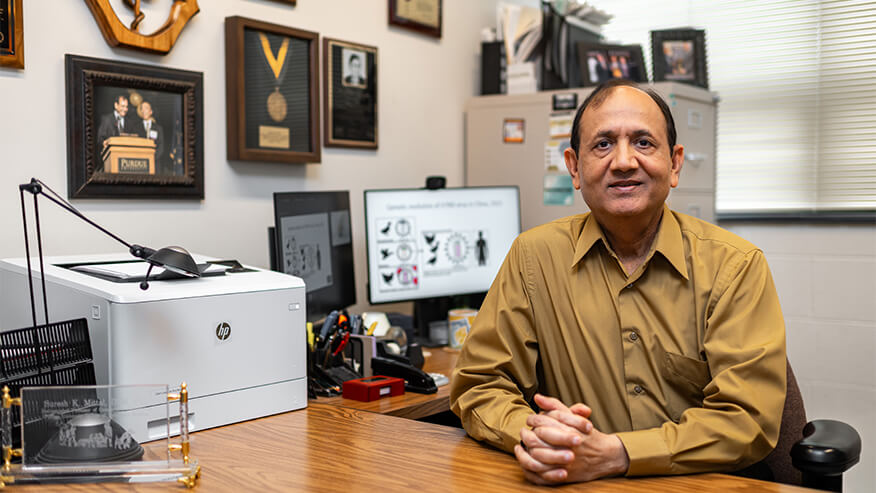
PVM virologist Suresh Mittal targets viruses including avian influenza and other problematic respiratory diseases
You fight fire with fire. And Purdue Veterinary Medicine vaccine expert Suresh Mittal fights viruses with viruses.
Using innovative techniques, Dr. Mittal, Distinguished Professor of Virology in the College of Veterinary Medicine’s Department of Comparative Pathobiology, develops novel vaccines for viral infections including avian influenza.
“Influenza viruses affect millions of people every year and kill hundreds of thousands of them,” Dr. Mittal said. “Vaccines are one of the most effective tools we have against influenza and other respiratory infections.”
Preventing viruses is easier, safer, cheaper and more effective than fighting them. The flu vaccine is safe, effective and widely available but must be updated every year, which is expensive and can be difficult for some people, logistically or financially.
No effective vaccine yet exists for the avian flu virus that arose in 2022 and continues to affect swathes of the globe, including the United States’ cows, chickens, turkeys, ducks and wild mammals. Dr. Mittal is working to change that using a technique that has shown to be promising with other illnesses.
Going Viral
Dr. Mittal is a member of the Bindley Bioscience Center, a member of the Purdue Institute for Cancer Research, a member of the Purdue Institute of Inflammation, Immunology and Infectious Disease, and part of Purdue’s presidential One Health initiative that involves research at the intersection of human, animal and plant health and well-being.
For years he has worked with viruses called adenoviruses, using them to create vaccines to prevent viral and other infections. The funding agencies for this work include the National Institutes of Health, the United States Department of Agriculture, and the Foundation for Food and Agriculture Research. Dr. Mittal has disclosed numerous innovations to the Purdue Innovates Office of Technology Commercialization, which has applied for and received patents to protect the intellectual property.
Dr. Mittal strips adenoviruses — small viruses with well-studied genomes — of their pathogenic parts and replaces those bits with keys that instruct immune systems in how to fight and build immunity to viruses and other pathogens.
It works like a universal socket set. Once an engineer develops the handle and the core and shank, a huge range of head sizes and shapes fit into it. And if a new, weird bolt or hex shape turned up tomorrow, the engineers could quickly create a new socket to fit the existing ratchet without having to create a whole new tool.
The way to the heart is through adenoids
Adenoviruses typically affect birds and mammals. In humans, they generally cause mild cold symptoms or gastrointestinal upset. Their name comes from their initial discovery, in the middle of the 20th century, in human adenoid glands, which sit between the uvula and the tonsils.
Adenoviruses’ genomes are small, well studied, well understood and relatively easy for scientists to manipulate. To create adenovirus vaccines, Dr. Mittal and other scientists isolate a selected adenovirus and alter it so that it can neither replicate nor cause illness. Rather than carrying an antigenic series of genes to make a host sick, an adenovirus vaccine carries a modified gene copy of the target virus or bacteria.
Because of their deep understanding and familiarity with the adenoviruses’ genomes, scientists can strip it of its ability to reproduce inside the host’s body, meaning it is introduced as a vaccine, teaches the host’s immune cells to recognize the pathogen and how to fight it, and then naturally dies out, leaving no adenovirus behind. No one gets an adenoviral disease from an adenovirus vaccine. The virus is the tool scientists wield to train people’s immune systems and keep them healthy.
The benefit is that this naturally trains the host’s immune system to recognize, neutralize and fight the viruses or bacteria. Adenovirus vaccines stimulate both the host’s innate and adaptive immunity — which means it gives both fast-acting and long-lasting immunity to the targeted virus or bacteria.
Adenoviral vaccines are cheaper to produce and easier to transport than many other equally effective vaccines. Labs and factories are already set up to produce these adenoviruses, meaning that should a novel pandemic arise, response time to create a safe, effective, accessible vaccine would be much shorter. They would not have to start from scratch.
“This vaccine we’re developing is just the delivery system,” Dr. Mittal said. “Suppose we got a new virus today, and then as soon as the genome sequence of the new agent is available, which takes only a day or so, we can compare the sequence with other related viruses. Then we will know which is the best immunogens for the vaccine to target for this specific virus. And then we can synthesize those genes, and, within two or three weeks, we can develop a safe and effective vaccine — a vaccine the industry already knows how to make in large quantities.”
What’s good for the goose is good for… everyone
The idea is not Dr. Mittal’s alone. Other labs and scientists are working on similar ideas. In fact, some of the most successful COVID vaccines were adenoviral based. Much of Europe, Africa and India — billions of people — were successfully vaccinated against COVID with adenovirus vaccines. Other such vaccines are in the works as well.
However, Dr. Mittal and his lab have discovered a unique peptide whose presence improves the response of T-cells, a type of white blood cells and part of the body’s immune system. Their adenovirus conscripts the autophagy process of the host cells for the development of enhanced immune responses against the vaccine.
Dr. Mittal and his team hope to use adenoviruses to combat avian flu, as well as potentially a combination vaccine for all flu viruses. The end goal is one flu shot that would be effective for two or three years and against a much wider range of flu viruses — from the seasonal to avian. And the universality of the adenovirus vaccine means that it would work on a range of vertebrates besides humans.
“Because this vector system is so universal, we can use it for any agent and for any host,” Dr. Mittal said. “It can be for horses, for pigs, for dogs, for cats, for cattle or for humans. Whatever we need it for, whoever we need to protect.”
The applications of adenoviruses go beyond viral vaccines. While much of Dr. Mittal’s work has involved respiratory illnesses — especially avian influenza — he is also tackling tuberculosis.
Although tuberculosis killed more than 1 million people globally in 2024, no effective, widely available vaccine exists. An adenoviral vaccine against tuberculosis would help save millions of lives.
Outside infectious diseases, adenoviral techniques can be paired with gene therapy to treat cancers — something Dr. Mittal is working on addressing in breast cancer.
