
Student Artwork Brightens Lynn Hall

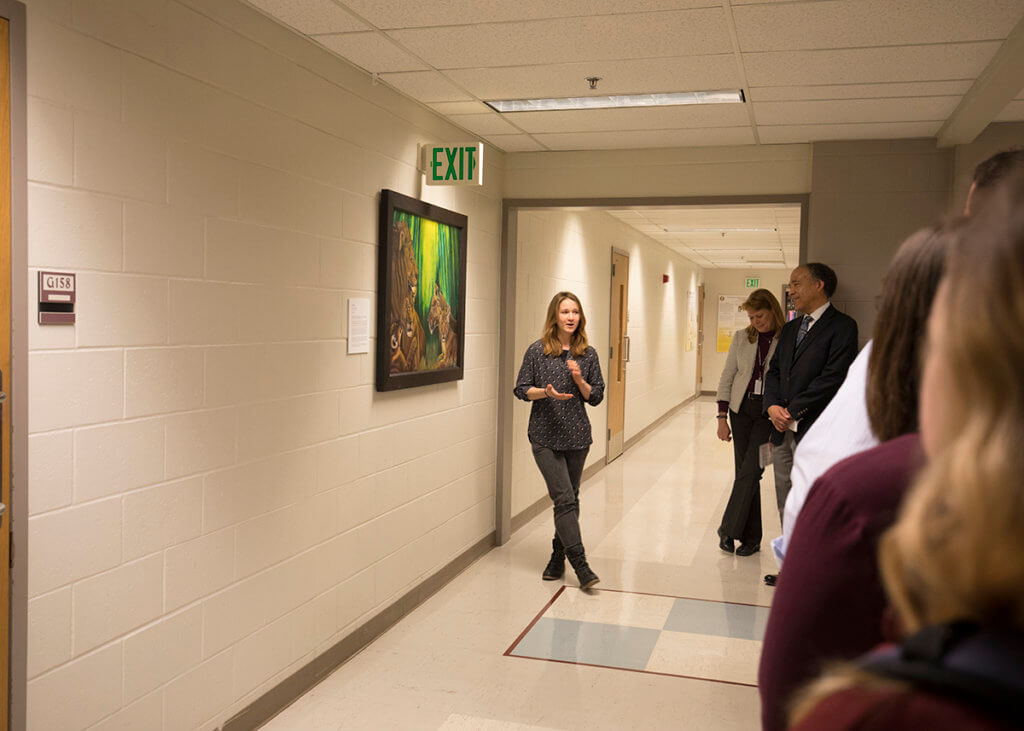
2018 Art Dedication Ceremony pictured

The walls in Lynn Hall got a little more colorful with the installation of four new works of art created by three veterinary students in the DVM Class of 2020: Brittany Crenshaw, Andrea Hall, and Kristen Thomas. The artwork was dedicated April 19 during a ceremony led by Dean Willie Reed, who began the PVM family art program eight years ago with the assistance of Professor of Medical Illustration David Williams. Dean Reed began by sharing, “We’ve had pieces done by not only students, but also by spouses of our faculty and by staff, so it’s something that we are very proud of and I think it adds so much beauty to our building.”
Andrea Hall with artwork

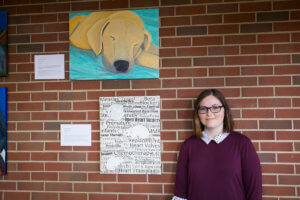
Andrea Hall, of the DVM Class of 2020, created two painting installations, “Tribute to Lab Dogs” (pictured on top) and “Life-Saving Rats” (pictured next to the artist). The paintings were dedicated during a ceremony in Lynn Hall on April 19.

The dedication began with Andrea Hall, who created two pieces, both installed in the curved hallway, behind Lynn 1136, that leads to the Continuum Café. Andrea began by introducing her first piece titled, “Tribute to Lab Dogs,” an oil painting on canvas. Created as a tribute to the College’s Labrador Retrievers in the lab dog program, she painted a yellow Labrador peacefully sleeping on an aqua blanket. As stated in Andrea’s artist statement, “These dogs mean a lot to us and we owe much of our education to them. Not only do they teach us skills which we will be using for the remainder of our careers, but they are a happy face on a bad day. They are stress relief in a busy schedule. They are a warm, fuzzy hug when you need it most. We form bonds with our lab dogs that go further than educational use.”

Andrea then introduced her second piece, a painting created with oil on canvas titled, “Life-Saving Rats,” which focuses on the important role laboratory animals play in veterinary and human medicine. The painting features white rats painted over a blanket of headlines including “Replacement Heart Valves” and “Gene Therapy,” which Andrea explained are just a small portion of the research areas rats have made a contribution to in modern medicine.
Brittany Crenshaw pictured with artwork

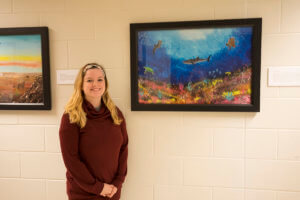
Brittany Crenshaw is pictured between “Chihuahuan Desert” and “Coral Triangle,” two of the five paintings she created depicting endangered biomes and the major endangered species of each. Brittany’s painting installation is hanging in the ground floor hallway near the Veterinary Technology Program office.

Ceremony attendees then transitioned to the ground floor near the Veterinary Technology Program office for the third installation, consisting of five painted pieces created by Brittany Crenshaw.  The artwork combines her two greatest passions: wildlife medicine and painting. With a unique application of spray paint to create the backgrounds, she painted five distinct endangered biomes: the Amazon, Arctic, Coral Triangle, Chihuahuan Desert, and Namibia.  Her artist statements about the paintings showcase the major endangered species of each biome and the major threats to their survival. Brittany explained, “I wanted to try to show people how beautiful they are to me, so they think it’s beautiful and they’ll work harder to try and save it and think about what they’re doing every day and what our impact is on the environment to try to help these endangered species.”  She added, “Something I thought was kind of cool was that each one has one threat in common that affects them all and that’s climate change.”
Kristen Thomas pictured with her mom beside painting

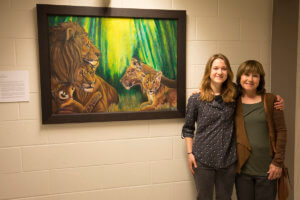
Veterinary student Kristen Thomas, of the DVM Class of 2020 is pictured next to her painting “Lion Pride” along with her mom who was in attendance for the art dedication April 19.

Just down the hallway, near G158, the ceremony concluded with the dedication of Kristen Thomas’s painting titled, “Lion Pride.” The vibrant large-scale painting depicts a pride of lions. In her artist statement, Kristen said, “I chose a pride of lions as my subject matter because of my admiration for lions, the family that they represent, and the strength combined that is a lion pride. That felt like a fitting contribution to our veterinary family here: a representation of a family from the animal kingdom, made up of an array of individuals from different walks of life – young cubs constantly learning, and adults watching over, guiding, and protecting – and all members surviving and thriving together.”

The full artists’ statements are displayed on plaques next to the installations. Take a moment to admire these and other artworks created by PVM family members around Lynn Hall. A special thank you to the artists and Professor of Medical Illustration David Williams for the continued success of this program!

Writer(s): Allison Carey | pvmnews@purdue.edu

Recent Stories

Purdue Veterinary Medicine’s Connection with Wildlife Rescue in Guatemala Highlighted during International Education Week

Hidden amid the dense forests near the shores of Lake Petén Itzá, the ARCAS Wildlife Rescue Center is one of Central America’s most active sanctuaries for endangered and trafficked wildlife. In addition to their conservation efforts, ARCAS (Asociación de Rescate y Conservación de Vida Silvestre) offers unparalleled hands-on experience for veterinary and biology students from around the world. The Purdue University College of Veterinary Medicine has proudly collaborated with ARCAS for many years, and International Education Week this week (November 16-22) provided the perfect opportunity to showcase this invaluable educational partnership.

Immersive Mixed Reality Experience Helps Purdue Veterinary Students Learn Cardiac Physiology

First year Doctor of Veterinary Medicine students at the Purdue University College of Veterinary Medicine recently stepped into a new era of learning — an immersive Mixed Reality (MR) experience at Purdue’s Envision Center. This cutting-edge session allowed students to interact with a dynamic, 3D representation of the heart, deepening their understanding of cardiac physiology in ways traditional methods cannot match.

Feathered Fame: Purdue Veterinary Medicine Research Featured on Journal Cover

The Department of Veterinary Clinical Sciences (VCS) at Purdue University is proud to announce that a recent study from its anesthesiology team has been selected as the cover feature for Veterinary Sciences (MDPI), Volume 12, Issue 11. Chosen from among 82 articles, the publication highlights the College of Veterinary Medicine’s growing impact in avian clinical research.

“Paws Up” – brought to you by the PVM Wellness Committee

Time to shine a spotlight on some “paws-itively” amazing work by one of our newest Purdue Veterinary Medicine staff members, Jennifer Hartman, VCS Curriculum Technologist in the Department of Veterinary Clinical Sciences.

“Paws Up” – brought to you by the PVM Wellness Committee

Today we are highlighting Rebecca Hoffman, BS, RVT, who is a veterinary technologist with the Bovine Field Service.

Learning Specialist Joins PVM Student Success Center Team

Purdue Veterinary Medicine’s Student Success Center is pleased to welcome Kelsey Luse Spille, who joined the team Monday, November 4, as a learning specialist.  In her new role, she will be supporting students with their academic needs while also serving as a member of the Veterinary Education Support Team (VEST), which assists faculty in developing inclusive teaching practices.

Purdue College of Veterinary Medicine Hosts Reception to Welcome New Dean Bret Marsh

Faculty, staff and students gathered at a reception in the Veterinary Medical Library Friday, November 8, to help extend a warm welcome the new dean of the Purdue University College of Veterinary Medicine, Dr. Bret Marsh.  The event marked the conclusion of the first week on the job for Dr. Marsh, who just started in the role Monday, November 4, after wrapping-up 30 years of service as Indiana State Veterinarian – the state’s top-ranking animal health leader.

Awareness Week to Shine Spotlight on Antimicrobial Resistance Next Week

Antimicrobial resistance (AMR) is a growing, significant One Health issue across the world. The WHO estimates that AMR was directly responsible for 1.27 million global deaths and contributed to 4.95 million deaths, with additional significant economic costs. AMR affects all countries and all income groups, and to tackle this urgent problem, researchers, producers, and practitioners from all areas must address the critical shortage of new antimicrobial drugs, and the use of antimicrobial drugs in medicine, farming, and industry. The week of November 18-24 is US Antibiotic Awareness Week and World AMR Awareness Week, and the College of Veterinary Medicine is taking advantage of these national and global campaigns to raise awareness about AMR and antimicrobial stewardship, and to highlight some of the research and practices being conducted at the college to address AMR.

PVM Faculty Honored for Research Success with Purdue Seed for Success Acorn Awards

When Purdue University’s Office of Research honored the accomplishments and innovative ideas of a host of researchers this week, several Purdue Veterinary Medicine scholars were among those recognized. At a ceremony Wednesday, November 14, in the Purdue Memorial Union North and South Ballrooms, the annual Seed for Success Acorn Awards were presented to Purdue Principal Investigators (PIs) and co-PIs who secured research awards of $1 million or more for a single proposal in fiscal year 2024.

Unlocking the Mysteries of the Brain

Despite more than six decades of research in the field of neuroscience, many functions of the brain — the most complex organ in the human body — remain a mystery. Recent research conducted in the Purdue University College of Veterinary Medicine and the Bindley Bioscience Center revealed that scientists are one step closer to understanding the process that activates and deactivates specific proteins within our cells. This breakthrough could one day lead to enhanced treatments that may slow down or perhaps reverse the advance of neurogenerative diseases such as Alzheimer’s, Parkinson’s and multiple sclerosis.