
Purdue Veterinary Medicine Research Supported by $44,656 from Trask Innovation Fund

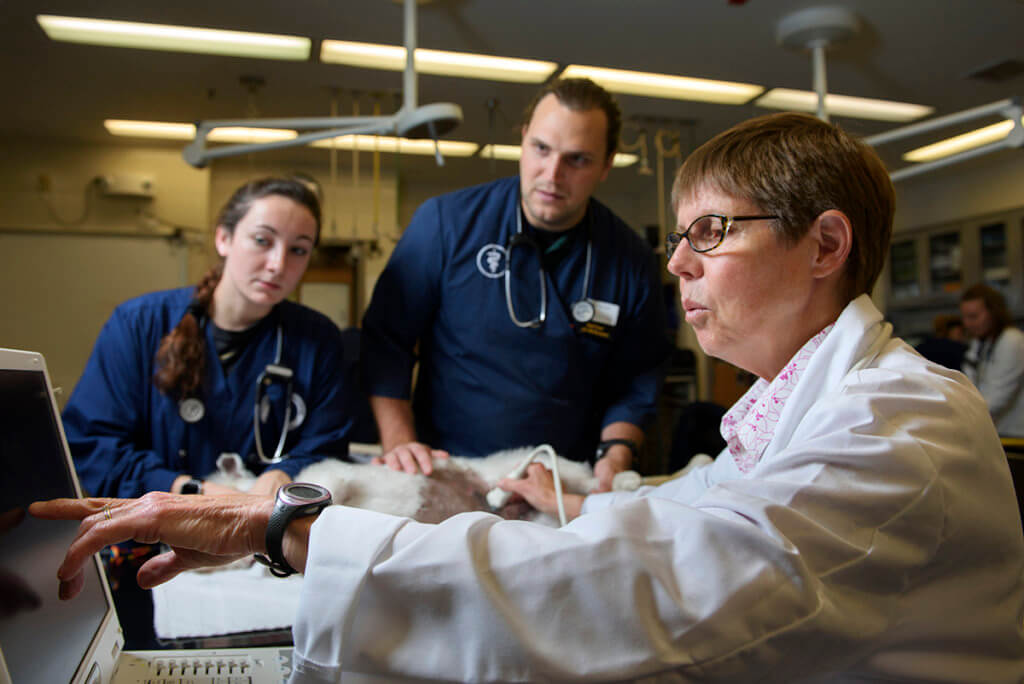
Dr. Debbie Knapp pictured performing an ultrasound on a dog

The Purdue Research Foundation Office of Technology Commercialization has awarded more than $143,000 from the Trask Innovation Fund across three projects, including one involving researchers in the Purdue University College of Veterinary Medicine and the College of Engineering.  That project is being led by Dr. Deborah Knapp, Distinguished Professor of Comparative Oncology and director of the Purdue Comparative Oncology Program, and Dr. Saeed Mohammadi, professor of electrical and computer engineering. Working as co-primary investigators, the pair is seeking to develop a faster, noninvasive and low-cost cancer screening technique.

The research involves creating a prototype which would allow bladder cancer in dogs to be detected from urine samples. Project leaders will distribute prototype devices to researchers at Purdue and elsewhere who work on transitional cell carcinoma, or TCC, in dogs. Provided these trials prove effective, the long term goal would be to detect bladder cancer and other diseases in humans as well. The innovation has been licensed from the Office of Technology Commercialization to Molecular Diagnostics, a startup company.

“Dr. Knapp is a world-renowned researcher on TCC. She will help with testing TCC and control samples,” Dr. Mohammadi said. “We hope to improve the sensitivity and specificity of our technique so it can be used to detect the disease at early stages and improve the prognosis of the disease. If this can be established, there will be a good potential for the application of such a simple and noninvasive technique for screening cancer in humans.”

The two other projects receiving Trask Innovation Fund support involve research in the College of Agriculture’s Department of Agronomy and Department of Botany and Plant Pathology.  The Trask Innovation Fund was established in 1974 by a gift from Verne A. Trask in memory of his wife, Ramoth Trask. The objective of the Trask Innovation Fund is to support short-term projects that will enhance the commercial value of Purdue University intellectual property assets. The fund is a competitive program available to Purdue innovators to fund activity in the innovators’ Purdue laboratories. Over $2.6 million dollars have been donated to 69 technologies over the last 10 years.

Click here for more information about the most recent round of funding.

Writer(s): Hailee Rolofson, PVM Communications Intern | pvmnews@purdue.edu

Recent Stories

“Paws Up” for Jennifer Danaher – brought to you by the PVM Wellness Committee

This week we express our gratitude to Jennifer Danaher, who is department secretary for Veterinary Clinical Sciences.

‘Purdue Pursuits’: A PVM angle on Purdue’s teaching and learning reading groups

Crafting meaningful and engaging course experiences has been at the top of Dielson Vieira’s mind ever since he joined the Purdue University College of Veterinary Medicine’s faculty in 2024. As a clinical assistant professor in the Department of Basic Medical Sciences, Vieira is already adept at applying innovative teaching practices to classroom environments, but that doesn’t stop him from seeking out new ideas, approaches and perspectives — insights he gains through outlets like Purdue’s teaching and learning reading groups.

Top tier biology journal publishes PVM study that unlocks secrets of a drug-resistant fungal pathogen, which causes serious infections in humans

Though the name “Candida auris” is far from a household term, public health experts know it well because the multi-drug-resistant fungal pathogen, which causes serious human infections, has been classified as an urgent threat by the U.S. Centers for Disease Control and Prevention (CDC) Antibiotic Threats Report (2019). Dr. Shankar Thangamani, Associate Professor of Microbiology and University Faculty Scholar in the Purdue University College of Veterinary Medicine’s Department of Comparative Pathobiology, is researching C. auris, aided by a 2.4 million grant from the National Institutes of Health (NIH). New research findings, just published in Nature Microbiology, show how C. auris adapts and evades the immune system.

In Print: ‘Translational Research Methods for Tauopathies’

A just-published 300-page volume edited by Jessica Fortin, Purdue assistant professor in the College of Veterinary Medicine’s Department of Basic Medical Sciences, provides a significant new resource for researchers studying a group of neurodegenerative diseases known as tauopathies. “Translational Research Methods for Tauopathies” provides detailed protocols intentionally selected to serve as a basis for research laboratories seeking to further treatments for such debilitating neurodegenerative diseases as Alzheimer’s and chronic traumatic encephalopathy (CTE).

It’s Almost Here!

Though the annual Purdue Veterinary Conference is almost upon us, there’s still time to register and take advantage of this time-honored College of Veterinary Medicine fall tradition that combines excellent continuing education with fun opportunities for reconnecting with colleagues and classmates, networking, and learning about the latest veterinary trends and products. The 2026 Purdue Veterinary Conference takes place September 23–26 on the Purdue University campus. The annual event has something for everyone, from veterinarians to veterinary technicians, faculty, staff and students.