
More Time Together

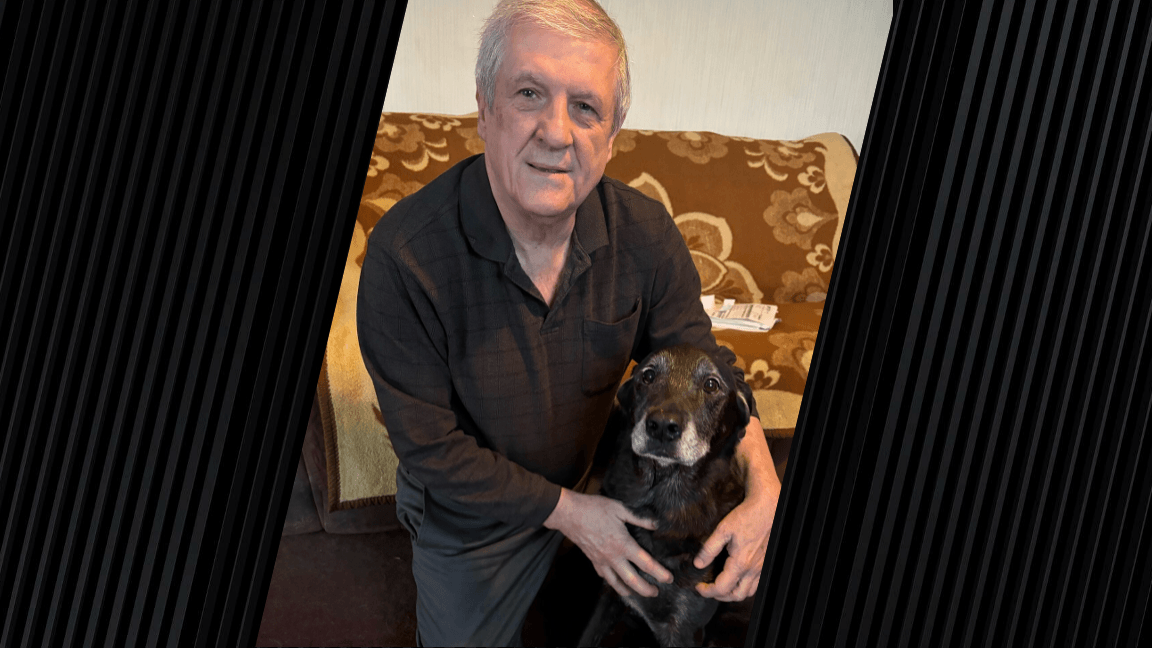
A man wearing a black shirt is kneeling down next to a black dog.
Brian with his beloved canine companion Blackie.

After two life-threatening emergencies, Blackie’s care at Purdue’s Veterinary Hospital gave Brian and his family the gift of more time

From the moment Brian met Blackie as a playful puppy at a rescue, their bond was undeniable. Over the years, Blackie became more than a pet. He was Brian’s loyal companion and a constant source of comfort for Brian and his brother, Branco.

That is why, when Brian found Blackie unresponsive in his yard one evening, he refused to give up. He took him to a nearby veterinary clinic, where initial tests were run. From there, Blackie was transferred to another animal hospital, but after three days with little improvement, Brian was told euthanasia was the only remaining option.

Unwilling to accept that outcome without exhausting every possibility, Brian drove Blackie an hour and a half to the Purdue University Veterinary Hospital’s Emergency and Critical Care team. There, Blackie received intensive treatment, including insulin therapy, fluid support, and around-the-clock monitoring. Slowly, he regained strength and was able to return home.

Months later, when Blackie collapsed again, Brian returned to Purdue, fearing the worst. During that second emergency, he found reassurance when the same veterinarian who had cared for Blackie previously stepped into the room. He also remembers the kindness of a veterinary student who spent extra time sitting with Blackie before and after shifts, offering comfort during a difficult moment.

With his condition carefully managed, Blackie was able to continue enjoying life at Brian’s side. Brian credits the Purdue Veterinary Hospital for saving Blackie, not once, but twice, and for giving Brian and Blackie more time together.

Brian tells every pet owner he meets, “If your animal ever needs help, take them straight to Purdue.”

Blackie returned one more time to the Purdue Veterinary Hospital’s Emergency Service on February 26 of this year, when he passed away. Although Brian continues to grieve that loss, he remains deeply grateful for the care Blackie received and for the extra time they were given together.

“It has been very hard,” Brian shared. “He was my buddy and I miss him so much, and my brother does as well. I will never forget the great care that the Purdue Veterinary Hospital team gave him in extending his life.”

Blackie’s story is a touching reminder of the powerful bond between people and their pets, and of how compassionate, dedicated care can mean so much in life’s most difficult moments.

Writer(s): Mackenzie Martin | pvmnews@purdue.edu

Recent Stories

Journal of Feline Medicine and Surgery Honors PVM Clinician Paulo Gomes as a Top Co-Author

Dr. Paulo Gomes, clinical associate professor of dermatology in the Purdue University College of Veterinary Medicine’s Department of Veterinary Clinical Sciences, recently was recognized for co-authoring one of the most widely read articles of 2025 in the Journal of Feline Medicine and Surgery. The publication is an online, open access, international, peer-reviewed journal.

“Paws Up” – brought to you by the PVM Wellness Committee

This week a big Paws Up goes to Gabriel Harris, who is a graduate research assistant in the Department of Basic Medical Sciences.

USDA Funding Fuels Purdue Veterinary Medicine Research Seeking Answers to Costly Cattle Production Mystery

A four-year, $650,000 New Investigator Award from the USDA National Institute of Food and Agriculture (USDA-NIFA) will support research led by Dr. Viju V. Pillai, a faculty member in Purdue Veterinary Medicine’s Department of Comparative Pathobiology and pathologist at the Animal Disease Diagnostic Laboratory (ADDL), aimed at solving a persistent and costly mystery in cattle production.  Dr. Pillai’s team wants to answer the question of why so many pregnancies fail before they are even recognized? The project will focus on the earliest stages of fetal–maternal communication and on a little-understood family of proteins called trophoblast Kunitz domain proteins (TKDPs), whose functions in pregnancy remain largely unknown.

In Memory: Dr. Ronald P. Miller (PU DVM ’63)

The Purdue Veterinary Medicine community is saddened by the passing of Dr. Ronald P. Miller, of Indianapolis, a member of the College of Veterinary Medicine’s first graduating class, the Class of 1963.  Dr. Miller died February 17, 2026, at the age of 89.

In Memory – Dr. Julie Anderson (PU DVM ’78)

A Purdue Veterinary Medicine alumna and beloved veterinarian, Dr Julie Anderson, of Rockville, Indiana, will be remembered at a celebration of life open house to be hosted in her honor by West Central Veterinary Services Sunday, April 27. Dr. Anderson, a member of the Purdue DVM Class of 1978, passed away in December at the age of 71.

Popular Veterinary Nursing Symposium Features Day of Learning and Networking

Purdue Veterinary Medicine’s annual Veterinary Nursing Symposium brought more than 150 veterinary professionals to Lynn Hall recently to gain practical knowledge and insights about a diverse range of topics covering both small and large animals. Veterinary nurses (technicians and technologists), veterinary assistants and veterinary nursing (technology) students participated in the all day lifelong learning program Sunday, March 23. The attendees came from across Indiana as well as Illinois, Ohio, Kentucky, Michigan, Tennessee, and Wisconsin.

“Paws Up” – brought to you by the PVM Wellness Committee

Today we are highlighting Dr. Heather Bornheim, who is a farm animal medicine and surgery clinician in the Purdue University Veterinary Hospital.

CPB’s Aryal Lab Members Recognized at 140th Annual Indiana Academy of Science Meeting

Two members of Research Associate Professor Uma Aryal’s lab in the Department of Comparative Pathobiology recently received noteworthy recognition during the 140th Indiana Academy of Science conference hosted in Indianapolis. According to the Indiana Academy of Science, since 1885, its annual conferences have served as the only multidisciplinary scientific meetings that take place in the state. The event on March 22 attracted hundreds of senior and junior scientists from Indiana and across the Midwest.