
Dr. Marejka Shaevitz’s journey of resilience and dedication to veterinary oncology
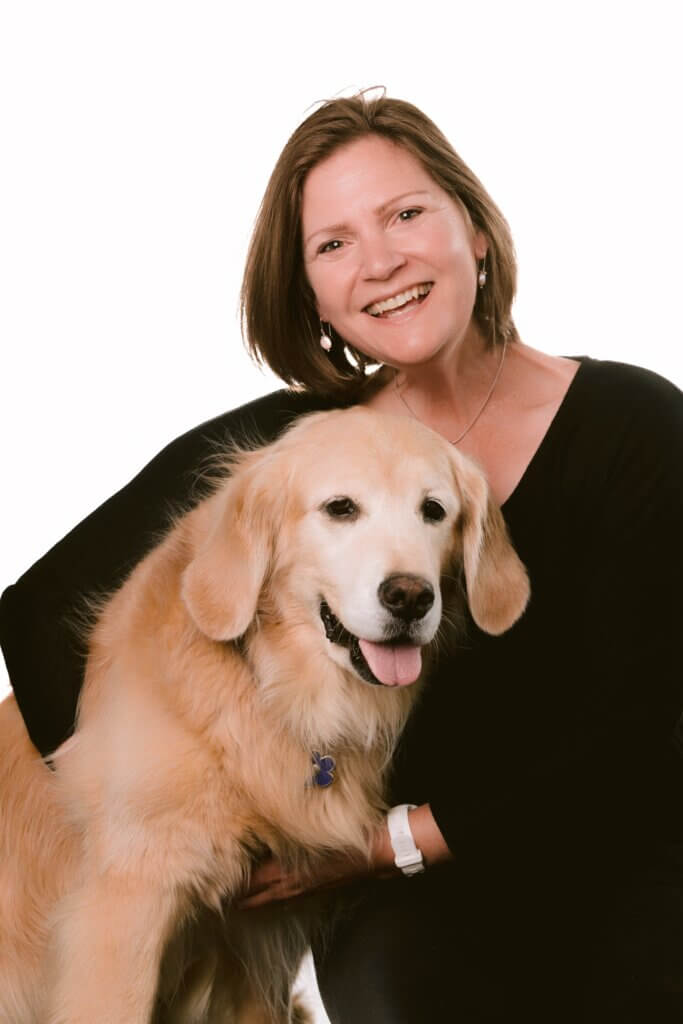
Unceasingly optimistic. That’s how colleagues describe Dr. Marejka Shaevitz, clinical assistant professor of oncology in the Purdue University College of Veterinary Medicine’s Department of Veterinary Clinical Sciences and the Werling Comparative Oncology Research Center.
Dr. Shaevitz, who completed a three-year residency program in comparative oncology at Purdue in 2020, spent four years in private clinical practice at MedVet Columbus (Ohio) before she returned to Purdue to join the faculty in February. In 2019, she was awarded the Outstanding Clinical Research Resident Award by the Veterinary Cancer Society. In 2023, her publication, which she co-authored with Dr. Chris Fulkerson, clinical associate professor of veterinary medical oncology, and Dr. George Moore, professor of epidemiology, was selected as the Outstanding Resident Manuscript by the Journal of the American Veterinary Medical Association.
“I remembered Dr. Shaevitz from when she interviewed for her residency at Purdue and I could tell right away, she was special,” said Dr. Deborah Knapp, distinguished professor of comparative oncology, the Dolores L. McCall Professor of Comparative Oncology and director of the Werling Research Center. “I always saw her as someone who could make her most important contributions in an academic setting. She possesses maturity, insight and clear dedication. We were grateful for the opportunity to recruit her back to Purdue.”
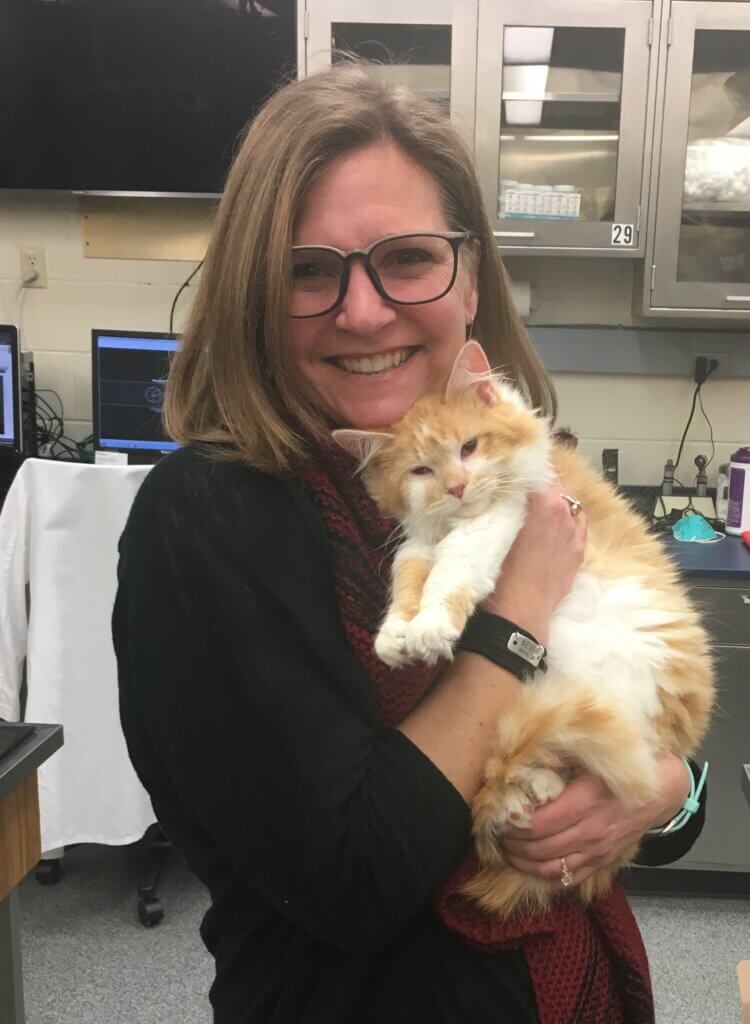
As a clinical assistant professor, Dr. Shaevitz helps facilitate in-clinic evaluation of drugs and treatment protocols. She oversees day-to-day clinic operations to promote best practice medicine among veterinary students and medical oncology residents who treat cancer patients in the Small Animal Hospital. She also contributes to translational research and supports clinical trials.
Since arriving at Purdue in February, she increased enrollment in a clinical trial facilitated by the Purdue Institute for Cancer Research for an intra-tumoral immunotherapy drug. She also established a legacy program to inform owners of the option to preplan the donation of organ tissues when their dog reaches the end of its life — an opportunity to contribute to both teaching and research objectives.
“When people learn I’m a veterinary oncologist, they assume my work must be depressing,” Dr. Shaevitz said. “There are certainly difficult losses, but our main focus is quality of life. Oncology is one of the most exciting fields in terms of how we can have a direct impact on helping dogs feel better. Living well with cancer is possible, for dogs and for humans.”
Dr. Shaevitz would know. She’s faced both difficult loss and challenging diagnoses herself. Those moments became turning points in her life that led her on the path toward a career in veterinary oncology.
From Diagnosis to Dedication
Just before she graduated from high school, Dr. Shaevitz was diagnosed with Type 1 diabetes. To learn more about life with a chronic autoimmune disease, she read “The Peripatetic Diabetic,” a book that dispels misconceptions about the disease and shares a positive outlook for enjoying a full life post-diagnosis.
“This was the first book on diabetes I read that gave me strategies for living well and not viewing my disease as a limitation,” Dr. Shaevitz said. “So instead of entering college worried about how my life would change drastically, it was more like diabetes just became something I carried around in my backpack. It was with me all the time, but it didn’t have to rule my life.”
She enrolled at Stanford University where one of her early classes in immunology sparked her interest in investigating the autoimmune underpinnings of Type 1 diabetes. She completed her senior thesis on the topic and through that process, cemented her love for research. After graduating with honors in 1997, Dr. Shaevitz spent two years in the then-emerging field of gene chip technology. From there, she transitioned to data analysis and database management.
“I gained a firm understanding in how to categorize data and how to code information to make it analyzable in the future,” Dr. Shaevitz said. “Proper information management is crucial when you’re collecting data in research, especially working with animals and humans where information can sometimes be subjective. When you code things in an objective way, it allows you to draw conclusions from a mathematical standpoint.”
Though she enjoyed the challenge of conceptualizing and organizing data, after about 10 years in the field, she realized that she didn’t find database management work fulfilling. And that’s when she reached another medical crossroads. This time she was diagnosed with Hodgkin’s lymphoma, a rare though highly curable form of cancer that affects the immune system.
“I adopted a positive approach to my cancer treatment,” Dr. Shaevitz said. “My friends and family rallied to support me in my pursuit of a good and enjoyable life while I was undergoing chemotherapy. I didn’t want cancer to take over my whole life. When my treatment was complete and I had been cured, I felt as though I’d been given another chance at life and I wanted to make the most of it.”
Dr. Shaevitz decided to earn a master’s degree in clinical health psychology at the University of Utah with a focus on helping others adjust to living with severe and chronic diseases. She knew from her own experience that staying engaged in hobbies and interests helped her remain focused and optimistic from a psychological standpoint.
“Although I don’t practice psychology in a therapeutic setting, it’s still helpful when discussing difficult diagnoses with pet owners,” Dr. Shaevitz said. “There are so many connections between psychology and physical health. Reflecting on how they can help their dog live well with cancer helps shape owners’ approaches to care at home.”
After earning her master’s in 2010, she soon received another life-changing diagnosis. This time it was her beloved golden retriever, Kimball, whom Dr. Shaevitz describes as her heart dog. At 10 years old, Kimball was diagnosed with hemangiosarcoma, a highly malignant and fast-growing cancer that develops in the lining of blood vessels.
“Initially, I was in disbelief,” Dr. Shaevitz said. “I didn’t want to accept Kimball’s diagnosis. Most of the time she seemed fine, so I needed to understand medically exactly what was happening. I asked the veterinarian to show me the CT scan and walk me through it. We visited a specialist in Oregon and they talked me through the biopsy. They let me observe the examination and answered every question I had. I had spent lots of time in human hospitals, but this was the first time I watched veterinarians treat an animal outside of a wellness visit. I was intrigued by the practice of medicine on dogs, especially one so important to me.”
Losing Kimball was her inspiration to become a veterinary medical oncologist. She wanted to honor Kimball’s legacy and to contribute to the field of science that granted her own survival. After earning her DVM from Oregon State University in 2016 and completing an internship in medicine and surgery at the University of Illinois Urbana-Champaign, Dr. Shaevitz applied to the comparative oncology residency program at Purdue.
“Anyone who gets matched with a residency in a specialty veterinary medicine program is incredibly fortunate,” Dr. Shaevitz said. “They pick you as much as you pick them. But Purdue felt like the right place for me from the start because it’s specifically comparative oncology. My desire to make good use of the time I’ve been given drives me to make a difference in canine and human cancer. Not only am I honoring Kimball, but I am honoring all the doctors who treated my cancer and gave me a life that I can dedicate to helping others.”
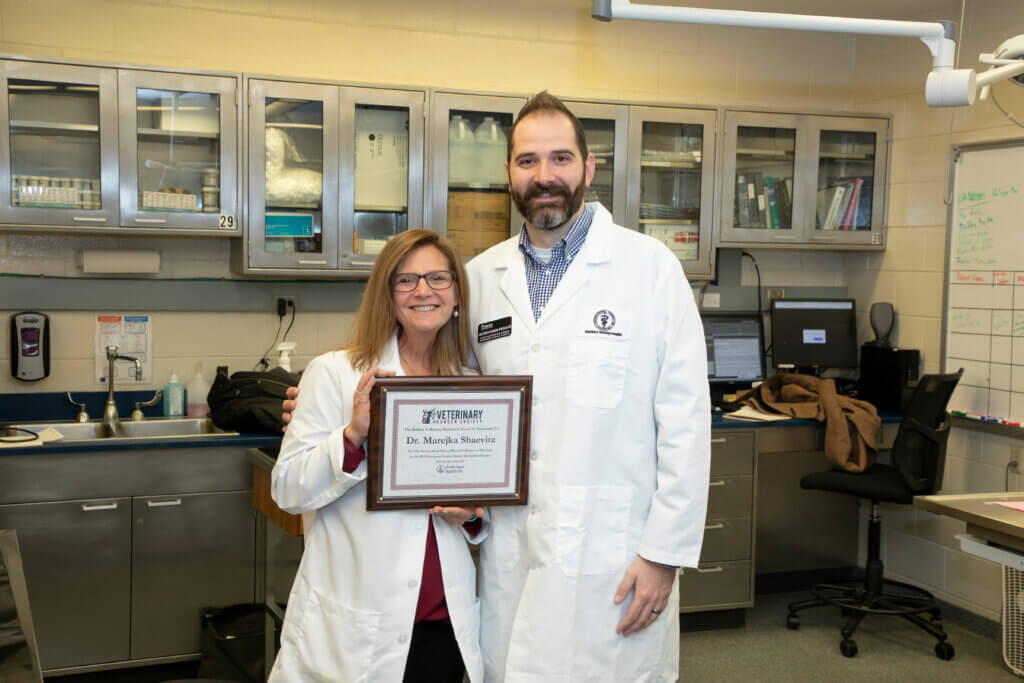
Although hers was not a straight path, Dr. Shaevitz knows now she is exactly where she was meant to be.
“Purdue feels like home,” she said. “I’m surrounded by brilliant, motivated, grounded, caring people. I look forward to coming to work every day.”
She soon will be joined by two new hires, Drs. Nick Dervisis and Shawna Klahn, a husband-wife team of veterinary oncologists with expertise in tumor ablation devices. When they start next month, they will join with Dr. Shaevitz in doubling the number of medical oncology faculty in the Department Veterinary Clinical Sciences. They will be featured in an upcoming issue of the Vet Gazette.
“Our mission is to change the outlook for pet animals and people facing cancer,” Dr. Knapp said. “Our current university administration has renewed interest in high-impact research in fields of medicine and health sciences. We have strong partnerships across campus and there’s a push for One Health collaborations. We are sitting here at the ideal place, in the ideal time — and we have the team that has the drive and the commitment to seize these opportunities.”
