
PVM to Play Role in Research on New Patent-pending Method to Mass-produce Antitumor Cells to Treat Blood Diseases and Cancer

Xiaoping Bao, a Purdue University assistant professor in the Davidson School of Chemical Engineering, has improved upon traditional methods to create human immune cells from human pluripotent stem cells. (Syahrir Maulana/iStock photo)
Xiaoping Bao, a Purdue University assistant professor from the Davidson School of Chemical Engineering, has improved upon traditional methods to create human immune cells from human pluripotent stem cells. The research was published in the peer-reviewed journal Cell Reports. (Syahrir Maulana/iStock photo)

A Purdue University chemical engineer has improved upon traditional methods to produce off-the-shelf human immune cells that show strong antitumor activity, according to a paper published in the peer-reviewed journal Cell Reports.  And future research plans include clinical trials involving the Purdue University College of Veterinary Medicine.

Dr. Xiaoping Bao, a Purdue University assistant professor in the Davidson School of Chemical Engineering, said CAR-neutrophils, or chimeric antigen receptor neutrophils, and engraftable HSCs, or hematopoietic stem cells, are effective types of therapies for blood diseases and cancer. Neutrophils are the most abundant white cell blood type and effectively cross physiological barriers to infiltrate solid tumors. HSCs are specific progenitor cells that will replenish all blood lineages, including neutrophils, throughout life.

“These cells are not readily available for broad clinical or research use because of the difficulty to expand ex vivo to a sufficient number required for infusion after isolation from donors,” Dr. Bao said. “Primary neutrophils especially are resistant to genetic modification and have a short half-life.”

Dr. Bao has developed a patent-pending method to mass-produce CAR-neutrophils from human pluripotent stem cells (hPSCs), that is, cells that self-renew and are able to become any type of human cell. The chimeric antigen receptor constructs were engineered to express on the surface of the hPSCs, which were directed into functional CAR-neutrophils through a novel, chemically defined protocol.
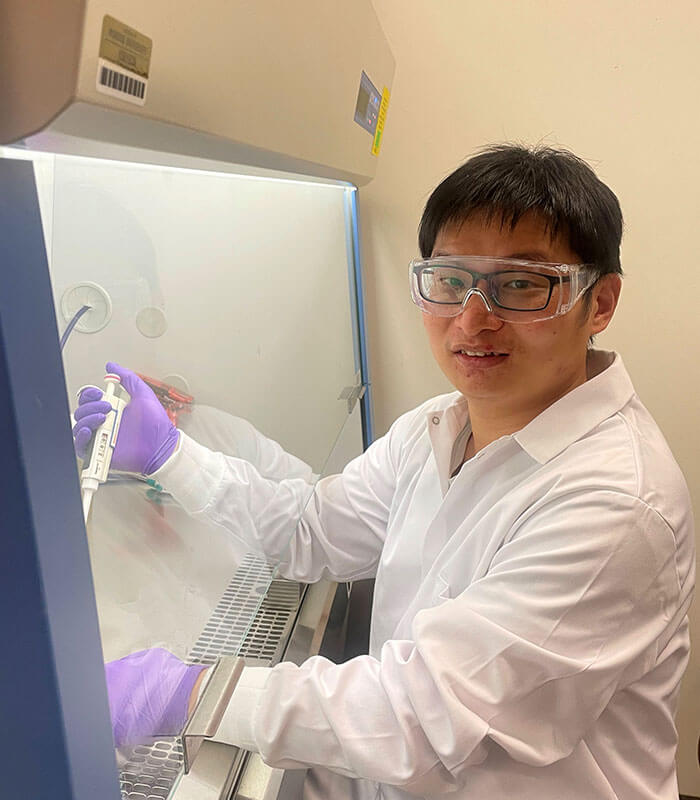
Xiaoping Bao (photo provided)

The method was created in collaboration with Dr. Qing Deng in Purdue’s Department of Biological Sciences; Dr. Hal E. Broxmeyer, now deceased, at the Indiana University School of Medicine; and Dr. Xiaojun Lian at Pennsylvania State University.

“We developed a robust protocol for massive production of de novo neutrophils from human pluripotent stem cells,” Dr. Bao said. “These hPSC-derived neutrophils displayed superior and specific antitumor activities against glioblastoma after engineering with chimeric antigen receptors.”

Dr. Bao disclosed the innovation to the Purdue Research Foundation Office of Technology Commercialization, which has applied for an international patent under the Patent Cooperation Treaty system of the World Intellectual Property Organization. The innovation has been optioned to an Indiana-headquartered life sciences company.

“We will also work with Dr. Timothy Bentley and his team at the Purdue College of Veterinary Medicine to run clinical trials in pet dogs with spontaneous glioma,” Dr. Bao explained. Dr. Bentley is professor of neurology and neurosurgery in the College of Veterinary Medicine’s Department of Veterinary Clinical Sciences

This research project was partially supported by the Davidson School of Chemical Engineering and College of Engineering Startup Funds, Purdue Center for Cancer Research, Showalter Research Trust and federal grants from the National Science Foundation and National Institute of General Medical Sciences.

Click here to view a complete news release.

Writer(s): Steve Martin | pvmnews@purdue.edu

Recent Stories

Purdue Veterinary Medicine Welcomes New Clinical Residents and Specialty Intern

A new class of clinical residents arrived this summer at the Purdue University College of Veterinary Medicine to begin their specialty training. On July 16, 2026, the Department of Veterinary Clinical Sciences (VCS) held a welcome breakfast to introduce the new VCS residents to faculty and staff. The breakfast provided the opportunity for the new residents and a new specialty intern in neurology to meet current VCS residents, as well as the faculty and staff they will be working closely with during their time at Purdue.

American Board of Veterinary Toxicology Honors Purdue Professor and ADDL Senior Veterinary Toxicologist Steve Hooser

Dr. Steve Hooser, DVM, PhD, DABVT, professor of veterinary toxicology at the Purdue University College of Veterinary Medicine and senior veterinary toxicologist for the Indiana Animal Disease Diagnostic Laboratory (ADDL), has received the American Board of Veterinary Toxicology's (ABVT) 2026 Service Award.  Given in recognition of a career that has shaped the field of veterinary toxicology for more than four decades, the award was announced July 13 at the ABVT Annual Business meeting held in Anaheim, California, in conjunction with the AVMA Convention 2026.

New Class of Veterinary Hospital Interns and Pharmacy Resident Welcomed to PVM

A total of 13 new interns and a new veterinary pharmacy resident began their advanced training in the Purdue University Veterinary Hospital this summer. The group of interns includes nine veterinarians who are completing a small animal rotating internship and four who are doing a large animal rotating internship. In addition, a pharmacy school graduate began the one year Wasson Veterinary Pharmacy Residency program, which is jointly offered by the Purdue Colleges of Veterinary Medicine and Pharmacy.

“Paws Up” for Lilia Beal-Preston and Mikey Galvin – brought to you by the PVM Wellness Committee

This week, we’re proud to recognize DVM students Lilia Beal-Preston and Mikey Galvin, who received a Paws Up recognition from a client after caring for the client's dog at the Purdue University Veterinary Hospital.

“Paws Up” for Jennifer Danaher – brought to you by the PVM Wellness Committee

Today we are congratulating Jennifer Danaher, who is a department secretary for Veterinary Clinical Sciences, for being recognized as a helpful colleague in our college.

Boo the Miracle Dog: A Story of Bravery, Breakthroughs, and a Bond That Inspires

Our series of articles about animals and their owners who've found help and healing at the Purdue University Veterinary Hospital continues with the story of "miracle dog" Boo Davis. At 13 years old, Boo Davis is living proof of the power of persistence, expert veterinary care, and the unshakable love between a pet and her person. Affectionately known as Lisa’s “miracle dog,” Boo’s journey is one that not only has extended her life, but also has helped shape the future of cancer treatment for other pets, too.

Placating Pets to Help them COPE this Fourth of July

Despite the excellent tips experts provide each year for pet safety and welfare on the 4th of July, many pet families still run into trouble and lose their pets. What are we missing and how can we even better protect our animal companions? That question is answered in an article by Dr. Candace Croney, director of the Center for Animal Welfare Science.