

Environment, Health and Welfare
Welfare of Dogs in Commercial Breeding Kennels
Related Studies
Establishing Stress and Welfare Benchmarks for Puppies Intended for Detection Work

Detection canines (DC) are a critical asset to homeland security. The demand for DC capable of meeting the rigorous physical and behavioral standards necessary for optimal performance in operational environments continues to grow. However, their ability to work effectively in high-stress environments is critical and is a primary cause of rejection during selection for or early release from training or deployment. This creates a need to evaluate methods for optimizing early development and training practices for candidate dogs. The current study aims to understand the interactive effects of genetic and early environmental factors on the behavior, stress resilience, and welfare of working canines to inform selection and management practices that optimize their career tracking and performance.
This study is a subtask of a larger project with multiple partners involved
Subtask Leaders: Candace Croney (PI), Shanis Barnard, Alessia Diana
Subtask Collaborators: Paul Waggoner (Auburn University); Lucia Lazarowski (Auburn University); Cynthia Otto (University of Pennsylvania)
Funding Source: This study was funded by the Department of Homeland Security, Science and Technology Directorate, Detection Canine Program Office, in collaboration with Auburn University under contract #70RSAT22CB0000002
Behavioral and Physiological Responses of Dogs to Commercial Breeding Kennel Management and Caretaker Interactions
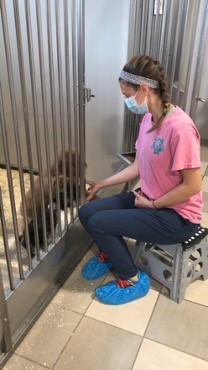
To ensure the welfare of dogs in commercial breeding kennels, it is important to evaluate the role management practices may play in influencing their behavioral and physical health. The aim of this study is to evaluate the effects of a short, positive caretaker intervention on the behavioral and physiological responses of dogs in commercial breeding kennels and to determine if effects persist over time and generalize to strangers.
Project Leaders: Candace Croney (PI), Kari Ekenstedt, Shanis Barnard, Traci Shreyer, Aitor Arrazola
Funding Source: Life of Riley at Spring Point
Related Publications:
Effects of Flooring on Breeding Dog Welfare and Cleanliness
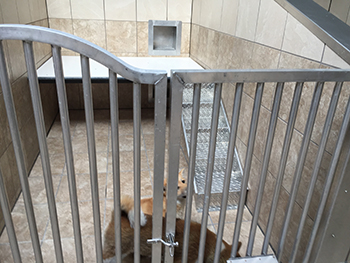
The aim of this study was to characterize the relationship between flooring types common in US breeding kennels and the physical health, body and kennel cleanliness of dogs housed on them. The results indicate that dog foot health and cleanliness can be maintained on the flooring substrates assessed. Dog comfort, behavior and preferences for flooring types require investigation.
Project Leaders: Candace Croney (PI), Judith Stella
Funding Source: World Pet Association & Pet Food Institute
Findings
- The foot health of dogs housed on 3 types of flooring- diamond-shaped coated expanded metal (i.e. Tenderfoot), polypropylene, and concrete- were assessed. Few foot, elbow or hock problems were identified on any flooring type.
Related Publications:
- A cross-sectional study to investigate associations between flooring substrates and prevalence of limb and paw abnormalities of dogs housed in commercial breeding facilities
- Does flooring substrate impact kennel and dog cleanliness in commercial breeding facilities?
- Effects of flooring on animal health and well-being: Implications for kenneled dogs
Prevalence of Periodontal Disease in Commercial Breeding Kennels
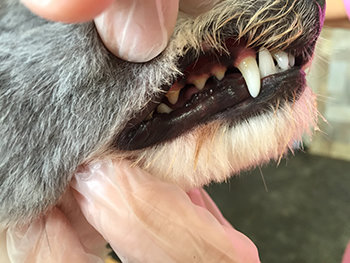
Periodontal disease, inflammation and breakdown of the structures that support the teeth, is one of the most commonly mentioned health concerns for dogs in commercial breeding facilities. However, to this point, no research has been performed to determine how common periodontal disease actually in within breeding facilities. This project has 2 goals: to determine what percentage of dogs in commercial breeding facilities have severe periodontal disease and to evaluate how well inspecting the teeth and gums of an awake can detect periodontal disease.
Project Leaders: Candace Croney (PI), Judith Stella, Amy Bauer
Funding Source: World Pet Association & Pet Food Institute
Evaluating the validity of a visual dental scale for detection of periodontal disease in non-anesthetized dogs.
Findings
- A visual assessment tool for scoring dental disease in awake dogs was compared to the "Gold Standard" of examination under anesthesia with radiographs to determine its validity and reliability.
Estimating the prevalence of periodontal disease in dogs housed in commercial breeding facilities
Findings
- Periodontal (dental) disease (PD) was visually scored using a 0-IV scale where 0 is no disease and IV is severe disease.
- The results do not support the assumption that the dental health of dogs in commercial breeding facilities is worse than that of the population as a whole.
Related Publications:
- Evaluating the validity and reliability of a visual dental scale for detection of periodontal disease (PD) in non-anesthetized dogs (Canis familiaris)
- A cross-sectional study to estimate prevalence of periodontal disease in a population of dogs (Canis Familiaris) in commercial breeding facilities in Indiana and Illinois
- Welfare implications of dental health in commercial breeding dogs
- Preventing periodontal disease in dogs
