
Would-be Veterinarians Flock to Boiler Vet Camp after a Pandemic-induced Hiatus

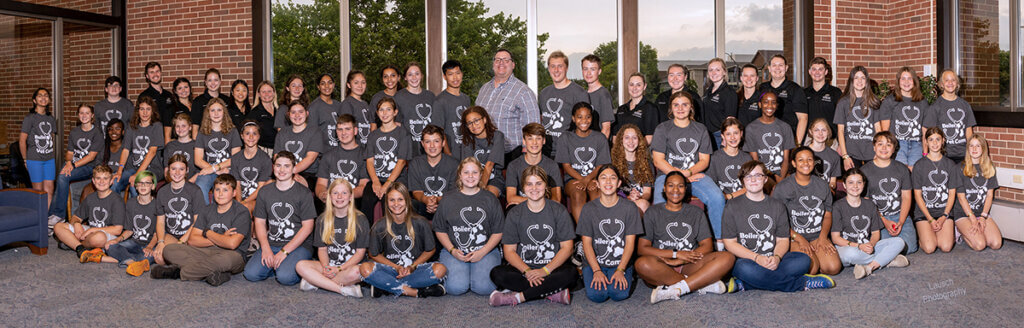
Junior Boiler Vet Campers and leaders gather for a group photo inside the Veterinary Medical Library
Junior Boiler Vet Camp | Summer 2022

Purdue Veterinary Medicine’s ever-popular Boiler Vet Camps returned in force during June after a two-year absence due to the COVID-19 pandemic. Over the course of two weeks, the College of Veterinary Medicine hosted 100 campers, giving them a first-hand look into the world of veterinary medicine.
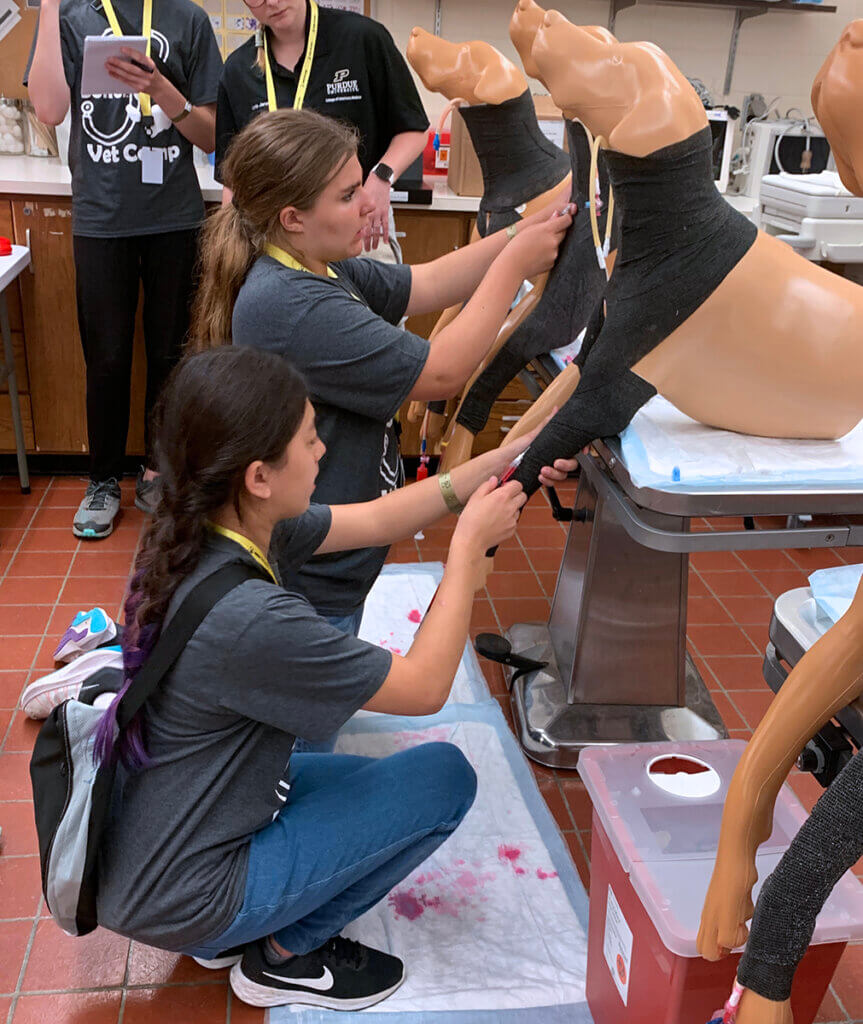
Campers practice drawing blood from dog models
Boiler Vet Campers learn about veterinary medicine by working with animal models in the Clinical Skills Lab.

The Junior and Senior Camps each had 50 campers, according to Jessie Sexton, a veterinary student in the DVM Class of 2024, who served as one of two camp student assistants. “My favorite part of camp this year was seeing the campers excited about showing their parents all they had learned during the graduation ceremony presentations,” Jessie said.

The Junior Camp was held June 12-18 for rising 8th and 9th graders. Nearly 30 of the campers were from Indiana. The others came from Arizona, California, Georgia, Hawaii, Illinois, Kentucky, Maryland, Michigan, Ohio, Pennsylvania, South Carolina, Texas, the Virgin Islands, and Wisconsin. The Junior Camp involved learning about a variety of veterinary-related topics through sessions such as “Cud It Out,” “Fish Need Doctors, Too,” “Equine Treadmill,” and “A Look Inside the Horse (with Endoscopy),” as well as opportunities to interact with animals. The camp itinerary also included visits to the Indianapolis Zoo and Fair Oaks Farms.

The next week, June 19-25, featured the Senior Camp for rising 10th, 11th, and 12th graders. More than half of the Senior Camp participants were from Indiana, while the others came from Alabama, California, Connecticut, Florida, Illinois, Maryland, Michigan, Montana, New Jersey, New York, Ohio, South Dakota, Texas, Utah, the Virgin Islands, Washington State, and Wisconsin. The Senior Camp focused on subjects like surgery and anesthesia, as well as on learning what goes into a strong veterinary school application. A big part of the Senior Boiler Vet Camp experience came on day one, when the campers got into groups, and each group received their camp dog to care for throughout the week. The campers also had the opportunity to observe and identify blood cells, learn to administer a canine physical exam, and much more.
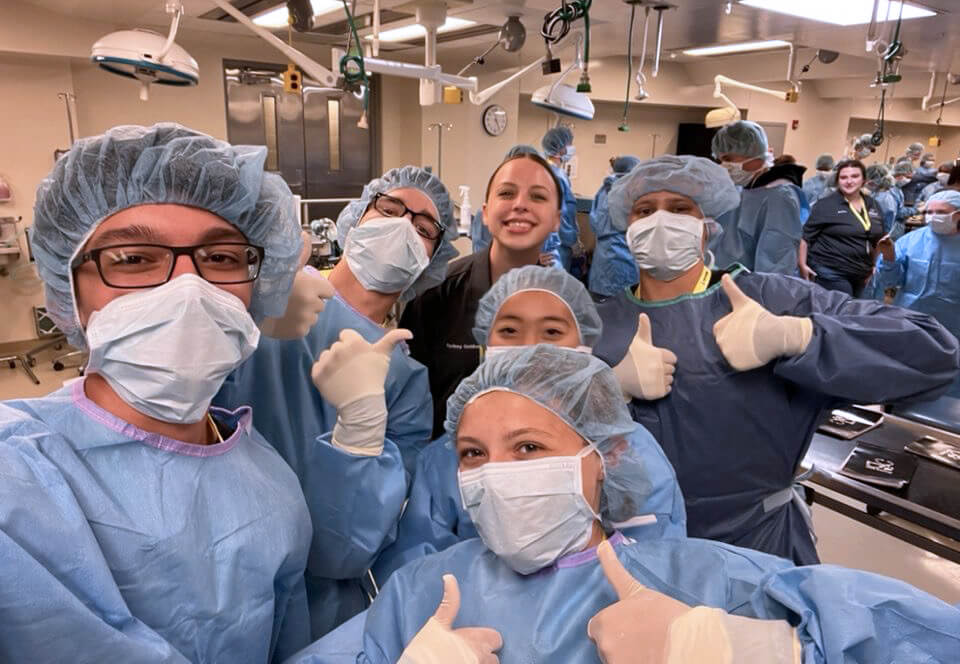
Campers wearing surgical gear give a thumbs up for the camera
In a session called “ABC’s of the OR,” campers learned the importance of proper sterility for surgery by gowning up and wearing surgical gloves.

Reflecting on the experience of serving as a Boiler Vet Camp student assistant, Juli Soda, of the DVM Class of 2025, said, “My favorite part was seeing the enthusiasm of the campers as they watched the surgeries and learned about various other medical procedures in a physical exam by working not only with animal models, but also on each other and other animals.”

Unique due to its immersive, in-residence format, Boiler Vet Camp provided the participants with a preview of the vast array of roles filled by veterinary medical professionals. The success of the camps reflects the support and contributions of a team of faculty and staff with diverse representation, as well as dedicated second- and third-year DVM student camp counselors. A total of 20 veterinary students in the DVM Classes of 2024 and 2025 served as camp counselors. By fueling the campers’ interests and getting them thinking about potential future careers veterinary medicine, the Boiler Vet Camps help expand the pipeline of potential future applicants for veterinary college admission. Boiler Vet Camp is a highly selective program, only accepting about 20% of applicants each year.
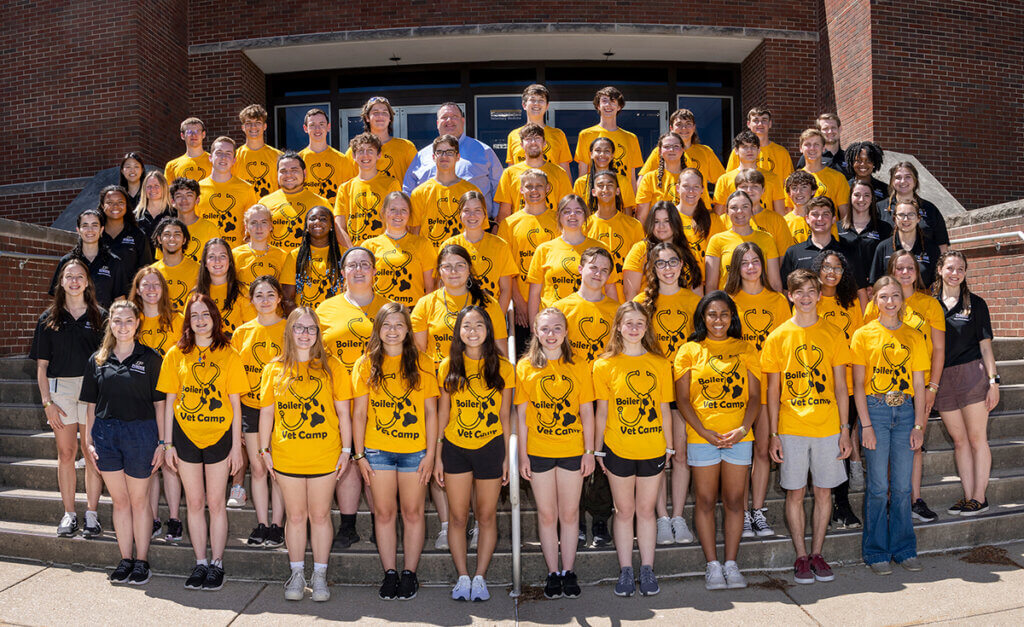
group photo of senior boiler vet campers and leaders
Senior Boiler Vet Camp | Summer 2022

Writer(s): Kevin Doerr | pvmnews@purdue.edu

Recent Stories

“Paws Up” for Jennifer Danaher – brought to you by the PVM Wellness Committee

This week we express our gratitude to Jennifer Danaher, who is department secretary for Veterinary Clinical Sciences.

‘Purdue Pursuits’: A PVM angle on Purdue’s teaching and learning reading groups

Crafting meaningful and engaging course experiences has been at the top of Dielson Vieira’s mind ever since he joined the Purdue University College of Veterinary Medicine’s faculty in 2024. As a clinical assistant professor in the Department of Basic Medical Sciences, Vieira is already adept at applying innovative teaching practices to classroom environments, but that doesn’t stop him from seeking out new ideas, approaches and perspectives — insights he gains through outlets like Purdue’s teaching and learning reading groups.

Top tier biology journal publishes PVM study that unlocks secrets of a drug-resistant fungal pathogen, which causes serious infections in humans

Though the name “Candida auris” is far from a household term, public health experts know it well because the multi-drug-resistant fungal pathogen, which causes serious human infections, has been classified as an urgent threat by the U.S. Centers for Disease Control and Prevention (CDC) Antibiotic Threats Report (2019). Dr. Shankar Thangamani, Associate Professor of Microbiology and University Faculty Scholar in the Purdue University College of Veterinary Medicine’s Department of Comparative Pathobiology, is researching C. auris, aided by a 2.4 million grant from the National Institutes of Health (NIH). New research findings, just published in Nature Microbiology, show how C. auris adapts and evades the immune system.

In Print: ‘Translational Research Methods for Tauopathies’

A just-published 300-page volume edited by Jessica Fortin, Purdue assistant professor in the College of Veterinary Medicine’s Department of Basic Medical Sciences, provides a significant new resource for researchers studying a group of neurodegenerative diseases known as tauopathies. “Translational Research Methods for Tauopathies” provides detailed protocols intentionally selected to serve as a basis for research laboratories seeking to further treatments for such debilitating neurodegenerative diseases as Alzheimer’s and chronic traumatic encephalopathy (CTE).

It’s Almost Here!

Though the annual Purdue Veterinary Conference is almost upon us, there’s still time to register and take advantage of this time-honored College of Veterinary Medicine fall tradition that combines excellent continuing education with fun opportunities for reconnecting with colleagues and classmates, networking, and learning about the latest veterinary trends and products. The 2026 Purdue Veterinary Conference takes place September 23–26 on the Purdue University campus. The annual event has something for everyone, from veterinarians to veterinary technicians, faculty, staff and students.
