
The recently announced Tyler Trent Pediatric Cancer Research Center within the Purdue Institute for Cancer Research has a strong tie to the Purdue University College of Veterinary Medicine through a faculty member in the Department of Veterinary Clinical Sciences. The new center is named in memory of the former graduate and devoted Boilermaker football fan who passed away more than four years ago from the rare bone cancer osteosarcoma. The center will be home to research to cure the disease that claimed Tyler’s life as well as other pediatric cancers.
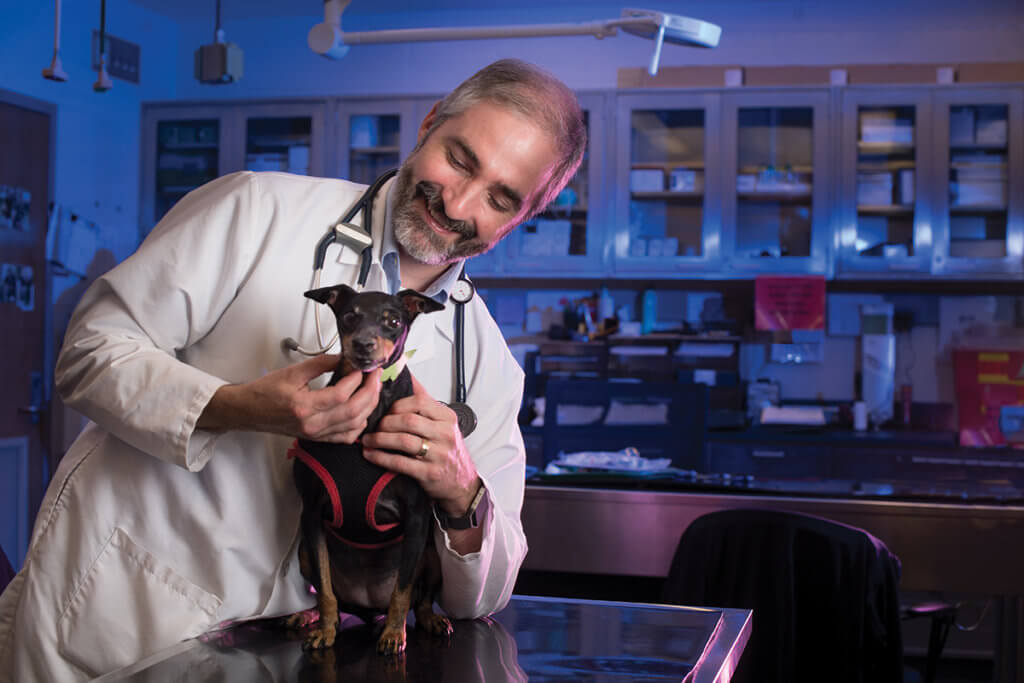
Dr. Michael Childress, professor of comparative oncology, will conduct research as part of the new center. Dr. Childress has been researching osteosarcoma as a member of the Purdue Institute for Cancer Research and is dedicated to what he describes as an urgent cause.
“A third of patients diagnosed with osteosarcoma die from it, and these are mostly adolescents. That’s a real tragedy that speaks to the need to continue to push the envelope and look for new ways to improve the outlook for those patients,” Dr. Childress said. His work targeting fundamental cancer mechanisms has the potential to contribute to the understanding of many forms of cancer and advance their therapies. Dr. Childress currently is working on a prospective drug therapy to target a specific protein that helps drive the progression of osteosarcoma and a number of other cancers in both dogs and humans. His findings hold the potential to advance therapies for those cancers.
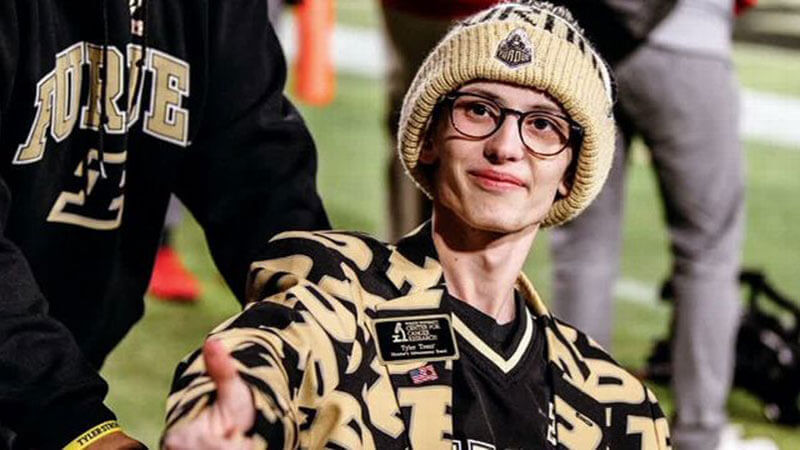
On Saturday, October 14, between quarters of Purdue’s Hammer Down Cancer football game against Ohio State University, Kelly and Tony Trent, Tyler’s parents, helped announce the establishment of the new Tyler Trent Pediatric Cancer Research Center. The announcement coincided with the five-year anniversary of Purdue’s upset win against then-No. 2 OSU, during which Tyler, and his valiant fight against cancer, were shared with a national TV audience. Despite suffering from a great deal of pain toward the end of his cancer battle, Tyler was in the stands for the 2018 game. He had famously predicted an against-the-odds Boilermaker win that day and was overjoyed when Purdue beat OSU 49-20 and the crowd erupted, chanting Tyler’s name.
Tyler died less than three months after that game, but his memory remains very much alive throughout the Purdue campus today. Purdue Institute for Cancer Research Director Andy Mesecar, who is the Walther Professor in Cancer Structural Biology, said Trent’s legacy will live on in the disease-fighting advancements of researchers dedicated to conquering his cancer and other childhood cancers.
“The Purdue Institute for Cancer Research leverages the strengths of faculty and student researchers in specialized areas of engineering, veterinary medicine, nutrition science, chemistry, pharmacy, and biological sciences, applying them in new ways to better understand childhood cancers and develop new diagnostics and treatments,” said Dr. Mesecar, who also is the Distinguished Professor of Biochemistry and assistant vice president for research. “The new Tyler Trent Center and the interdisciplinary research that take place here will set us apart from other pediatric cancer research centers. Our combination of scientific talent is uniquely Purdue. There is really nothing else like this.”
The Trents are inspiring others with their dedication to their son’s legacy. They were among the first to support the research of the new center with a gift of $100,000. Tyler’s mother, Kelly, talked about what the new research center will do to preserve his legacy and turn the sadness of his loss into something productive and meaningful.
“There are hardly words to articulate what this means,” Kelly said. “As a parent who has lost a child, the best gift you can give me is to remember my child and celebrate him. One of Tyler’s passions, as many know, was pediatric cancer research, and to have his name attached to a center doing that work, in his honor, is absolutely priceless! Words and a thank you to the Purdue Cancer Institute are just not enough. Words feel inadequate for how grateful we are as a family.” Donations to the Tyler Trent Pediatric Cancer Research Center may be made online.
