
Three More Years: How Specialized Care Helped Extend One Dog’s Life

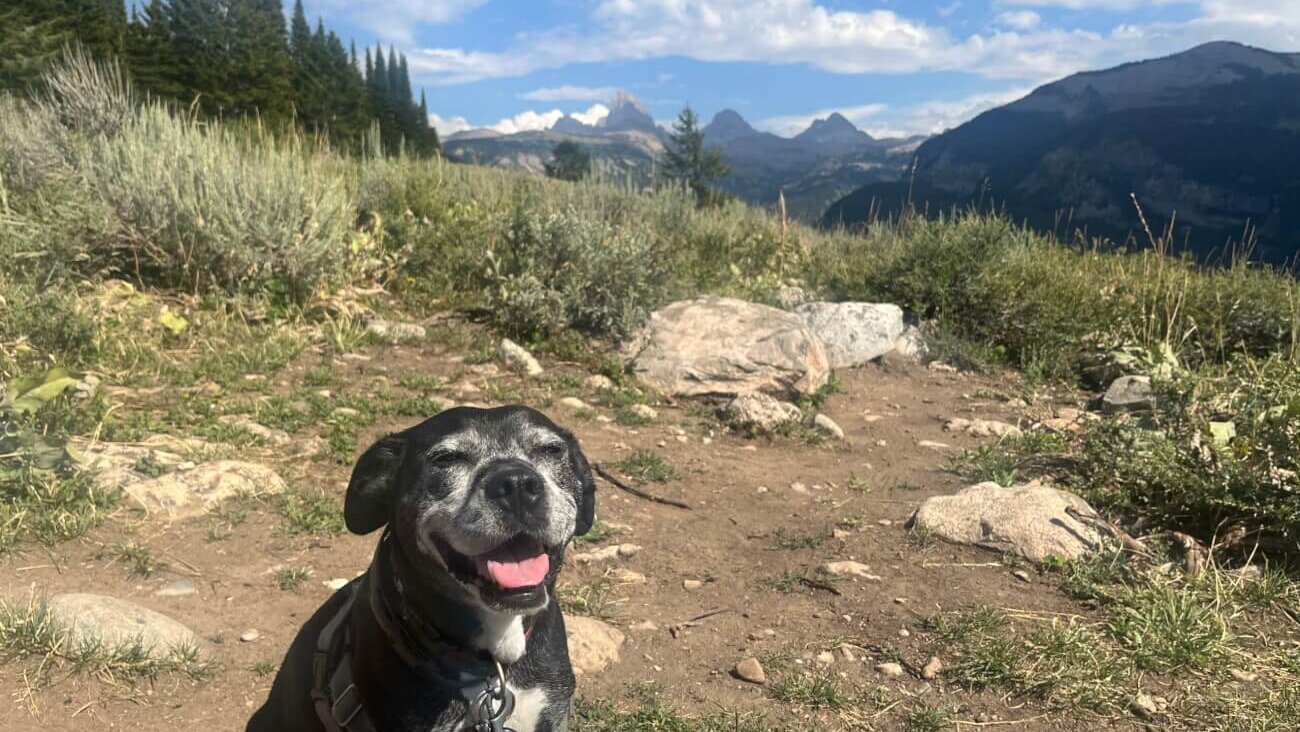
A black dog is pictured in an outdoor, grassy setting with rocks and mountains in the background.
Ella – the pittie beagle mix named after Ella Fitzgerald – as depicted in a photo from one of her many hikes she would take with her human companion, Jennifer.

When Ella, a pittie beagle mix, was diagnosed with bladder cancer at age 11, Jennifer Turner knew she wanted to make every decision count. What she did not yet know was that a cross country drive to Purdue University would give her three more years with the dog she described as her constant companion.

Jennifer, originally from Michigan, had adopted Ella nine years earlier, after the dog was found on the side of a road. She named her after Ella Fitzgerald and sometimes dressed her as the jazz icon for Halloween. Ella had a distinctly human personality. She was highly attuned to people’s emotions and adapted herself to those around her. She was also an avid hiker and rarely strayed from Jennifer’s side.

After moving to Seattle, Jennifer noticed something unusual during a hike. Ella suddenly ate something off the trail — a behavior that was completely out of character. Looking back, Jennifer believes it was as if Ella was trying to force the issue, as though she knew something was wrong and needed attention. Soon after, gastrointestinal upset led to further testing and an unexpected diagnosis. Ella had early-stage bladder cancer.

Surgery at Oregon State University successfully removed a small mass, and Ella was asymptomatic afterward. In assessing whether to opt for chemotherapy as a follow-up treatment, Jennifer began researching other options.  She quickly found Dr. Deborah Knapp at the Purdue University College of Veterinary Medicine in West Lafayette, Indiana. During spring break, shortly after the COVID vaccine became available, Jennifer drove Ella from Seattle to Indiana to be seen by Dr. Knapp, who later shared that Ella was one of only a small number of dogs she had encountered whose bladder cancer was detected at such an early stage. Rather than starting chemotherapy immediately, she recommended close monitoring and Deramaxx, selected to minimize stress on Ella’s other organs.

For Jennifer, the visit brought clarity and relief. “I finally spoke with someone who had managed a case exactly like Ella’s,” she said. “I left Purdue feeling like we had a plan.”

Dr. Knapp agreed to follow Ella’s case remotely, and exchange notes with Jennifer’s local veterinarian. Every six weeks, Ella underwent ultrasounds to monitor for changes. She remained active, fit, and enthusiastic about hiking.

Over time, bloodwork showed kidney stress which could have been related to one of her medications. Adjustments were made, but ultrasounds of the urinary tract eventually revealed tumor growth in a different part of the bladder, in a location where it could not be surgically removed. Jennifer continued returning to Indiana whenever possible to meet with Dr. Knapp.

When Jennifer elected to have Ella receive radiation therapy, she pursued that at Colorado State University, and Ella went there at the end of 2022. Ella tolerated radiation well during the treatment.

As the cancer continued to progress Dr. Knapp recommended chemotherapy. Jennifer was initially afraid, but by that point her trust in the Purdue team was unwavering. Ella received chemotherapy, and continued to enjoy life for several more months.

Unfortunately, over time the cancer spread and became resistant to therapy. Ella passed away in January 2024.

In total, the cancer treatments extended Jennifer’s time with her dog by three years. She describes that time as deeply restorative, made possible by a knowledgeable and compassionate team that allowed her to focus on Ella’s comfort and joy rather than feelings of uncertainty.

Recently, Jennifer shared a small token of gratitude. She had made sweatshirts featuring a photo of Ella on a hike and sent them to Dr. Knapp and members of the oncology team.

The gesture was simple, but it reflected feelings of gratitude that run deep, and the lasting impact of expert care given with heartfelt compassion.

Writer(s): Mackenzie Martin | pvmnews@purdue.edu

Recent Stories

“Paws Up” – brought to you by the PVM Wellness Committee

This week our gratitude goes to Andrea Kellogg, who is the director of Lifelong Learning.

Purdue Veterinary Students Get Up Close View of Veterinary Care at Professional Bull Riding Event

During a weekend dedicated to championship-level competition, students from the Purdue University College of Veterinary Medicine gained a first-hand perspective on a unique aspect of the livestock industry with a behind-the-scenes pass to the Professional Bull Riding event held recently in Indianapolis.  Ram Trucks PBR Indianapolis presented by Cooper Tires was held at Gainbridge Fieldhouse March 21-22, even as first- and second-round NCAA Men’s Basketball Tournament games were held across the country the same weekend.

In Memory – Professor Emeritus of Veterinary Physiology Gerald Bottoms

The Purdue Veterinary Medicine community is deeply saddened to learn that Dr. Gerald D. Bottoms, a longtime faculty member and Professor Emeritus of Veterinary Physiology, passed away on February 24, 2026.  He was 95.

PVM Scholars Recognized at Purdue One Health and Well-Being Research Event

Purdue University’s recent One Health and Well-Being Research Event: A Celebration of Interdisciplinary Health Research, put the spotlight on several scholars in the College of Veterinary Medicine.  The one-day event was organized by the College of Health and Human Sciences in partnership with several other colleges including Purdue Veterinary Medicine. It is estimated that more than 300 people attended the event at the Purdue Memorial Union North and South Ballrooms March 10.

In Memory – Dr. Jeffrey Hanssen (PU DVM ’71)

The College of Veterinary Medicine mourns the passing of an alumnus and longtime practitioner from Greenfield, Indiana. Dr. Jeffrey Hanssen died March 12, 2026, at Brandywine - Brickyard Healthcare Center in Greenfield. He was 71.

Beautiful Spring Lilies Pose Serious Danger to Cats

Spring weather heralds the arrival of the beautiful blooms of true lilies (Lilium sp.) and daylilies (Hemerocallis sp.). Unfortunately, many cats have been poisoned by these lovely plants. The poisoning is so severe and the possible consequences so dire (even death) that in 2021, the FDA issued this warning: “Lilies in the “true lily” and “daylily” families are very dangerous for cats. The entire lily plant is toxic: the stem, leaves, flowers, pollen, and even the water in a vase. Eating just a small amount of a leaf or flower petal, licking a few pollen grains off its fur while grooming, or drinking the water from the vase can cause your cat to develop fatal kidney failure in less than 3 days. The toxin, which only affects cats, has not been identified. Dogs that eat lilies may have minor stomach upset but they don’t develop kidney failure.”

Through study abroad opportunities, Purdue’s Veterinary Technology Distance Learning program is helping students think globally

Promoting animal health is a value that transcends cultures and unites the world. That’s why there are veterinary professionals practicing in nearly every country around the globe. But access to high-quality, affordable veterinary care is far from universal — in many nations, particularly developing nations, access to veterinarians is inconsistent, and affordability is a concern all over the world. To confidently address these issues, veterinary professionals must be able to think globally. That’s why Purdue Veterinary Medicine encourages students to study abroad, including those in the Veterinary Technology Distance Learning Program (VTDL). “Study abroad enriches our online curriculum by bringing classroom concepts to life in a global, real-world context,” said Addison Sheldon, the college’s director of global engagement. The VTDL program offers students the option to study abroad in Guatemala, Japan and Zimbabwe by partnering with local universities and organizations.

Public Invited to Learn about Veterinary Medicine at 2026 PVM Open House April 18

The Purdue University College of Veterinary Medicine will welcome the public for its annual Spring Open House at Lynn Hall on Saturday, April 18, 2026. Scheduled from 9:00 a.m. to 4:00 p.m., the event will feature a hands-on look at the world of veterinary medicine.

Annual Purdue Veterinary Technician Symposium Remains Popular in 12th Year

The enduring popularity of the annual Purdue Veterinary Technician Symposium was evident again this spring as more than 125 participants turned out for the day-long continuing education program in Lynn Hall. The 12th annual symposium on Sunday, March 8, attracted attendees from Indiana and seven other states, including Illinois, Michigan, Wisconsin, South Carolina, Pennsylvania, Alabama and Ohio.

Ruby’s Road to Recovery

When Ruby first came to the Purdue University Veterinary Hospital, she was just nine months old, and her injuries were more complex than when they first appeared. Ruby is a toy poodle and over a month earlier, while playing, she jumped off a couch and fractured both of her front legs. Despite several weeks of treatment with splints and casts, her legs were not healing properly. She had surgery performed on both her front legs and received a bone graft to help speed up the healing process. With meticulous surgical aftercare and a planned series of rechecks, Ruby began her journey to recovery.