
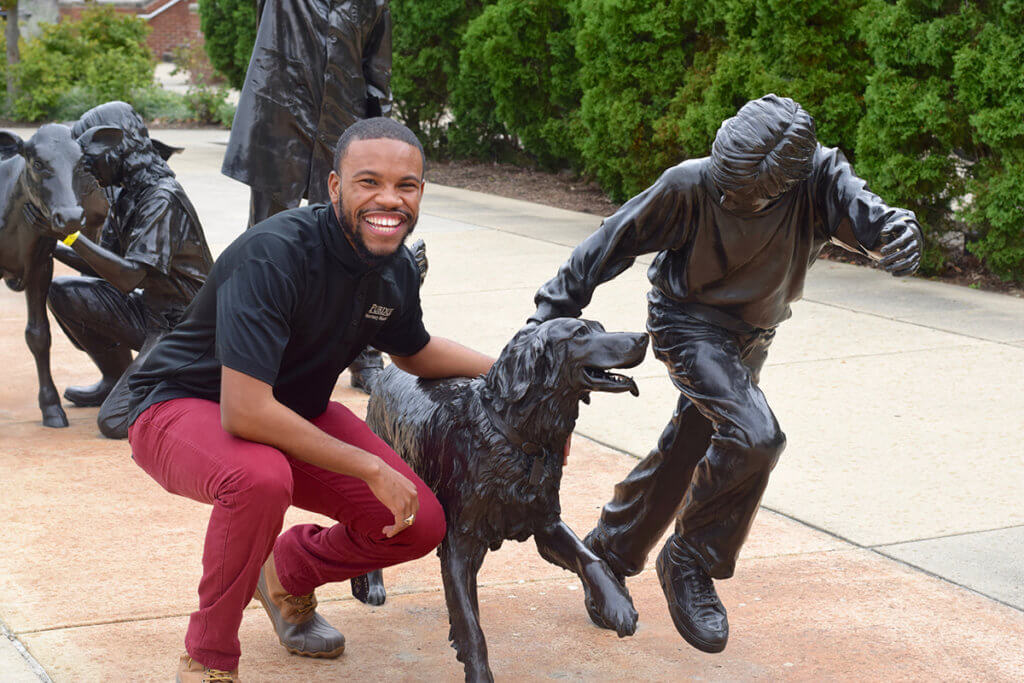
The just-completed interview days for prospective DVM students reminds us of how challenging it is to gain admission to veterinary college. One of Purdue Veterinary Medicine’s most important attributes is its excellent student body. Among our outstanding students are several who have stepped-up to fulfill important leadership roles. Today, the Vet Gazette begins a series of profiles of these student leaders. Our first profile focuses on a student who loves giving back to help others in the same spirit as those who helped him prepare for veterinary school.
Edris Grate is in the DVM Class of 2021. Even as a child, Edris knew he was interested in working with animals. When he was younger, he looked up to Steve Irwin, best known as “The Crocodile Hunter,” and had an interest in zoology because of him.
In addition to being dedicated to his studies, Edris involves himself in many PVM and campus activities. Edris serves as one of the College’s Student Ambassadors, a responsibility that includes giving tours to prospective DVM students. He also works with This is How We ‘Role’ – the program launched by PVM’s Office of Engagement that provides fun and interactive science and math experiences to kids in grades K-4 who are educationally disadvantaged due to socioeconomic status, race, or ethnicity, with the long-term goal of diversifying the veterinarian-scientist workforce. In addition, as president of the Purdue Chapter of VOICE (Veterinarians as One Inclusive Community for Empowerment), Edris seeks to promote diversity and inclusion in the PVM family and the veterinary medical profession. Just last month, the Purdue chapter received the national VOICE organization’s 2018 Programming Excellence Award, as reported in last week’s Vet Gazette.
Edris also willingly gives of his time to support a PVM program that played an important role in his own efforts to gain admission to veterinary school. As a pre-veterinary student, Edris participated in the College’s Access to Animal Related Careers (A2RC) program, which provided a two-week residential campus experience for pre-veterinary students who are historically and currently underrepresented in veterinary medicine to provide a glimpse into the life of a first-year Purdue DVM student. Since then the program has been replaced by VetUp! College, and Edris now serves as a VetUp! student leader. “The forerunner to VetUp! College gave me hands-on experiences and perspectives that really helped prepare me to pursue a career path in veterinary medicine,” Edris said. “Now I really enjoy participating on the other side and helping motivate today’s pre-veterinary students in the same way that I was motivated through this innovative program.”
As a current Purdue veterinary student, Edris is seeking to gain a better idea of the specific veterinary medical career path that he wants to pursue. Outside of his academics, Edris likes to “help others who aren’t here yet, get here.” He is trying to accomplish this goal through his work with VetUp! and This is How We ‘Role.’ Edris is excited to be studying toward his Doctor of Veterinary Medicine degree at Purdue University, but he is especially proud of Purdue’s efforts to bring diversity and inclusion to the College and the veterinary medical profession. “It’s from the top down, not just one person, but the institution as a whole,” Edris commented. Characterizing VetUp! College as a one-of-a-kind program, Edris emphasized that this program is unique to Purdue, but the first of many at other veterinary colleges. VetUp! College is part of the newly established “Vet Up!™ The National Health Careers Opportunity Program (HCOP) Academy for Veterinary Medicine.” Funded with a nearly $3.2 million grant from the Health Resources and Services Administration, an agency of the U.S. Department of Health and Human Services, VetUp! is designed to provide opportunities and support for equity-minded individuals from disadvantaged backgrounds to enter the veterinary profession and serve society by advancing public health, ensuring food safety, or serving rural areas. PVM was the only veterinary college to receive support through the grant program.
For Edris, volunteering to be a student leader and college ambassador on top of coping with the rigorous academic demands of the veterinary curriculum is natural because of his passion for helping others and making a difference. In doing so, he is a true reflection of the qualities that make PVM’s student body exceptional.
