
Spotlights in AVMA Journals Showcase Purdue Veterinary Education and Research

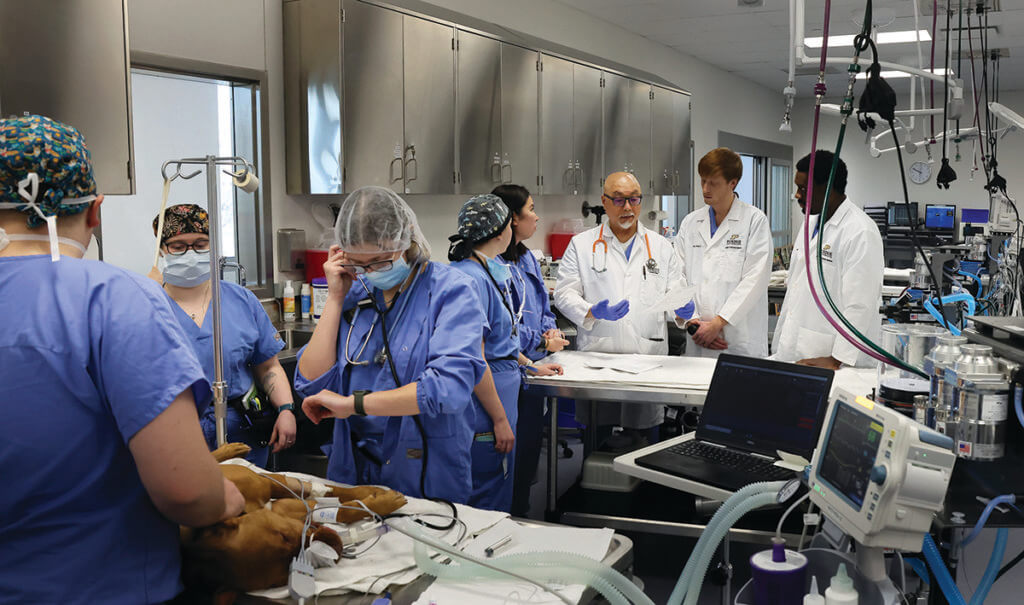
The veterinary team anesthetizes a dog on a table in the foreground while Dr. Ko instructs students at the table in the background.
This photo used in the JAVMA article about Purdue veterinary education shows members of the veterinary team collaborating in the new David and Bonnie Brunner Small Animal Hospital’s anesthesiology induction area.

As part of a series of feature articles, the American Veterinary Medical Association (AVMA) is highlighting education and research at the Purdue University College of Veterinary Medicine in articles published recently in JAVMA (Journal of the American Veterinary Medical Association) and AJVR (American Journal of Veterinary Research). The journals introduced “Spotlight” in July as a new regular feature that each month highlights several colleges of veterinary medicine accredited by the Council on Education.  Purdue Veterinary Medicine was chosen to be featured in the March 2023 issues of the two journals.

The article on Purdue veterinary education in JAVMA carries the subtitle, “Purdue’s Legacy of Leading in Graduating Career Ready Veterinarians.” It explains that graduating practice-ready veterinarians who have the foundation to pursue any veterinary career path they choose, is a hallmark of the college. The article goes on to detail how, with advanced technology, new and innovative approaches to learning, and state-of-the-art facilities, that trait is stronger now than ever.

The spotlight feature on the college’s animal health research published in AJVR is subtitled, “Purdue’s Comparative Approach to Advancing Animal Health.” The article emphasizes that, “since its opening in 1959, the college has built an enduring legacy of research that seeks to improve the understanding and treatment of animal diseases while also advancing human medicine.” The feature then gives examples of the college’s areas of research, including comparative oncology and equine sports medicine. 

The Spotlight series articles are written by authors at each college, working with an editorial team. The Purdue articles were written by Kevin Doerr, director of public affairs and communications, who worked with the editorial committee of Dr. S. Kathleen Salisbury, associate dean for academic affairs; Dr. Harm HogenEsch, associate dean for research; Dr. Sandra San Miguel, associate dean for engagement; and Dean Willie Reed. The articles had to meet strict manuscript standards, including limits on word counts and images, in order to be accepted for publication. 

Click here to view the article in JAVMA.  Click here to view the AJVR article. The Spotlight feature series is one of a number of innovations and changes that have been implemented in the journals by Dr. Lisa Fortier, editor-in-chief of JAVMA and AJVR and AVMA division director of publications. Dr. Fortier said the idea behind the series is to give all of the colleges the opportunity to share their innovations in the clinical preparation of the next generation of veterinarians, as well as their novel research programs that are significantly impacting animal health or welfare. The journals now boast circulation to over 100,000 readers. 

Writer(s): Kevin Doerr | pvmnews@purdue.edu

Recent Stories

“Paws Up” for Jennifer Danaher – brought to you by the PVM Wellness Committee

This week we express our gratitude to Jennifer Danaher, who is department secretary for Veterinary Clinical Sciences.

‘Purdue Pursuits’: A PVM angle on Purdue’s teaching and learning reading groups

Crafting meaningful and engaging course experiences has been at the top of Dielson Vieira’s mind ever since he joined the Purdue University College of Veterinary Medicine’s faculty in 2024. As a clinical assistant professor in the Department of Basic Medical Sciences, Vieira is already adept at applying innovative teaching practices to classroom environments, but that doesn’t stop him from seeking out new ideas, approaches and perspectives — insights he gains through outlets like Purdue’s teaching and learning reading groups.

Top tier biology journal publishes PVM study that unlocks secrets of a drug-resistant fungal pathogen, which causes serious infections in humans

Though the name “Candida auris” is far from a household term, public health experts know it well because the multi-drug-resistant fungal pathogen, which causes serious human infections, has been classified as an urgent threat by the U.S. Centers for Disease Control and Prevention (CDC) Antibiotic Threats Report (2019). Dr. Shankar Thangamani, Associate Professor of Microbiology and University Faculty Scholar in the Purdue University College of Veterinary Medicine’s Department of Comparative Pathobiology, is researching C. auris, aided by a 2.4 million grant from the National Institutes of Health (NIH). New research findings, just published in Nature Microbiology, show how C. auris adapts and evades the immune system.

In Print: ‘Translational Research Methods for Tauopathies’

A just-published 300-page volume edited by Jessica Fortin, Purdue assistant professor in the College of Veterinary Medicine’s Department of Basic Medical Sciences, provides a significant new resource for researchers studying a group of neurodegenerative diseases known as tauopathies. “Translational Research Methods for Tauopathies” provides detailed protocols intentionally selected to serve as a basis for research laboratories seeking to further treatments for such debilitating neurodegenerative diseases as Alzheimer’s and chronic traumatic encephalopathy (CTE).

It’s Almost Here!

Though the annual Purdue Veterinary Conference is almost upon us, there’s still time to register and take advantage of this time-honored College of Veterinary Medicine fall tradition that combines excellent continuing education with fun opportunities for reconnecting with colleagues and classmates, networking, and learning about the latest veterinary trends and products. The 2026 Purdue Veterinary Conference takes place September 23–26 on the Purdue University campus. The annual event has something for everyone, from veterinarians to veterinary technicians, faculty, staff and students.