
Senior Veterinary Technologist Students Celebrate Success with Senior Project Presentations

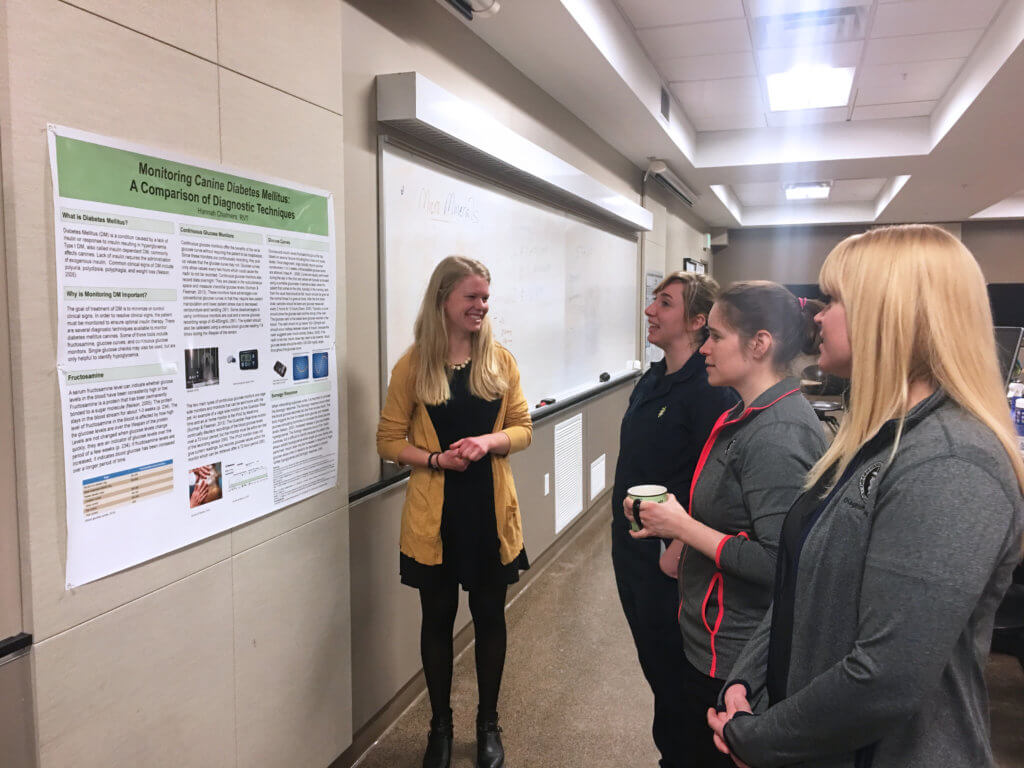
Hannah Chalmers pictured “Monitoring Canine Diabetes Mellitus: A Comparison of Diagnostic Techniques” was the title of the capstone project poster presented by Hannah Chalmers, RVT.
Brenna Hiday pictured

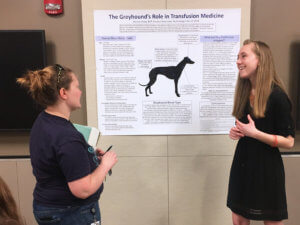
Brenna Hiday, RVT, discusses the capstone project she completed as a senior veterinary technologist student on the topic, “The Greyhound’s Role in Transfusion Medicine.”

Senior veterinary technologist students celebrated their program completion by presenting their capstone projects as the spring semester drew to a close. The students had the opportunity to give a lecture style presentation or share their project in a poster session.

The capstone presentation represents the final result of months of planning and preparation.  “Students must pick a topic of interest in the fall semester, find a mentor, and devote 80 clinical hours to learn about their project,” explained Dr. Bianca Zenor, director of the Veterinary Technology Program.  The capstone project is one of the differentiating tasks that separates Bachelor of Science students from Associate in Applied Science students.  “The project requires self-motivation and discipline, enables students to build relationships with mentors, allows them to be subject matter experts in their topic, and builds their communication skills through their presentation,” Dr. Zenor said.
Emily Mullins pictured

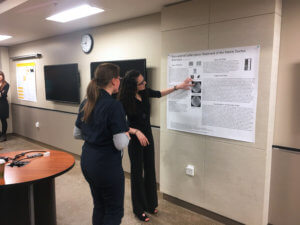
Senior veterinary technologist student Emily Mullins, RVT, points out an image on the poster she prepared about her capstone project on “Trans-arterial Catheterization Treatment of the Patent Ductus Arteriosus.”

The PowerPoint presentations were held on April 11 and 18.  A poster session was held April 25.  A new aspect this year involved the senior students presenting their projects to second-year students during Grand Rounds.  This is the first year that senior students presented to an audience outside of their assigned class.  “This allowed the opportunity for them to teach and motivate the second-year students on what will be their future project,” Dr. Zenor said.  “Both the PowerPoint and poster sessions were standing room only and drew a large number of faculty and staff from supporting departments.  Seeing the success of these students should make everyone involved in the Veterinary Nursing program very proud of our newest colleagues!”
senior veterinary technologist students pictured

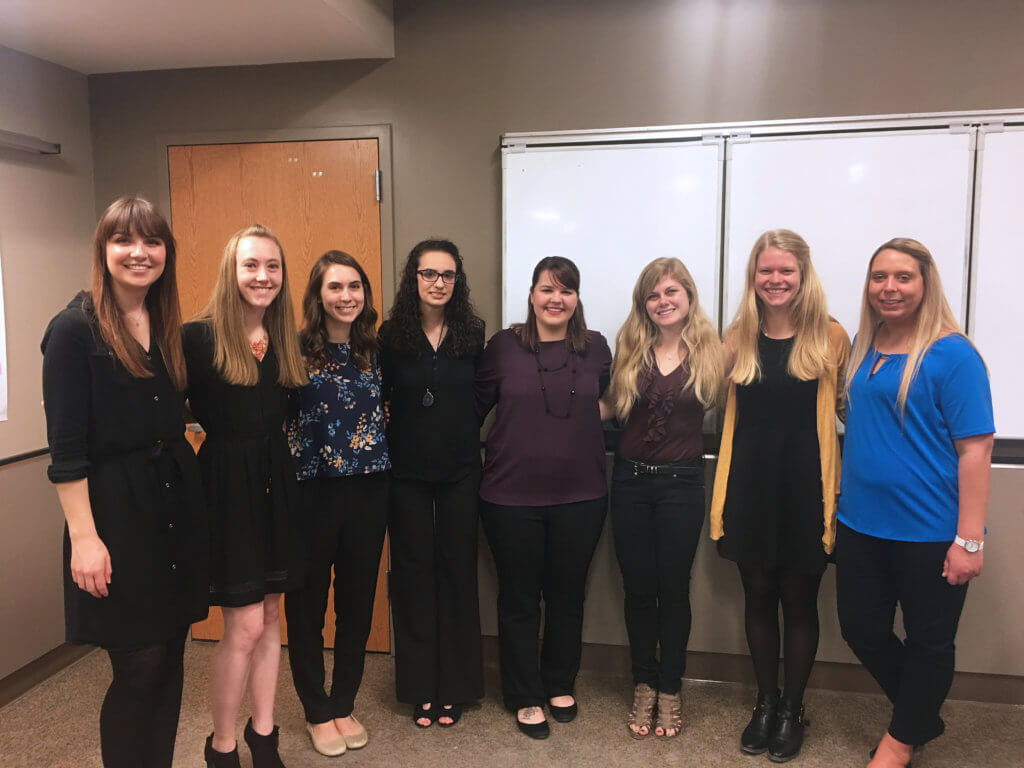
Senior veterinary technologist students who gave capstone presentations: (left – right) Hailey Parr, RVT; Brenna Hiday, RVT; Amanda Gillespie, RVT; Emily Mullins, RVT; Sierra Church, RVT; Molly Roberts, RVT; Hannah Chalmers, RVT; and Lindsey Wann, RVT.

Writer(s): Bianca Zenor | pvmnews@purdue.edu

Recent Stories

“Paws Up” for Jennifer Danaher – brought to you by the PVM Wellness Committee

This week we express our gratitude to Jennifer Danaher, who is department secretary for Veterinary Clinical Sciences.

‘Purdue Pursuits’: A PVM angle on Purdue’s teaching and learning reading groups

Crafting meaningful and engaging course experiences has been at the top of Dielson Vieira’s mind ever since he joined the Purdue University College of Veterinary Medicine’s faculty in 2024. As a clinical assistant professor in the Department of Basic Medical Sciences, Vieira is already adept at applying innovative teaching practices to classroom environments, but that doesn’t stop him from seeking out new ideas, approaches and perspectives — insights he gains through outlets like Purdue’s teaching and learning reading groups.

Top tier biology journal publishes PVM study that unlocks secrets of a drug-resistant fungal pathogen, which causes serious infections in humans

Though the name “Candida auris” is far from a household term, public health experts know it well because the multi-drug-resistant fungal pathogen, which causes serious human infections, has been classified as an urgent threat by the U.S. Centers for Disease Control and Prevention (CDC) Antibiotic Threats Report (2019). Dr. Shankar Thangamani, Associate Professor of Microbiology and University Faculty Scholar in the Purdue University College of Veterinary Medicine’s Department of Comparative Pathobiology, is researching C. auris, aided by a 2.4 million grant from the National Institutes of Health (NIH). New research findings, just published in Nature Microbiology, show how C. auris adapts and evades the immune system.

In Print: ‘Translational Research Methods for Tauopathies’

A just-published 300-page volume edited by Jessica Fortin, Purdue assistant professor in the College of Veterinary Medicine’s Department of Basic Medical Sciences, provides a significant new resource for researchers studying a group of neurodegenerative diseases known as tauopathies. “Translational Research Methods for Tauopathies” provides detailed protocols intentionally selected to serve as a basis for research laboratories seeking to further treatments for such debilitating neurodegenerative diseases as Alzheimer’s and chronic traumatic encephalopathy (CTE).

It’s Almost Here!

Though the annual Purdue Veterinary Conference is almost upon us, there’s still time to register and take advantage of this time-honored College of Veterinary Medicine fall tradition that combines excellent continuing education with fun opportunities for reconnecting with colleagues and classmates, networking, and learning about the latest veterinary trends and products. The 2026 Purdue Veterinary Conference takes place September 23–26 on the Purdue University campus. The annual event has something for everyone, from veterinarians to veterinary technicians, faculty, staff and students.