
Scientists study how service dogs help veterans cope with PTSD

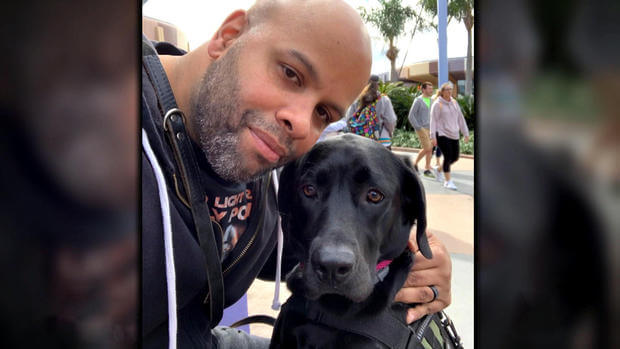
Army Sgt. Carlos Cruz with Hannah   CBS NEWS
Army Sgt. Carlos Cruz with Hannah   CBS NEWS

 To say retired Army Sgt. Carlos Cruz depends heavily on his service dog, Hannah, is an understatement. Cruz was diagnosed with post-traumatic stress disorder after returning from service in northern Afghanistan where he hunted for enemy explosive devices.

He acquired Hannah in January 2018 and says he’s thankful for her every day. “It’s amazing what she does for me,” Cruz told CBS News. “I don’t even know how she knows half the time. It’s like an unspoken language, I guess you could say.”

Scientists say there may be more to it than that.

About a 100 veterans and their service dogs are being studied by researchers at Purdue University of Indiana. As part of the unprecedented study, Cruz collected his saliva three times a day for three straight days this month to test his stress hormones.

He also dons a wrist-band to track vital signs Hannah may actually be affecting and Hannah gets tracked, too. They’ll be tested again in the summer.

“I think there are people out there who question whether or not service dogs actually help and they are looking for numbers and science,” Dr. Maggie O’Haire told CBS News. O’Haire leads the Organization for Human-Animal Interaction Research and Education, a research group at Purdue that has undertaken this project.

O’Haire and her team are trying to find out if there is a chemical reaction service dogs ignite in their owners and vice versa — findings which could say for certain that dogs can help and why.

Cruz can’t define it, but he knows Hannah helps.

“Sometimes just feeling her heartbeat and her breathing helps to calm me,” he said.

Watch the whole story at Scientists study how service dogs help veterans cope with PTSD on CBSnews.com.

Recent Stories

“Paws Up” – brought to you by the PVM Wellness Committee

Behind the scenes, Alicia Williams has been making PVM a kinder, stronger place.

Purdue Veterinary Medicine Computational Biologist Uses Big Data, AI and Math to Find Patterns in Cancer

With recent advances, cancer research now generates vast amounts of information. The data could help researchers detect patterns in cancer cells and stop their growth, but the sheer volume is just too much for the human mind to digest. Enter Nadia Lanman, research associate professor in the Department of Comparative Pathobiology, whose expertise in computational biology helps researchers at Purdue University distill solutions from the sea of numbers.

Purdue to Host Fourth Annual Antimicrobial Conference in February

With leadership by the Purdue University College of Veterinary Medicine, the Fourth Annual Conference on Antimicrobial Resistance (AMR) will be held at Purdue University West Lafayette February 25–26, 2026. With multidrug-resistant infections on the rise globally, this event brings together experts and practitioners across the spectrum of human, animal, and environmental health to address one of today’s most urgent public health challenges.

PVM Well-represented by Humans and Animals During Annual Homecoming Celebrations

Every fall, Boilermakers from near and far return to the campus in West Lafayette for the annual ritual known as Homecoming. And Purdue’s Homecoming events also attract plenty of non-alumni who are Purdue fans, patrons, prospective students, or clients of the Purdue University Veterinary Hospital. During this year’s Homecoming weekend October 24-25, Purdue Veterinary Medicine engaged with attendees in multiple ways, with the help of some furry companions.

Purdue University and Akston Biosciences Bring “First Dose of Hope” in New Cancer Immunotherapy Trial for Dogs with Urinary Bladder Cancer

The Purdue University College of Veterinary Medicine, in partnership with Akston Biosciences Corporation, has initiated the enrollment of dogs with urinary bladder cancer in a clinical trial of a pioneering immunotherapy. The strategic partnership between Purdue and Akston was announced in August after the underlying technology was developed at the College of Veterinary Medicine and the Purdue Institute for Cancer Research (PICR).

“Paws Up” – brought to you by the PVM Wellness Committee

Today we share appreciation for Beth Laffoon, MS, RVT, and Holly McCalip, BS, RVT, who are both instructional technologists in the Veterinary Nursing Program.

MMAS Symposium Brings Participants Face to Face with Specialists and Species from Parrots to Pocket Pets

Thanks to Purdue Veterinary Medicine’s Exotic Animal Club and dedicated faculty, staff and students, nearly 100 in-person and on-line participants got a chance recently to gain valuable knowledge and insight about the Medicine of Mammalian and Avian Species. The two-day educational event known as the MMAS Symposium is a biennial conference, and the 2024 edition held in Lynn Hall November 9 and 10 featured an impressive program that included 22 lectures and several hands-on labs, organized into two tracks focusing on avian and mammalian species.

Veterinary Boilermakers Take Part in Purdue One Health Alumni Reunion

Purdue University College of Veterinary Medicine faculty, staff and students turned out for Purdue University’s first One Health Alumni Reunion, which was held on the West Lafayette campus November 14-16. They joined more than 150 Boilermakers from a variety of medical professions who came together to network and participate in timely discussions with Purdue President Mung Chiang, First Lady Kei Hui and fellow alumni.