
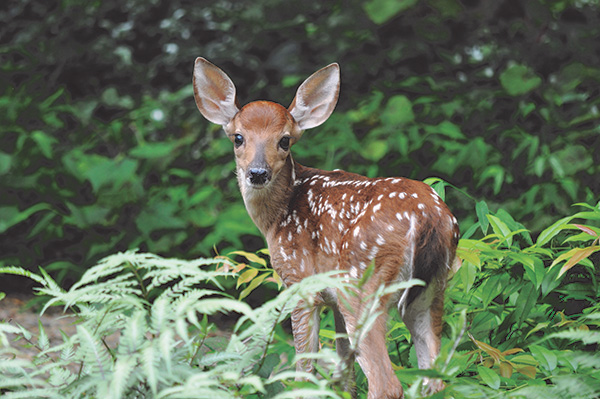
Rare Case Leads ADDL Resident to First-time Discovery in White-tailed Deer

White Tail Deer


When Dr. Andrea Vanderpool (PU DVM 2004), resident in anatomic pathology at the Indiana Animal Disease Diagnostic Laboratory, received a biopsy submission of a farmed deer in Indiana, she wasn’t aware she was looking at a landmark discovery.

The deer died from chronic bacterial pneumonia, which is common, but the referring veterinarian noticed that the deer’s front and rear limbs were swollen as well. The swelling wasn’t edema, although edema would have made sense as a symptom resulting from pneumonia. In this case, it was bony thickening of all four limbs.

Hypertrophic osteopathy was the eventual diagnosis. There is no previous record of this condition being seen in a white-tailed deer. Commonly seen in dogs, and sometimes humans, hypertrophic osteopathy occurs when lesions in the lungs lead to production of new bone on the distal limbs. “There are a number of theories why this might occur,” said Dr. Vanderpool, “but why something in the chest leads to increased growth factors in the limbs is still unknown.”

There are very few known cases of hypertrophic osteopathy in other deer species, with one reported in a deer species in Europe.

“That this is even a possibility is fascinating to the veterinary community,” said Dr. Vanderpool. “It helps to know that this is an entity that exists in deer, and that we might look out for symptoms in our cases moving forward.”

Dr. Vanderpool earned her Purdue DVM degree in 2004. Following graduation, she worked in small animal private practice in Indiana and Tennessee, before returning to Purdue to begin her residency and graduate teaching assistantship in the Department of Comparative Pathobiology.

Writer(s): Lauren Bruce | pvmnews@purdue.edu

Recent Stories

“Paws Up” – brought to you by the PVM Wellness Committee

This week, we are proud to recognize Lorraine Fox, who is a business assistant with the Veterinary Medicine Procurement Center.

PVM Interview Days Move College Closer to Admitting the DVM Class of 2030

After a total of three afternoons dedicated to conducting in-person interviews with 226 prospective veterinary students, the Purdue University College of Veterinary Medicine is close to completing the process of admitting 84 members of the incoming first-year DVM class – the Class of 2030.  The students invited for the interview days were selected from a total pool of 1,930 applicants from across the country as well as countries abroad.

Experts to Gather at Purdue for Conference Addressing the Public Health Threat of Antimicrobial Resistance

The ongoing challenges posed by multi-drug resistant infections will be the focus of a multidisciplinary conference taking place in three weeks at Purdue University.  The Fourth Annual Conference on Antimicrobial Resistance is set for February 25–26, 2026 at Purdue’s Stewart Center in West Lafayette. Registration is still open for the event, which will bring together scientists and scholars from human and veterinary medicine, public health, research, and industry to address the determinants, dynamics and deterrence of drug resistance.

PVM’s Upcoming Coppoc One Health Lecture to Focus on Dogs as Sentinels of Environmental Exposure

The Purdue University College of Veterinary Medicine brings a leading One Health scholar to campus each year to address vital health issues from a One Health perspective as part of the Coppoc One Health Lecture series.  This year’s presentation, scheduled for February 26 in Lynn Hall Room 2026, is on the engaging topic, “One Health at Home: Dogs as Sentinels of Environmental Exposure.” The speaker will be Audrey Ruple, DVM, MS, PhD, DACVPM, MRCVS, the Dorothy A. and Richard G. Metcalf Professor of Veterinary Medical Informatics at the Virginia-Maryland College of Veterinary Medicine at Virginia Tech.

“Paws Up” – brought to you by the PVM Wellness Committee

Today we are happy to acknowledge our Student Success Center Team.

One Health: A ‘digital twin’ model for predicting cancer outcomes

The striking similarities between invasive bladder cancer in dogs and humans have fueled research advances for more than three decades. Most of that work has looked at separate aspects of the disease — risk factors, early detection, symptoms, treatment and gene expression. But a new project at Purdue University that combines many types of available data in a “digital twin” model of bladder cancer may prove powerful enough to predict patient outcomes, starting with the probability of metastasis.

Purdue Professor Emeritus Bill Blevins Wins Lifetime Achievement Award at ACVR Annual Meeting

The American College of Veterinary Radiology (ACVR) gave its esteemed Lifetime Achievement Award for 2024 to Purdue Professor Emeritus Bill Blevins, who is well known to countless Purdue Veterinary Medicine alumni for the expertise he taught them about all things Diagnostic Imaging during his long Purdue career.