
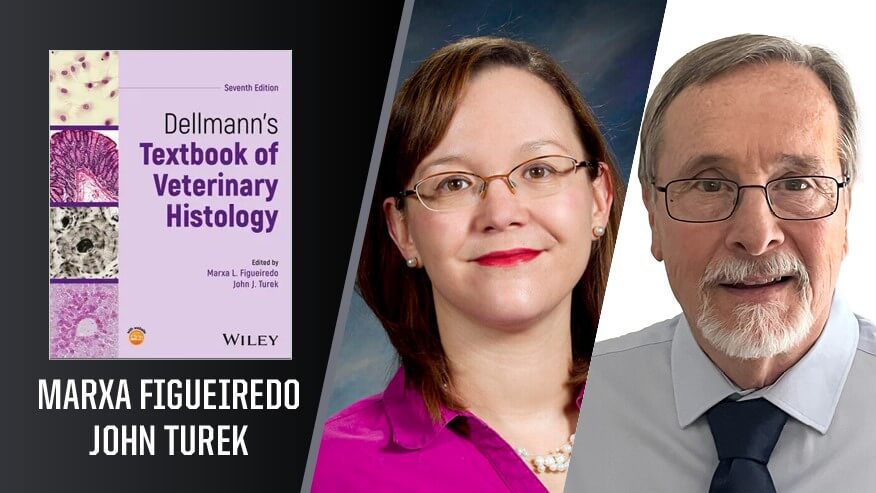
A new edition of a time-tested and influential veterinary work is on the market thanks to the scholarly efforts of two Purdue Veterinary Medicine faculty members and their team of U.S. and international experts from multiple veterinary schools. “Dellmann’s Textbook of Veterinary Histology” is an essential resource connecting the microscopic world of cells and tissues to the broader understanding of anatomy and physiology in domestic animals. Co-edited by Drs. Marxa Figueiredo and John Turek, associate professor and professor emeritus, respectively, in the college’s Department of Basic Medical Sciences, this latest edition integrates high-resolution electron and color micrographs with updated content that reflects current scientific and clinical knowledge.
Dr. Figueiredo said, “This is a high impact project supported by the Purdue Books Initiative, and a very exciting development for the college and the BMS Department.” Purdue’s connection to the work even was spotlighted this week in Purdue Today.
Many chapters of the book draw from the college’s own tissue slides, images, and teaching materials, resources developed over years of educating Purdue veterinary and graduate students. A companion website with some 800 high-resolution color images offers new and updated illustrations to enhance learning. Designed for veterinary and biomedical graduate students, the textbook also supports students in veterinary nursing/veterinary technology, veterinary researchers, and professionals in practice seeking a reliable and comprehensive resource on the subject.
About the Purdue Authors
In addition to serving on the Department of Basic Medical Sciences faculty as an associate professor, Dr. Figueiredo is the Dean’s Fellow for Graduate Programs in the College of Veterinary Medicine. Her research lab focuses on discovering how bones and immune systems interact and uses this knowledge to create next-generation therapies for cancer and inflammatory diseases. Her leadership in editing this textbook reflects her commitment to bridging foundational science with clinical relevance.
The title of professor emeritus was conferred on Dr. Turek upon his retirement as a member of the Department of Basic Medical Sciences faculty in 2024, following a long and illustrious Purdue career. His pioneering research used biodynamic imaging to analyze intact 3D tumor tissue for predicting personalized cancer drug responses more accurately than traditional genetic or cell culture methods. His extensive contributions to histology education and his involvement in this edition ensure that students learn from a legacy of innovation.
Dr. Figueiredo also points out the key contributions and collaborative efforts of two additional Purdue Veterinary Medicine faculty members. Dr. Eli Asem, professor of physiology in the Basic Medical Sciences Department, was a co-author with Dr. Turek on the chapter on the Endocrine System; and Dr. Joanne Messick, professor of veterinary clinical pathology in the Department of Comparative Pathobiology, was a returning author from the 6th edition of the book, and authored the Blood and Bone Marrow chapter. Other contributors were from veterinary schools across the U.S. and around the world.
The publisher, Wiley, says of the book, “In the newly revised seventh edition of ‘Dellmann’s Textbook of Veterinary Histology’, a team of distinguished veterinary professionals delivers a comprehensive update on the function of cells, tissues and organs in domestic animal species. It effectively bridges the gap between anatomy and physiology and is filled with high-quality electron micrograph and color micrograph images.”
The newly published work was featured Monday, September 22, in Purdue Today, as part of a weekly book series designed to celebrate Purdue faculty members’ excellence in scholarship by highlighting faculty expertise across diverse subjects and disciplines. Find out more about the Purdue University Books Initiative and how to suggest a book for Purdue Today’s “In Print” series on the Office of the Provost website.
