
PVM Scholar Featured in Purdue Today Series on Inventors and Innovators

Dr. Riyi Shi


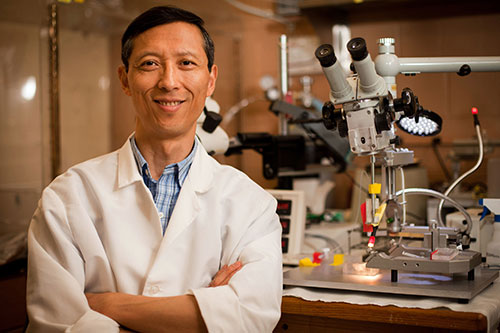
Dr. Riyi Shi, professor of neuroscience and biomedical engineering in Purdue Veterinary Medicine’s Department of Basic Medical Sciences and the Weldon School of Biomedical Engineering, was in the spotlight Friday, January 26, as part of a series in the Purdue Today e-newsletter on inventors and innovators. Noting that Purdue graduates continue to develop innovations and breakthroughs that help move the world forward, Purdue Today reports that it is highlighting these inventors and innovators by featuring two each month in the newsletter and on social media.

In a feature last Friday, January 26, Dr. Shi was showcased as a medical scientist specializing in uncovering the mechanisms of central nervous system trauma and diseases and instituting new treatments through innovative experimentation and pioneering new strategies in the field. His research contributions include originating the use of double sucrose gap technique for recording action potential conduction, establishing the methods of neuronal membrane resealing by polyethylene glycol (PEG), and identifying acrolein as a key pathological factor in spinal cord injury and multiple sclerosis.

Dr. Shi graduated from Shanghai Jiao Tong University and the University of North Texas before earning his PhD at Purdue in developmental neurobiology. Along with retired PVM Mari Hulman George Professor of Applied Neuroscience Richard Borgens and former PVM Professor Andrew Blight, Dr. Shi contributed to the development of the Ampyra drug, the first and only FDA-approved drug to help multiple sclerosis patients improve their ability to walk and other motor skills.

The Purdue Inventors & Innovators website contains Purdue alumni from business and industry; technology; medicine and health; and the food and consumer industries. Click here to view the site, including information about Dr. Shi.

Recent Stories

Purdue Veterinary Medicine Fosters Learning and Engagement linking people, animals and agriculture at Indiana State Fair

In just more than two weeks’ time during the month of August, the 2026 Indiana State Fair served up an abundance of fun, food, and festivities, and in the midst of it all, faculty, staff and students from the Purdue University College of Veterinary Medicine were visible and vibrant participants. Purdue Veterinary Medicine representatives made a difference in a variety of ways, from providing veterinary care for the animals on the fairgrounds, to helping animal agriculture organizations as volunteers, to conducting veterinary checks on animals at the annual 4-H State Fair Dog Show and Cat Show.

“Paws Up” for Jennifer Danaher – brought to you by the PVM Wellness Committee

This week we express our gratitude to Jennifer Danaher, who is department secretary for Veterinary Clinical Sciences.

‘Purdue Pursuits’: A PVM angle on Purdue’s teaching and learning reading groups

Crafting meaningful and engaging course experiences has been at the top of Dielson Vieira’s mind ever since he joined the Purdue University College of Veterinary Medicine’s faculty in 2024. As a clinical assistant professor in the Department of Basic Medical Sciences, Vieira is already adept at applying innovative teaching practices to classroom environments, but that doesn’t stop him from seeking out new ideas, approaches and perspectives — insights he gains through outlets like Purdue’s teaching and learning reading groups.

Top tier biology journal publishes PVM study that unlocks secrets of a drug-resistant fungal pathogen, which causes serious infections in humans

Though the name “Candida auris” is far from a household term, public health experts know it well because the multi-drug-resistant fungal pathogen, which causes serious human infections, has been classified as an urgent threat by the U.S. Centers for Disease Control and Prevention (CDC) Antibiotic Threats Report (2019). Dr. Shankar Thangamani, Associate Professor of Microbiology and University Faculty Scholar in the Purdue University College of Veterinary Medicine’s Department of Comparative Pathobiology, is researching C. auris, aided by a 2.4 million grant from the National Institutes of Health (NIH). New research findings, just published in Nature Microbiology, show how C. auris adapts and evades the immune system.

In Print: ‘Translational Research Methods for Tauopathies’

A just-published 300-page volume edited by Jessica Fortin, Purdue assistant professor in the College of Veterinary Medicine’s Department of Basic Medical Sciences, provides a significant new resource for researchers studying a group of neurodegenerative diseases known as tauopathies. “Translational Research Methods for Tauopathies” provides detailed protocols intentionally selected to serve as a basis for research laboratories seeking to further treatments for such debilitating neurodegenerative diseases as Alzheimer’s and chronic traumatic encephalopathy (CTE).