
PVM Hosts Successful Iverson Bell Midwest Regional Diversity Summit

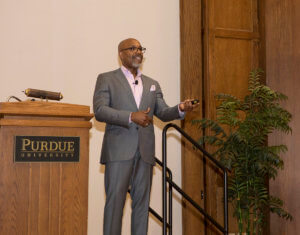
Glenn E. Singleton pictured

Glenn E. Singleton gives the keynote address in the Purdue Memorial Union South Ballroom at the start of the Iverson Bell Midwest Regional Diversity Summit.

Nearly 120 faculty, staff, and students from eleven universities across the country attended the Iverson Bell Midwest Regional Diversity Summit held at Purdue University May 18 – 20.  The biennial event is a collaboration among the colleges and schools of veterinary medicine at Purdue, Michigan State University, the University of Minnesota, The Ohio State University, and the University of Wisconsin, with additional sponsorship by Zoetis.

The summit kicked off at lunch Friday, May 18, with a keynote address by Glenn E. Singleton, founder of the Pacific Education Group, which seeks to achieve racial equity in education.  The author of Courageous Conversations about Race: A Field Guide for Achieving Equity in Schools (2006), a protocol for sustained, deep dialog, Singleton has devoted more than 30 years to constructing racial equity worldwide and developing leaders to do the same.
Iverson Bell Midwest Regional Diversity Summit workshop pictured

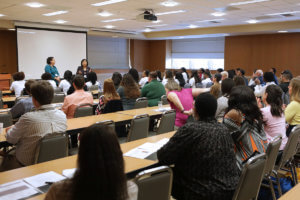
Iverson Bell Midwest Regional Diversity Summit participants listen to facilitators Anna Yeakley, program director for the Intergroup Relations Program at UCLA, and Kathleen Wong(Lau), San Jose State’s chief diversity officer, during the start of afternoon workshops on Friday, May 18.

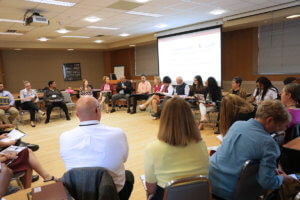
Kathy Wong (Lau), chief diversity officer at San Jose State University, and Anna Yeakley, Intergroup Relations Program director at UCLA served as facilitators for the summit, which included workshops focused on the theme of “Courageous ConversationsTM”.  Purdue Veterinary Medicine faculty members also assisted as facilitators for different tracks.  Summit participants were able to choose between the topics of “Diversity Curriculum Infusion – in the Classroom,” facilitated by Dr. Henry Green; “Student Affairs for a Multicultural Environment – Institutional Framework,” facilitated by Dr. Susan Mendrysa; and “Putting Inclusion into the Institutional Culture,” facilitated by Drs. Kathy Salisbury and Sandy San Miguel.
Dr. Kathy Salisbury facilitates track during summit

“Putting Inclusion into the Institutional Culture” is the title of a track facilitated by Drs. Kathleen Salisbury and Sandy San Miguel during the Iverson Bell Midwest Regional Diversity Summit.

Additional sessions included Intergroup Dialogue Skills and a panel discussion featuring students, staff, and faculty.  Throughout the event, participants took time to develop role play scenarios to demonstrate how to have both planned and spontaneous, courageous conversations in the context of the curriculum, student affairs, and institutional culture.  The summit concluded with group presentations and role play in Lynn 1136.

Besides the attendees from Purdue and the collaborating veterinary schools and colleges, participants also came from Oklahoma State University, the University of Georgia, Tuskegee University, the University of California – Davis, the University of Florida and the University of Illinois.

Writer(s): Kevin Doerr | pvmnews@purdue.edu

Recent Stories

“Paws Up” for Jennifer Danaher – brought to you by the PVM Wellness Committee

This week we express our gratitude to Jennifer Danaher, who is department secretary for Veterinary Clinical Sciences.

‘Purdue Pursuits’: A PVM angle on Purdue’s teaching and learning reading groups

Crafting meaningful and engaging course experiences has been at the top of Dielson Vieira’s mind ever since he joined the Purdue University College of Veterinary Medicine’s faculty in 2024. As a clinical assistant professor in the Department of Basic Medical Sciences, Vieira is already adept at applying innovative teaching practices to classroom environments, but that doesn’t stop him from seeking out new ideas, approaches and perspectives — insights he gains through outlets like Purdue’s teaching and learning reading groups.

Top tier biology journal publishes PVM study that unlocks secrets of a drug-resistant fungal pathogen, which causes serious infections in humans

Though the name “Candida auris” is far from a household term, public health experts know it well because the multi-drug-resistant fungal pathogen, which causes serious human infections, has been classified as an urgent threat by the U.S. Centers for Disease Control and Prevention (CDC) Antibiotic Threats Report (2019). Dr. Shankar Thangamani, Associate Professor of Microbiology and University Faculty Scholar in the Purdue University College of Veterinary Medicine’s Department of Comparative Pathobiology, is researching C. auris, aided by a 2.4 million grant from the National Institutes of Health (NIH). New research findings, just published in Nature Microbiology, show how C. auris adapts and evades the immune system.

In Print: ‘Translational Research Methods for Tauopathies’

A just-published 300-page volume edited by Jessica Fortin, Purdue assistant professor in the College of Veterinary Medicine’s Department of Basic Medical Sciences, provides a significant new resource for researchers studying a group of neurodegenerative diseases known as tauopathies. “Translational Research Methods for Tauopathies” provides detailed protocols intentionally selected to serve as a basis for research laboratories seeking to further treatments for such debilitating neurodegenerative diseases as Alzheimer’s and chronic traumatic encephalopathy (CTE).

It’s Almost Here!

Though the annual Purdue Veterinary Conference is almost upon us, there’s still time to register and take advantage of this time-honored College of Veterinary Medicine fall tradition that combines excellent continuing education with fun opportunities for reconnecting with colleagues and classmates, networking, and learning about the latest veterinary trends and products. The 2026 Purdue Veterinary Conference takes place September 23–26 on the Purdue University campus. The annual event has something for everyone, from veterinarians to veterinary technicians, faculty, staff and students.