
PVM Graduate Student Awarded Second Place at 2021 AAVLD Diagnostic Pathology Slide Seminar

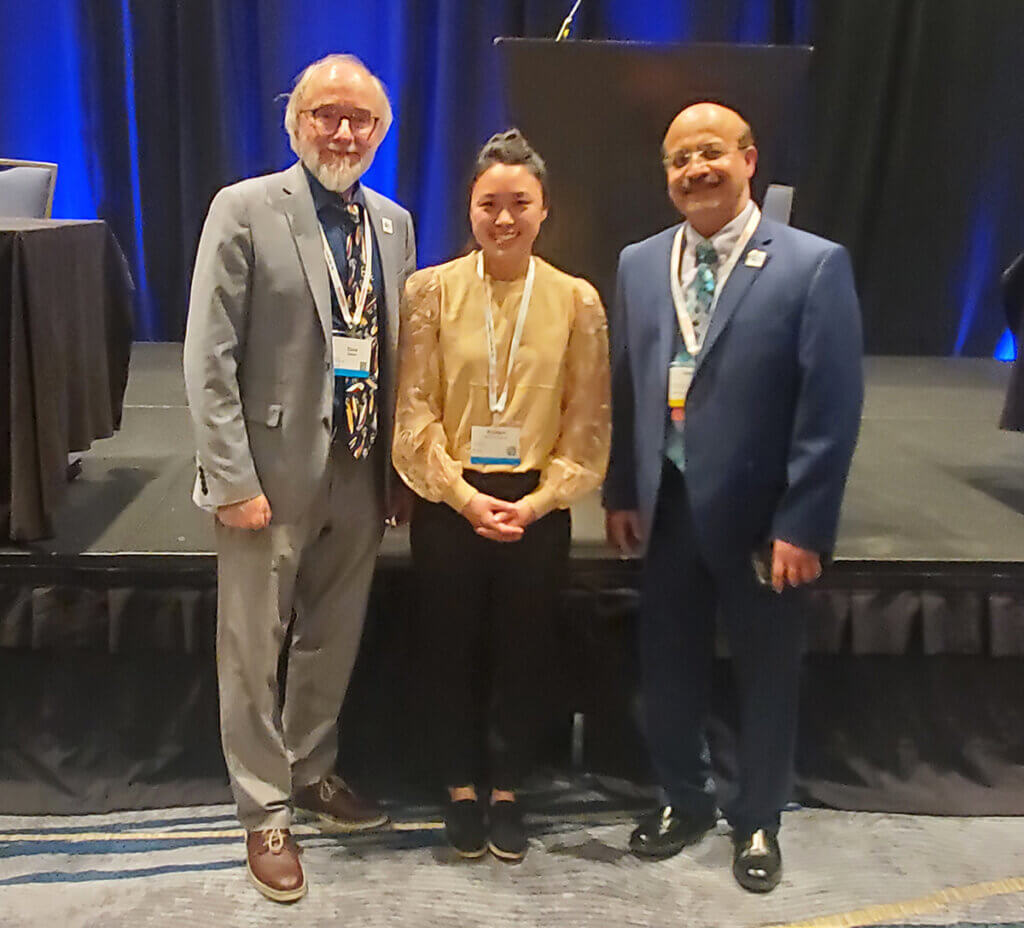
Kristen stands in between David and Deepanker in front of the stage
Dr. Kristen Hill-Thimmesch is joined by AAVLD Executive Director David Zeman and Immediate Past President Deepanker Tewari at the AAVLD annual meeting.

The American Association of Veterinary Laboratory Diagnosticians (AAVLD) recognized two Purdue Veterinary Medicine graduate students, Dr. Kristen Hill-Thimmesch and Dr. Daniela Peña, at its annual meeting last month.  Both are residents in the Department of Comparative Pathobiology and the Animal Disease Diagnostic Laboratory. Dr. Peña, a microbiology resident who received the Brenda Love Best Student Bacteriology Poster Award for her diagnostic microbiology research on Salmonella, was featured in last week’s Vet Gazette. This week, we are spotlighting Dr. Hill-Thimmesch, who received the second place award as part of the 2021 Diagnostic Pathology Slide Seminar for her presentation titled, “Multiple Viral Agents in Racing Pigeons.” An award of up to $300 was given to the three residents delivering the best diagnostic slide seminar presentation.

Meet Dr. Kristen Hill-Thimmesch

Dr. Kristen Hill-Thimmesch joined the Department of Comparative Pathobiology in September 2017 as a poultry diagnostic medicine resident.  Her residency was under the mentorship of Dr. Pat Wakenell, who is now professor emerita, Dr. Tsang-Long Lin, professor of veterinary pathology and head of the ADDL Avian and Aquatic Section, and Dr. Geoff Lossie, clinical assistant professor of pathology and avian diagnostician. 
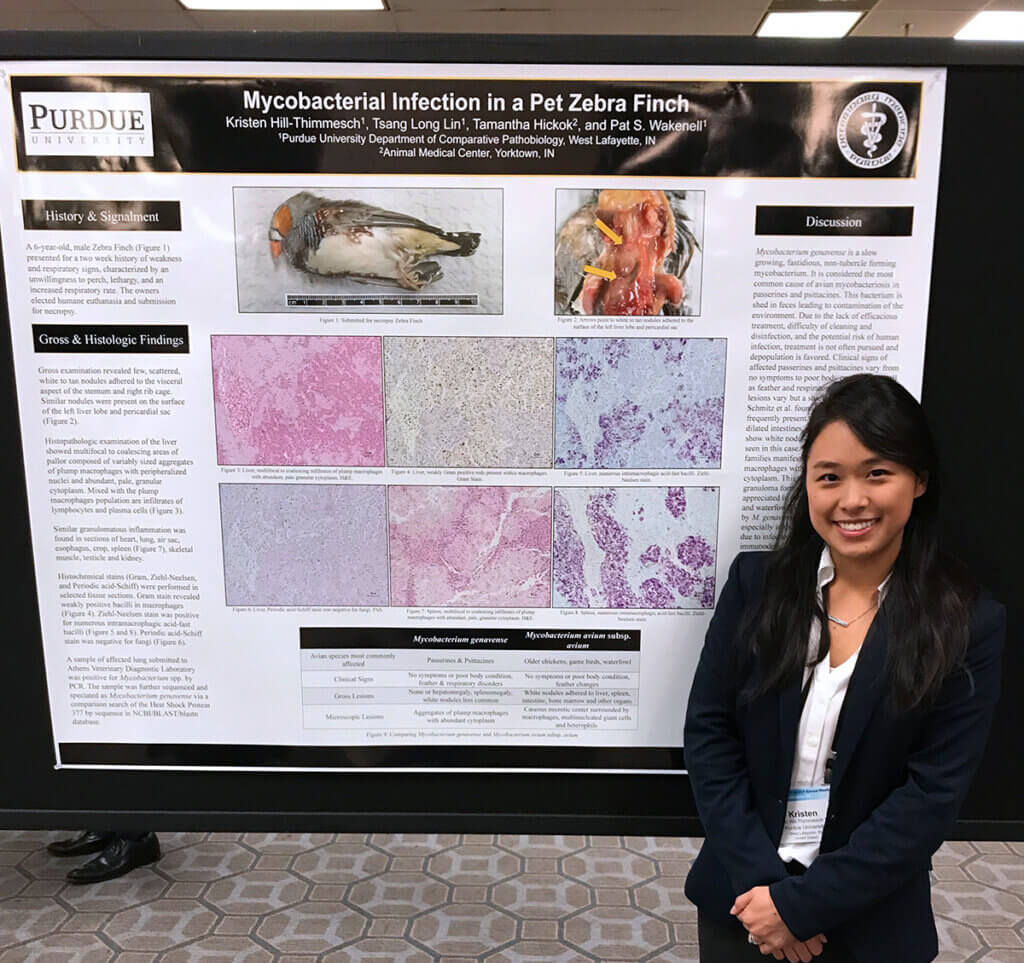
Kristen smiles as she stands beside her displayed poster
Dr. Kristen Hill-Thimmesch stands beside her research poster entitled, “Mycobacterial Infection in a Pet Zebra Finch.”

Upon completing her poultry residency, she was accepted as an anatomic pathology resident at Purdue and is following a program prescribed by the American College of Veterinary Pathologists (ACVP) that includes diagnostic pathology service in the ADDL, diagnostic research, and teaching assignments. Her anatomic pathology residency is under the mentorship of Dr. Abigail Cox, associate professor of veterinary anatomic pathology, Dr. Nobuko Wakamatsu-Utsuki, clinical associate professor and anatomic pathologist, and Dr. Lin.

In addition to her outstanding accomplishment at the AALVD Conference, Dr. Hill-Thimmesch also has passed the American College of Poultry Veterinarians (ACPV) certification exam and is now approved for diplomate status in the ACPV. Additionally, she has passed Phase I of the American College of Veterinary Pathologists exam and plans to take Phase II in August 2022. Before beginning her residencies, Dr. Hill-Thimmesch visited Purdue University as part of her fourth year clinical rotation as a poultry extern. She earned her DVM degree from Iowa State University with a focus on poultry health and medicine. Her career goal is to become a diplomate of both the ACPV and the ACVP and work in an animal disease diagnostic laboratory.

Writer(s): Madeline Brod, PVM Communications Intern | pvmnews@purdue.edu

Recent Stories

“Paws Up” for Jennifer Danaher – brought to you by the PVM Wellness Committee

This week we express our gratitude to Jennifer Danaher, who is department secretary for Veterinary Clinical Sciences.

‘Purdue Pursuits’: A PVM angle on Purdue’s teaching and learning reading groups

Crafting meaningful and engaging course experiences has been at the top of Dielson Vieira’s mind ever since he joined the Purdue University College of Veterinary Medicine’s faculty in 2024. As a clinical assistant professor in the Department of Basic Medical Sciences, Vieira is already adept at applying innovative teaching practices to classroom environments, but that doesn’t stop him from seeking out new ideas, approaches and perspectives — insights he gains through outlets like Purdue’s teaching and learning reading groups.

Top tier biology journal publishes PVM study that unlocks secrets of a drug-resistant fungal pathogen, which causes serious infections in humans

Though the name “Candida auris” is far from a household term, public health experts know it well because the multi-drug-resistant fungal pathogen, which causes serious human infections, has been classified as an urgent threat by the U.S. Centers for Disease Control and Prevention (CDC) Antibiotic Threats Report (2019). Dr. Shankar Thangamani, Associate Professor of Microbiology and University Faculty Scholar in the Purdue University College of Veterinary Medicine’s Department of Comparative Pathobiology, is researching C. auris, aided by a 2.4 million grant from the National Institutes of Health (NIH). New research findings, just published in Nature Microbiology, show how C. auris adapts and evades the immune system.

In Print: ‘Translational Research Methods for Tauopathies’

A just-published 300-page volume edited by Jessica Fortin, Purdue assistant professor in the College of Veterinary Medicine’s Department of Basic Medical Sciences, provides a significant new resource for researchers studying a group of neurodegenerative diseases known as tauopathies. “Translational Research Methods for Tauopathies” provides detailed protocols intentionally selected to serve as a basis for research laboratories seeking to further treatments for such debilitating neurodegenerative diseases as Alzheimer’s and chronic traumatic encephalopathy (CTE).

It’s Almost Here!

Though the annual Purdue Veterinary Conference is almost upon us, there’s still time to register and take advantage of this time-honored College of Veterinary Medicine fall tradition that combines excellent continuing education with fun opportunities for reconnecting with colleagues and classmates, networking, and learning about the latest veterinary trends and products. The 2026 Purdue Veterinary Conference takes place September 23–26 on the Purdue University campus. The annual event has something for everyone, from veterinarians to veterinary technicians, faculty, staff and students.