
PVM Cancer Researcher Speech Highlights Purdue Inventors’ Reception

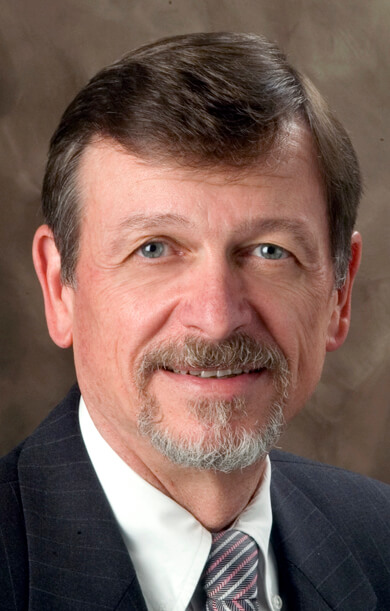
Dr. Ratliff pictured
Dr. Timothy Ratliff, distinguished professor of comparative pathobiology in the College of Veterinary Medicine and the Robert Wallace Miller Director of the Purdue University Center for Cancer Research

Dr. Timothy Ratliff, a Purdue Veterinary Medicine faculty member who helps lead Purdue’s efforts to find treatments and potential cures for cancer, served as the featured speaker at an event honoring the University’s inventors who received a patent in the most recent fiscal year.  The Purdue’s Inventors Recognition Reception, an annual event held February 6, celebrated innovation at the University.  Several PVM faculty members are among those who received patents in 2017-18. 

Dr. Ratliff, distinguished professor of comparative pathobiology in the College of Veterinary Medicine and the Robert Wallace Miller Director of the Purdue University Center for Cancer Research, works with professors and researchers from across the University to translate basic research into lifesaving treatments.  “Working with world-class researchers to discover new ways to treat and eradicate cancer while enhancing the lives of those touched by this devastating disease is truly a lifetime commitment for all involved,” Dr. Ratliff said. “In this endeavor, we are bringing together the best minds and using the highest level of technology and fundamental science to accomplish things that could not be done without collaboration to make a profound impact on those touched by this terrible disease.”  Dr. Ratliff, who lost his father and father-in-law to cancer, said some of the current research being done at Purdue focuses on immunotherapy, chemotherapy sensitivity, nanoparticle development, and drug discovery. 

Receivers of patents in 2017-18 included the following Purdue Veterinary Medicine faculty members and professor emeritus:

  • Dr. Harm HogenEsch, associate dean for research and professor in the Department of Comparative Pathobiology
  • Dr. James F. Leary, professor emeritus in the Department of Basic Medical Sciences
  • Dr. Sophie A. Leliévre, professor in the Department of Basic Medical Sciences; co-leader of the Drug Discovery and Molecular Sensing Program, Purdue University Center for Cancer Research; and scientific director, 3D Cell Culture Core (3D3C) facility
  • Dr. Joanne B. Messick, professor in the Department of Comparative Pathobiology
  • Dr. Timothy Ratliff, Distinguished Professor of Comparative Pathobiology in the Department of Comparative Pathobiology; Robert Wallace Director of the Purdue University Center for Cancer Research
  • Dr. Mohamed Seleem, professor of microbiology in the Department of Comparative Pathobiology
  • Dr. John J. Turek, professor in the Department of Basic Medical Sciences
  • Dr. Sherry L. Voytik-Harbin, professor in the Department of Basic Medical Sciences and Weldon School of Biomedical Engineering

Click here to read a complete news release about the Purdue’s Inventors Recognition Reception, which includes a complete listing of honored Purdue faculty members.

Writer(s): Chris Adam, Purdue Research Foundation, and Kevin Doerr | pvmnews@purdue.edu

Recent Stories

“Paws Up” for Jennifer Danaher – brought to you by the PVM Wellness Committee

This week we express our gratitude to Jennifer Danaher, who is department secretary for Veterinary Clinical Sciences.

‘Purdue Pursuits’: A PVM angle on Purdue’s teaching and learning reading groups

Crafting meaningful and engaging course experiences has been at the top of Dielson Vieira’s mind ever since he joined the Purdue University College of Veterinary Medicine’s faculty in 2024. As a clinical assistant professor in the Department of Basic Medical Sciences, Vieira is already adept at applying innovative teaching practices to classroom environments, but that doesn’t stop him from seeking out new ideas, approaches and perspectives — insights he gains through outlets like Purdue’s teaching and learning reading groups.

Top tier biology journal publishes PVM study that unlocks secrets of a drug-resistant fungal pathogen, which causes serious infections in humans

Though the name “Candida auris” is far from a household term, public health experts know it well because the multi-drug-resistant fungal pathogen, which causes serious human infections, has been classified as an urgent threat by the U.S. Centers for Disease Control and Prevention (CDC) Antibiotic Threats Report (2019). Dr. Shankar Thangamani, Associate Professor of Microbiology and University Faculty Scholar in the Purdue University College of Veterinary Medicine’s Department of Comparative Pathobiology, is researching C. auris, aided by a 2.4 million grant from the National Institutes of Health (NIH). New research findings, just published in Nature Microbiology, show how C. auris adapts and evades the immune system.

In Print: ‘Translational Research Methods for Tauopathies’

A just-published 300-page volume edited by Jessica Fortin, Purdue assistant professor in the College of Veterinary Medicine’s Department of Basic Medical Sciences, provides a significant new resource for researchers studying a group of neurodegenerative diseases known as tauopathies. “Translational Research Methods for Tauopathies” provides detailed protocols intentionally selected to serve as a basis for research laboratories seeking to further treatments for such debilitating neurodegenerative diseases as Alzheimer’s and chronic traumatic encephalopathy (CTE).

It’s Almost Here!

Though the annual Purdue Veterinary Conference is almost upon us, there’s still time to register and take advantage of this time-honored College of Veterinary Medicine fall tradition that combines excellent continuing education with fun opportunities for reconnecting with colleagues and classmates, networking, and learning about the latest veterinary trends and products. The 2026 Purdue Veterinary Conference takes place September 23–26 on the Purdue University campus. The annual event has something for everyone, from veterinarians to veterinary technicians, faculty, staff and students.