
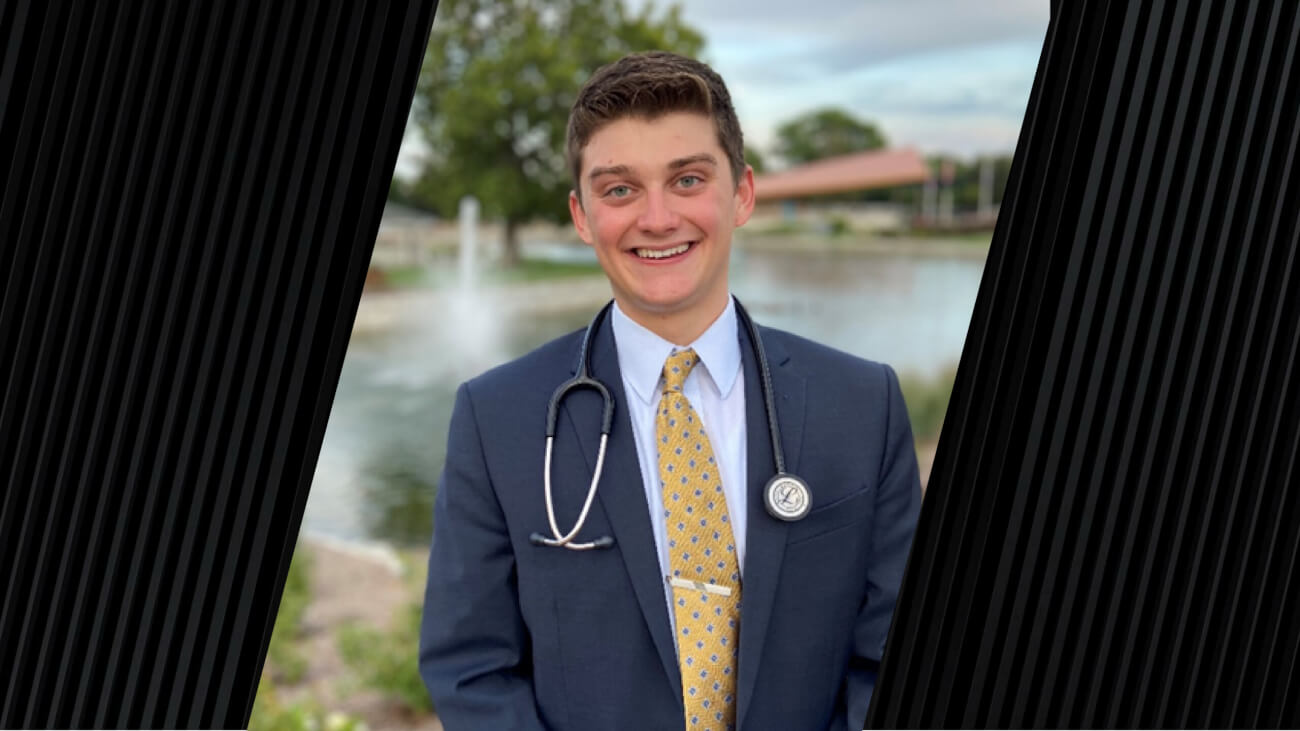
Purdue Veterinary Student Named as National Theriogenology Scholarship Recipient

Devon Anderson, Purdue DVM Class of 2025

Congratulations to Devon Anderson, of the Purdue DVM Class of 2025, who recently was notified that he has been selected as one of just four recipients of the prestigious Nandi Theriogenology Scholarship. The award, given by the Society for Theriogenology, recognizes exceptional veterinary students from across North America who have demonstrated a strong commitment to the field of theriogenology — the study of animal reproduction.

Hailing from Brownsburg, Indiana, Anderson came to Purdue as an undergraduate student, earning a Bachelor of Science degree in Animal Sciences with a concentration in biosciences. He chose to continue his academic journey at Purdue to pursue his DVM degree, attracted by the College of Veterinary Medicine’s location and close-knit community.

“I chose Purdue University for my DVM degree because it is close to home and has small class sizes,” Anderson said. “Through my veterinary student career, I truly made connections with my professors and clinicians, who became incredible mentors and close colleagues.”

Anderson’s passion for theriogenology — particularly in large animals and equine medicine — began during his undergraduate years. He immersed himself in reproductive physiology coursework and took part in research focused on estrous synchronization priming in beef heifers. He further pursued his interests during veterinary school through targeted courses and clinical rotations.

“My initial interest in theriogenology developed during my undergraduate degree program,” he explained. “There is honestly no better feeling than to pull a live calf during a case of dystocia, or to breed a mare and see the fetus on a transrectal ultrasound.”
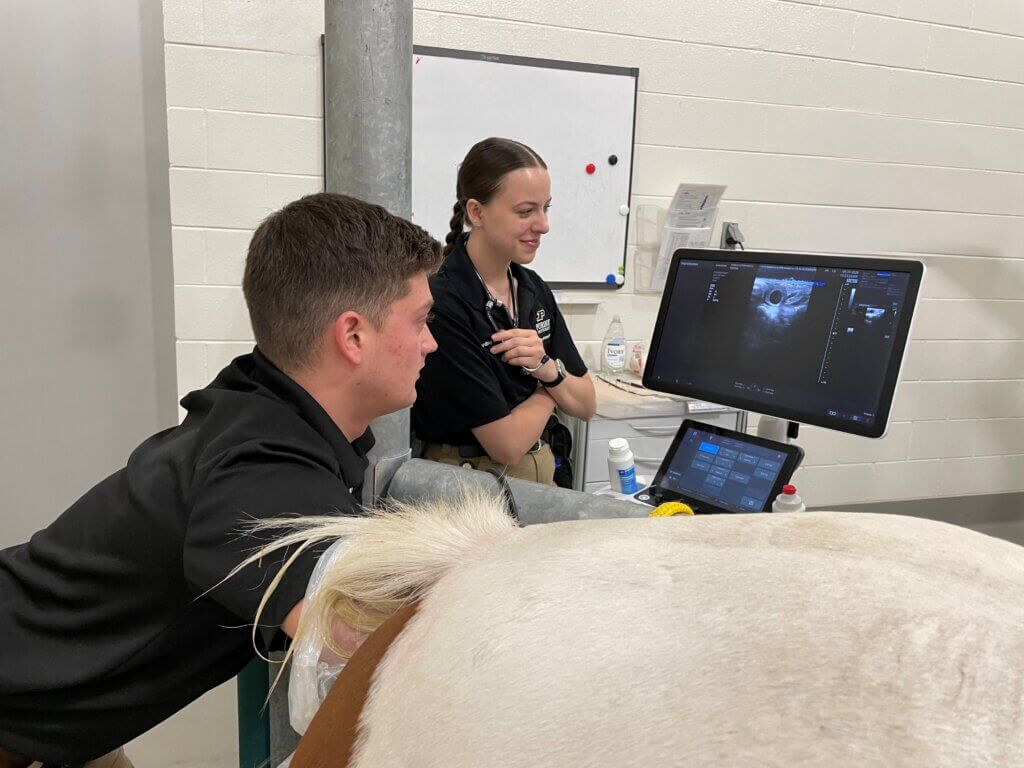
Fourth-year veterinary student Devon Anderson performs transrectal ultrasound to diagnose a pregnancy in a Pony, while classmate Sydney Gehlhausen assists by screen capturing ultrasound images.

Anderson’s dedication to the field of theriogenology will continue post-graduation as he begins a Large Animal Rotating Internship at Purdue in June 2025, with aspirations of completing a residency to become a board-certified theriogenologist.

Dr. Bethany Funnell, clinical associate professor of bovine theriogenology, said Anderson’s selection as a Nandi Scholarship recipient is a wonderful reflection on him and PVM’s theriogenology program. “This scholarship award involves a highly competitive selection process, and it is a tremendous honor for Devon to be chosen as a recipient,” Dr. Funnell explained.

The Nandi Theriogenology Scholars Program, administered by the Theriogenology Foundation, recognizes veterinary students in their fourth year who exhibit outstanding clinical and academic promise and leadership in the field. Scholarship recipients will be honored during the Annual Therio Conference, which will be held in Sacramento, California, from July 23–26, 2025.

Writer(s): Kelly Dold, Kevin Doerr | pvmnews@purdue.edu

Recent Stories

Purdue Veterinary Medicine’s Connection with Wildlife Rescue in Guatemala Highlighted during International Education Week

Hidden amid the dense forests near the shores of Lake Petén Itzá, the ARCAS Wildlife Rescue Center is one of Central America’s most active sanctuaries for endangered and trafficked wildlife. In addition to their conservation efforts, ARCAS (Asociación de Rescate y Conservación de Vida Silvestre) offers unparalleled hands-on experience for veterinary and biology students from around the world. The Purdue University College of Veterinary Medicine has proudly collaborated with ARCAS for many years, and International Education Week this week (November 16-22) provided the perfect opportunity to showcase this invaluable educational partnership.

Immersive Mixed Reality Experience Helps Purdue Veterinary Students Learn Cardiac Physiology

First year Doctor of Veterinary Medicine students at the Purdue University College of Veterinary Medicine recently stepped into a new era of learning — an immersive Mixed Reality (MR) experience at Purdue’s Envision Center. This cutting-edge session allowed students to interact with a dynamic, 3D representation of the heart, deepening their understanding of cardiac physiology in ways traditional methods cannot match.

Feathered Fame: Purdue Veterinary Medicine Research Featured on Journal Cover

The Department of Veterinary Clinical Sciences (VCS) at Purdue University is proud to announce that a recent study from its anesthesiology team has been selected as the cover feature for Veterinary Sciences (MDPI), Volume 12, Issue 11. Chosen from among 82 articles, the publication highlights the College of Veterinary Medicine’s growing impact in avian clinical research.

“Paws Up” – brought to you by the PVM Wellness Committee

Time to shine a spotlight on some “paws-itively” amazing work by one of our newest Purdue Veterinary Medicine staff members, Jennifer Hartman, VCS Curriculum Technologist in the Department of Veterinary Clinical Sciences.

“Paws Up” – brought to you by the PVM Wellness Committee

Today we are highlighting Rebecca Hoffman, BS, RVT, who is a veterinary technologist with the Bovine Field Service.

Learning Specialist Joins PVM Student Success Center Team

Purdue Veterinary Medicine’s Student Success Center is pleased to welcome Kelsey Luse Spille, who joined the team Monday, November 4, as a learning specialist.  In her new role, she will be supporting students with their academic needs while also serving as a member of the Veterinary Education Support Team (VEST), which assists faculty in developing inclusive teaching practices.

Purdue College of Veterinary Medicine Hosts Reception to Welcome New Dean Bret Marsh

Faculty, staff and students gathered at a reception in the Veterinary Medical Library Friday, November 8, to help extend a warm welcome the new dean of the Purdue University College of Veterinary Medicine, Dr. Bret Marsh.  The event marked the conclusion of the first week on the job for Dr. Marsh, who just started in the role Monday, November 4, after wrapping-up 30 years of service as Indiana State Veterinarian – the state’s top-ranking animal health leader.

Awareness Week to Shine Spotlight on Antimicrobial Resistance Next Week

Antimicrobial resistance (AMR) is a growing, significant One Health issue across the world. The WHO estimates that AMR was directly responsible for 1.27 million global deaths and contributed to 4.95 million deaths, with additional significant economic costs. AMR affects all countries and all income groups, and to tackle this urgent problem, researchers, producers, and practitioners from all areas must address the critical shortage of new antimicrobial drugs, and the use of antimicrobial drugs in medicine, farming, and industry. The week of November 18-24 is US Antibiotic Awareness Week and World AMR Awareness Week, and the College of Veterinary Medicine is taking advantage of these national and global campaigns to raise awareness about AMR and antimicrobial stewardship, and to highlight some of the research and practices being conducted at the college to address AMR.

PVM Faculty Honored for Research Success with Purdue Seed for Success Acorn Awards

When Purdue University’s Office of Research honored the accomplishments and innovative ideas of a host of researchers this week, several Purdue Veterinary Medicine scholars were among those recognized. At a ceremony Wednesday, November 14, in the Purdue Memorial Union North and South Ballrooms, the annual Seed for Success Acorn Awards were presented to Purdue Principal Investigators (PIs) and co-PIs who secured research awards of $1 million or more for a single proposal in fiscal year 2024.

Unlocking the Mysteries of the Brain

Despite more than six decades of research in the field of neuroscience, many functions of the brain — the most complex organ in the human body — remain a mystery. Recent research conducted in the Purdue University College of Veterinary Medicine and the Bindley Bioscience Center revealed that scientists are one step closer to understanding the process that activates and deactivates specific proteins within our cells. This breakthrough could one day lead to enhanced treatments that may slow down or perhaps reverse the advance of neurogenerative diseases such as Alzheimer’s, Parkinson’s and multiple sclerosis.