
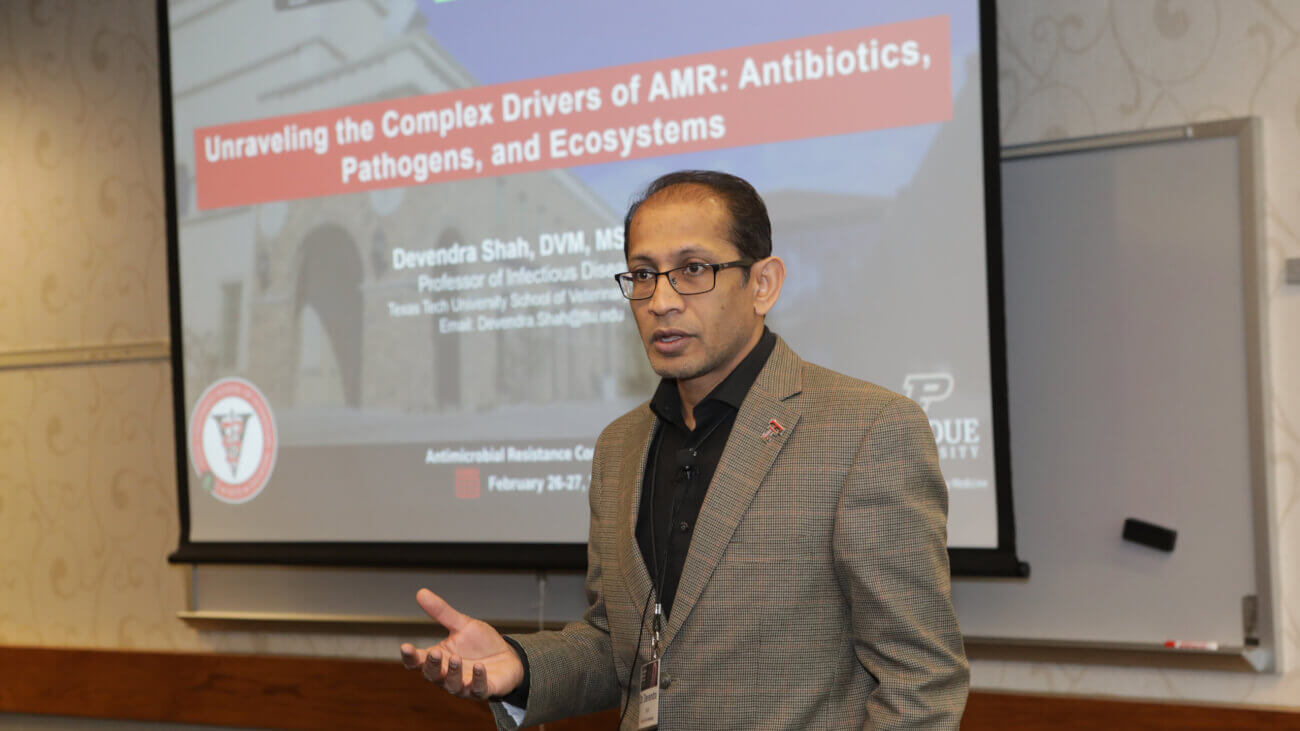
With leadership by the Purdue University College of Veterinary Medicine, the Fourth Annual Conference on Antimicrobial Resistance (AMR) will be held at Purdue University, West Lafayette on February 25–26, 2026. With multidrug-resistant infections on the rise globally, this event brings together experts and practitioners across the spectrum of human, animal, and environmental health to address one of today’s most urgent public health challenges.
The 2026 conference features three keynote presentations organized around the themes Determinants, Dynamics, and Deterrence, each highlighting a critical aspect of AMR research and response. After each keynote speaker, three researchers with relevant expertise will talk. Each segment will conclude with a question-and-answer session featuring a panel consisting of all the speakers for that theme.
Determinants: The Elements and Mechanisms of AMR
Renee Fleeman, PhD, assistant professor in the University of Central Florida’s College of Medicine, will discuss the growing threat of multidrug-resistant Klebsiella pneumoniae and her team’s discoveries regarding how antimicrobial peptides can overcome membrane-mediated colistin resistance. Dr. Fleeman serves on the faculty of the UCF College of Medicine’s Burnett School of Biomedical Sciences. Her work highlights important physiochemical properties that allow host defense peptides to bypass resistance mechanisms and reveals the emerging role of phenotypic tolerance in AMR.
Dynamics: Tackling AMR in Humans and Animals—A One Health Approach
This keynote by Herman Barkema, DVM, PhD, a professor in epidemiology of infectious diseases, Faculty of Veterinary Medicine, University of Calgary, will explore AMR from a global One Health perspective, emphasizing the interconnectedness of human, animal, and environmental health. Dr. Barkema will address key drivers of AMR in medicine and agriculture, the importance of integrated surveillance, and the need for international collaboration, particularly in supporting low- and middle-income countries.
Deterrence: Control and Mitigations of AMR
Dubraska Diaz-Campos, DVM, PhD, a veterinarian and associate professor of clinical microbiology at The Ohio State University College of Veterinary Medicine, will highlight practical, evidence-based strategies for controlling AMR through improved infection prevention, optimized antimicrobial use, and enhanced diagnostics. Her presentation will feature real-world examples showing how veterinarians and diagnostic laboratories can lead stewardship efforts within a One Health framework.
Another feature of the 2026 Purdue AMR conference will be a Poster Session showcasing AMR research from students and early-career scientists. Poster presenters will receive complimentary conference registration, and undergraduate students and graduate students are eligible to compete for cash prizes. After registering, participants will receive additional information regarding the poster submission process.
The AMR conference welcomes a wide range of participants, including academic researchers, medical and veterinary professionals, public health specialists, and individuals working in food production, food safety, and biotechnology. The event is designed to foster networking, collaboration, and multidisciplinary problem-solving among those committed to addressing antimicrobial resistance.
Plan to participate in this important event that focuses on working together to combat antimicrobial resistance and protect global health. For more information and to register, click here to visit the Purdue University Antimicrobial Resistance Conference website of the Purdue University College of Veterinary Medicine.
