
Purdue Veterinary Medicine and Purdue Football Share Bullish Outlook at Summer Event

Purdue Veterinary Medicine Dean Bret Marsh with Purdue Head Football Coach Barry Odom and the Purdue Beef Angus Bull named Odom at the Purdue Football Coaches Celebration at McGraw’s in West Lafayette.

Purdue University College of Veterinary Medicine Dean Bret Marsh recently attended the Purdue Football Coaches Celebration at McGraw’s Purdue Chop House in West Lafayette, where he connected with new Purdue Head Football Coach Barry Odom. The event, hosted by McGraw’s owner Todd McGraw, also featured an opportunity to meet “Odom,” the Purdue Beef Angus Bull that serves as the latest symbol of Boilermaker pride.

Dean Marsh and Coach Odom, as two new leaders at Purdue, discussed their shared commitment to excellence, tradition, and community. Dean Marsh highlighted the state-of-the-art services offered by the Purdue University Veterinary Hospital, which plays a critical role in advancing animal health and supporting Indiana’s agricultural backbone.

Coach Odom expressed genuine interest in working with the College of Veterinary Medicine in the coming year — signaling a promising collaboration between two of Purdue’s most recognized programs. Their conversation underscores the dynamic ways Purdue is fostering innovation and connection across campus, offering alumni and donors an exciting glimpse into the future.
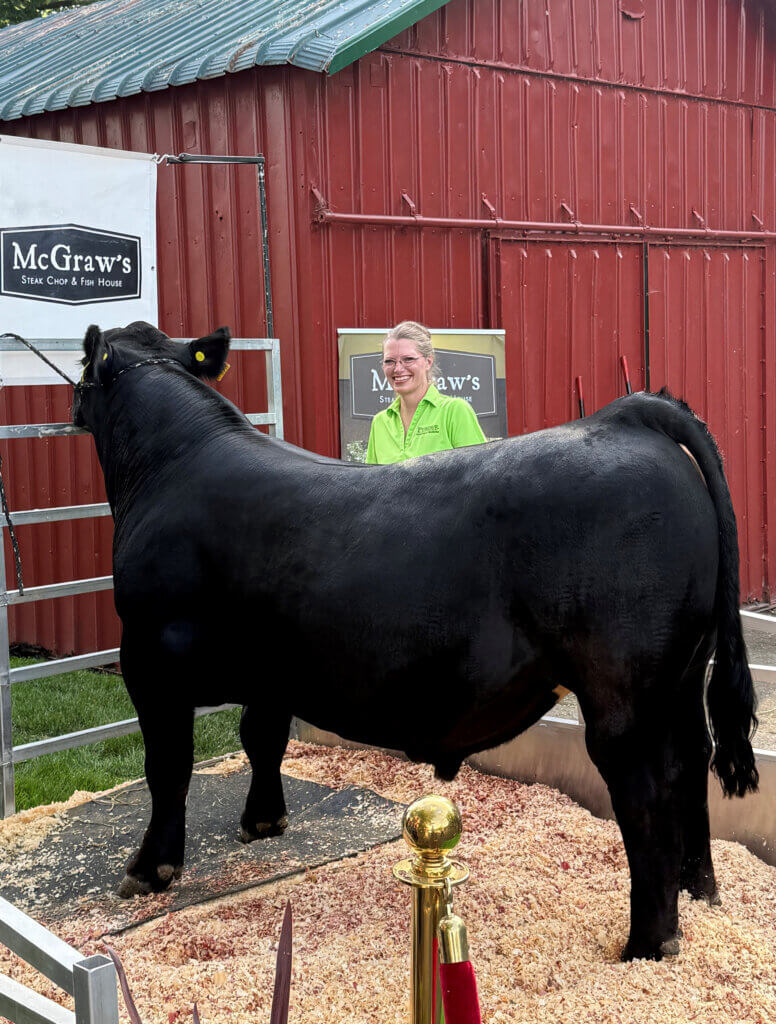
Dr. Bethany Funnell, clinical associate professor and board certified bovine theriogenologist, with Odom, the bull that was produced with the help of her expertise in assisted reproductive technologies.

Another VIP guest at the event was Dr. Bethany Funnell, Purdue Veterinary Medicine clinical associate professor of bovine theriogenology, who teaches veterinary students about bovine reproduction and provided the clinical expertise necessary for the bull named Odom to be produced via in vitro fertilization and embryo transfer. Dr. Funnel said these kinds of “assisted reproductive technologies,” or ARTs, are examples of Purdue Veterinary Medicine’s advanced clinical services supporting animal agriculture. The process involved aspirating the eggs (oocytes) from the donor cow, fertilizing them with frozen/thawed semen from the donor bull, and then transferring the resultant embryo into the recipient female. After an additional 275 days of in utero growth and development, the bull Odom was born.

“We utilize these ARTs to increase the number of offspring born from animals with higher value genetics,” said Dr. Funnell. “In particular, this is advantageous for high value females, since a cow generally will only have one calf per year. By utilizing ARTs, a high value cow can have many more of her offspring born to genetically unrelated recipients.”

The summer celebration at McGraw’s put the spotlight on two exciting Purdue programs – one under the leadership of Coach Odom that looks to showcase excellence on the gridiron this fall, and the other under the guidance of Dean Marsh, that’s creating the next chapter of excellence in Purdue veterinary medical education, research and service.
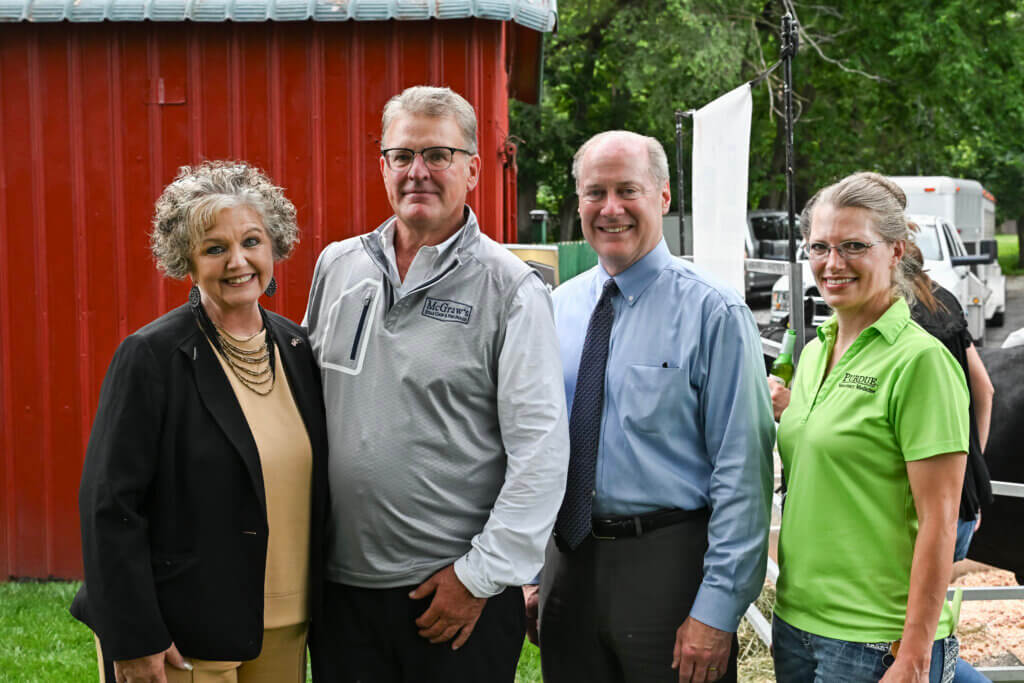

Purdue Veterinary Medicine Staff and faculty standing with Todd McGraw outside
Todd McGraw (2nd from left) with Purdue Veterinary Medicine colleagues (left-right) Julia Wickard, Purdue Veterinary Alumni Association director; Dean Bret Marsh; and Clinical Associate Professor Bethany Funnell. (Photo courtesy of David Teter/Grey Event Media)

Writer(s): Kevin Doerr, Julia Wickard | pvmnews@purdue.edu

Recent Stories

“Paws Up” for Jennifer Danaher – brought to you by the PVM Wellness Committee

This week we express our gratitude to Jennifer Danaher, who is department secretary for Veterinary Clinical Sciences.

‘Purdue Pursuits’: A PVM angle on Purdue’s teaching and learning reading groups

Crafting meaningful and engaging course experiences has been at the top of Dielson Vieira’s mind ever since he joined the Purdue University College of Veterinary Medicine’s faculty in 2024. As a clinical assistant professor in the Department of Basic Medical Sciences, Vieira is already adept at applying innovative teaching practices to classroom environments, but that doesn’t stop him from seeking out new ideas, approaches and perspectives — insights he gains through outlets like Purdue’s teaching and learning reading groups.

Top tier biology journal publishes PVM study that unlocks secrets of a drug-resistant fungal pathogen, which causes serious infections in humans

Though the name “Candida auris” is far from a household term, public health experts know it well because the multi-drug-resistant fungal pathogen, which causes serious human infections, has been classified as an urgent threat by the U.S. Centers for Disease Control and Prevention (CDC) Antibiotic Threats Report (2019). Dr. Shankar Thangamani, Associate Professor of Microbiology and University Faculty Scholar in the Purdue University College of Veterinary Medicine’s Department of Comparative Pathobiology, is researching C. auris, aided by a 2.4 million grant from the National Institutes of Health (NIH). New research findings, just published in Nature Microbiology, show how C. auris adapts and evades the immune system.

In Print: ‘Translational Research Methods for Tauopathies’

A just-published 300-page volume edited by Jessica Fortin, Purdue assistant professor in the College of Veterinary Medicine’s Department of Basic Medical Sciences, provides a significant new resource for researchers studying a group of neurodegenerative diseases known as tauopathies. “Translational Research Methods for Tauopathies” provides detailed protocols intentionally selected to serve as a basis for research laboratories seeking to further treatments for such debilitating neurodegenerative diseases as Alzheimer’s and chronic traumatic encephalopathy (CTE).

It’s Almost Here!

Though the annual Purdue Veterinary Conference is almost upon us, there’s still time to register and take advantage of this time-honored College of Veterinary Medicine fall tradition that combines excellent continuing education with fun opportunities for reconnecting with colleagues and classmates, networking, and learning about the latest veterinary trends and products. The 2026 Purdue Veterinary Conference takes place September 23–26 on the Purdue University campus. The annual event has something for everyone, from veterinarians to veterinary technicians, faculty, staff and students.