
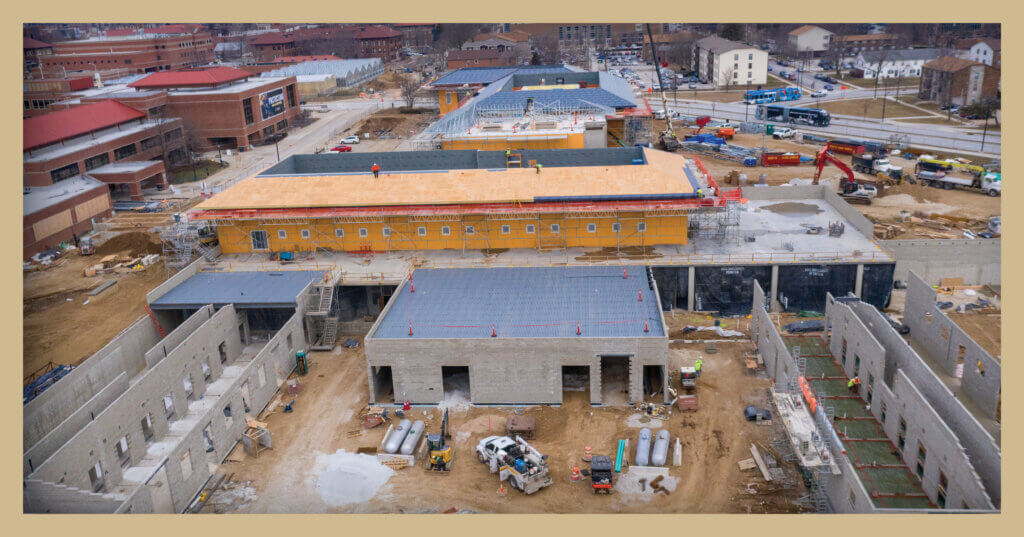
As the date for opening the Purdue University College of Veterinary Medicine’s new hospital facilities draws closer, the Purdue Board of Trustees has approved a new name for the complex in recognition of a $10 million leadership commitment from PVM alumnus David Brunner and his wife, Bonnie. The board took the action at its meeting Friday, February 5, honoring the Brunners for their gift that will be meaningful to students, staff, faculty, clients, and alumni alike for years ahead.
Encompassing 162,500 square feet, the new veterinary hospital facilities will be known as the David and Bonnie Brunner Purdue Veterinary Medical Hospital Complex, and will include three components located just east of the existing Lynn Hall of Veterinary Medicine:
- The David and Bonnie Brunner Small Animal Hospital, which will add 65,000 square feet to the existing small animal hospital facilities in Lynn Hall that amount to about 40,000 square feet;
- The David and Bonnie Brunner Equine Hospital providing 73,000 square feet of new space;
- The David and Bonnie Brunner Farm Animal Hospital amounting to 24,000 square feet and replacing facilities in the existing large animal hospital.
“As the pandemic has underscored, a state-of-the-art veterinary medicine program now not only benefits our animal population, but is an integral element in protecting human health,” said Purdue President Mitch Daniels. “Thanks to David and Bonnie, Indiana and the nation will now have such an invaluable asset.”
Dr. Brunner earned his Doctor of Veterinary Medicine degree at Purdue in 1979, and then began his career as a practitioner in what he calls the “most enjoyable profession in the world. I go to work and play with puppies and kittens.” He credits his time as a student at Purdue for fueling his passion.

Dr. Brunner is the owner of the Broad Ripple Animal Clinic (BRAC), a business he founded on the north side of Indianapolis in 1981 with one employee. BRAC now has nine full-time veterinarians and is one of the 15% of hospitals in the U.S. accredited by the American Animal Hospital Association. Dr. Brunner retired as a practicing clinical veterinarian in 2012 but continues to be involved with the clinic as chief visionary and staff “cheerleader.”
Dr. Brunner has been a member of the Indiana Veterinary Medical Association, the American Veterinary Medical Association, and the American Animal Hospital Association. He is a past president of the Indianapolis Humane Society, having previously served on the board for ten years. In addition, Dr. Brunner has authored two books, “The Dog Owner’s Manual” and “The Cat Owner’s Manual,” currently published in 12 languages worldwide.
Bonnie (MacLeod) Brunner holds degrees in economics and comparative politics and an MBA in finance from UCLA. She retired from trading at Morgan Stanley and owns Lupo Design & Build, a luxury contemporary residential home building company in Hermosa Beach, Calif. She balances this business with her role as chief financial officer of the veterinary practice and managing the couple’s personal and commercial properties. Bonnie was actively involved in animal rescue organizations in Los Angeles before meeting David. The Brunners split their time between Indianapolis; Southern California; and St. Barths, French West Indies.
“My years at Purdue were life-changing,” Dr. Brunner said. “It took me a while to appreciate the incredible education I received from Purdue’s vet school. To this day, I reflect with sincere appreciation on the many professors and clinical instructors who helped shape me into the veterinarian I became.”
“Bonnie and I have been presented with an extraordinary opportunity to contribute to the construction of the new veterinary medical complex. It is our hope that this contribution will aid and inspire veterinary students, now and for years to come. I am passionate about companion animal practice and have a special interest in inspiring the entrepreneurial spirit in veterinary students and teaching them the art of veterinary practice and the business of veterinary medicine.”
The couple is looking forward to having an active role in the Purdue Alumni Association and to finally attending some Boilermaker football games, as they joke, “We did not have time to do things like that when we were in school because we were always studying.”
The design of the new David and Bonnie Brunner Purdue Veterinary Medical Hospital Complex optimizes hands-on learning for students and creates dedicated space for community engagement opportunities. In addition, the complex’s larger footprint and updated equipment will increase clinical research and allow faculty researchers to respond to more clinical trial opportunities, thus expanding the College of Veterinary Medicine’s reputation as a world-renowned research institute.
“Due to the generosity of David and Bonnie Brunner, our vision of constructing a true state-of-the-art hospital is becoming a reality,” said Purdue Veterinary Medicine Dean Willie Reed. “The new hospital will provide a wonderful learning environment for our students, enable our faculty to advance their clinical research programs that involve clinical trials and greatly enhance our capability to deliver the highest quality care to our animal patients. I am especially grateful to have an alumnus of the college and his wife make such an impactful contribution to the college’s future success.”
Slated to be completed by December and open by spring 2022, the new complex will provide for the varied needs of clients while also maximizing efficiency. For the first time, horses will have their own equine hospital rather than being treated at the same facility as farm animals like cows, pigs, and sheep, which will be attended to at the new farm animal hospital. Efficiencies in the existing hospital facility also will be incorporated into the new structures. For example, expensive imaging technology will be located centrally so it can be accessed from both the small animal and equine hospitals, which mirrors current practice in the existing facilities.
Some small animal services will remain at the current small animal hospital. In addition to treating animals, the hospital complex will serve as a catalyst for interdisciplinary research, including cancer drug discovery and the development of treatments for paralysis.
The total cost of the project is $108 million. Purdue has committed $35 million, which includes ongoing fundraising by the College of Veterinary Medicine, and the state of Indiana approved a $73 million appropriation.
