
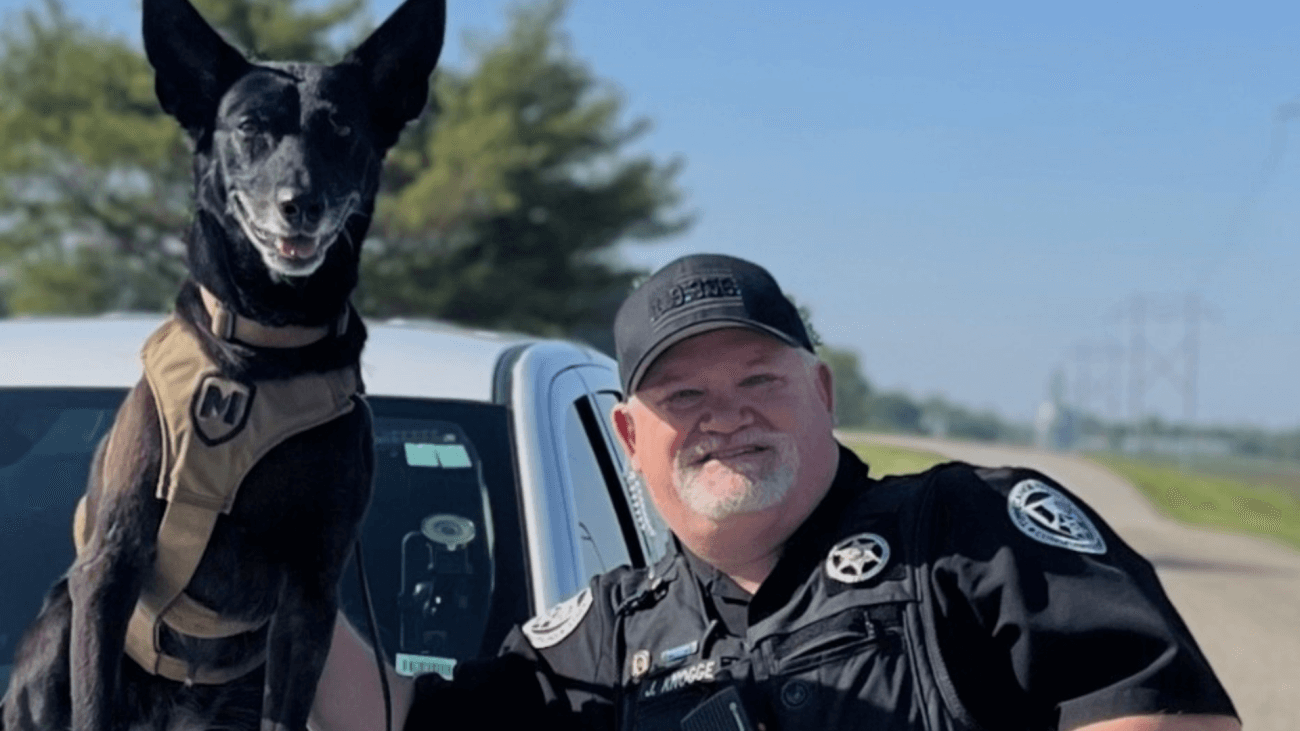
Making Good of a Bad Break for a Police Dog
Luna is used to doing what she does best at full speed – helping to take criminals and their illegal drugs off the streets. She had been doing that for most of her eight years with her partner, Officer Jim Knogge, who is a Surveillance K-9 Handler for Tippecanoe County Community Corrections. Life for Luna was good. But all that changed for her in an instant earlier this year. Luna was outside playing with a ball when all of a sudden, she became severely lame. Officer Knogge rushed Luna to the Purdue University Veterinary Hospital’s Small Animal Emergency Service, where x-rays revealed she had shattered the bone that is the canine equivalent of a right elbow.
As it turned out, Luna’s injury involved a silent condition that had been brewing in her elbow for years. That condition is known as HIF (humeral intercondylar fissure) – a disorder that occurs when the individual parts of the humerus (the upper bone in the front leg) fail to fuse together during the normal growth that occurs in puppyhood. If the degree of failure is severe enough, the bone can break, even with just normal activity. This condition is seen in large and medium sized breeds of dogs and, as in Luna’s case, may not show itself until adulthood, often with catastrophic consequences.
At the Purdue Veterinary Hospital, the Emergency Service veterinarians consulted with Dr. Mark Rochat, one of Purdue’s small animal orthopedic surgeons, who recommended surgery to repair the fracture. “Elbow fractures are challenging because of the shape of the bone and the need for perfect alignment to minimize the arthritis that can develop after this type of fracture,” explained Dr. Rochat, who is a professor in the College of Veterinary Medicine’s Department of Veterinary Clinical Sciences. “To compound the challenges facing Luna, fractures that result from HIF are often slow to heal because of the abnormal nature of the bone that led to the HIF. Fortunately, our college has bone plates and screws that are specifically made for this scenario.”
Dr. Rochat notes that Arthrex, a company that makes products for human orthopedic surgery, also strongly supports the veterinary orthopedic community. “Veterinary surgeons have often had to use generic straight bone plates, even in areas of the skeleton where they don’t fit well,” Dr. Rochat said. “Thankfully, Arthrex recently introduced anatomic-specific plates, including one made just for this situation.”
Luna underwent surgery the next day. The Purdue Veterinary Hospital’s orthopedic surgery team, with the assistance of the anesthesia team, repaired her fracture with a distal humeral plate and screws. Following surgery, Luna underwent several physical therapy sessions with the rehabilitation team to help restore her elbow’s normal range of motion.
The result was like a new lease on life for Luna as well as Officer Knogge and his family. “The care and compassion that my family and I received from the moment Luna arrived at the hospital was second to none,” Officer Knogge said. “Everyone we came into contact with showed their concern for our Luna.”
Dr. Rochat added, “Now, several months later, Luna’s fracture has healed, leaving her little to show for her misadventure except for a cool looking scar. Now Luna is fine and back at work helping keep the citizens of Tippecanoe County safe.”
For Officer Knogge and his family, the gratitude is heartfelt. “The surgical team…. WOW…. Second to none!!! Total Rockstars. They have Luna back to her new normal and we are back on the street making that difference,” Officer Knogge said. “THANK YOU ALL!!!!!!”
And thank you to Office Knogge, his family and Tippecanoe County Community Corrections for the honor of treating Luna, the Rockstar K-9!
