
Lecture Hall Murals by Acclaimed Artist Continue to Inspire Lynn Hall Visitors

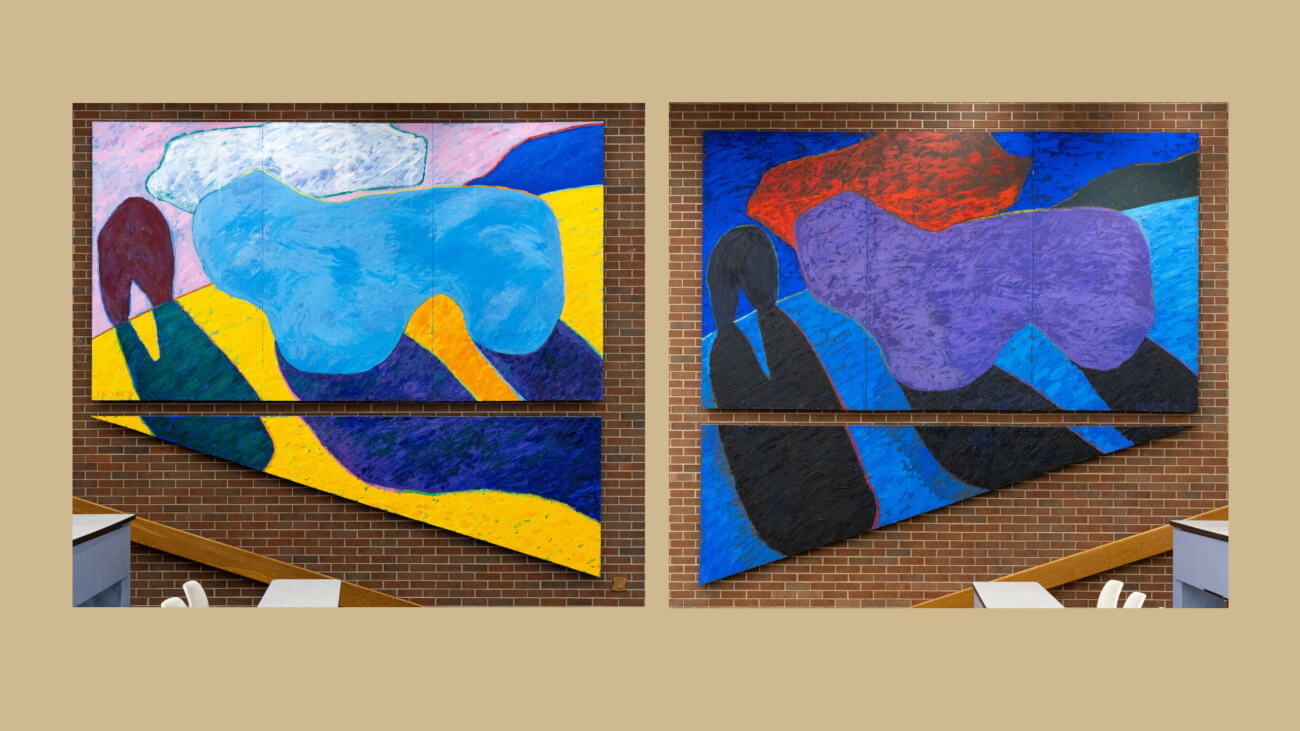
Pastoral Eclipse – AM, 1998, acrylic and oil on four conjoined canvases, 144” x 144” (left), Pastoral Eclipse – PM, 1998-99, acrylic and oil on four conjoined canvases, 144” x 144” (right)

Tucked into the architectural lines of Lynn Hall’s large lecture hall, two vivid murals by artist Harry Boone have been greeting students and visitors at the Purdue University College of Veterinary Medicine for over two decades. Originally commissioned in 1998 as part of a university-wide program to integrate original art across campus, the works in the Lynn 1136 lecture hall remain a powerful visual presence in the academic heart of the college.

The Commission and Creative Process

Boone responded to a call for proposals issued through a Purdue program which selected one artist annually to create site-specific work for a designated college. In 1998, the focus turned to the College of Veterinary Medicine. Boone’s thoughtful, site-responsive proposal included two murals rather than one, designed to mirror the scale and slope of the lecture hall space.

The artist created the work over the span of a year in a rented studio above an old drugstore in downtown Franklin, Indiana. “It was truly a memorable and delightful time spent in that studio,” Boone said, reflecting on the period.

Pastoral Eclipse, AM and Pastoral Eclipse, PM

Boone knew he wanted the subject matter of the work to be relevant to the college. Interestingly, the two murals began as renderings of grazing cows. To be more inclusive, Boone revised these images with abstract shapes that suggested farm animals, but not any certain species. This decision was connected to his experience in the countryside, bicycling past and observing herds of cattle. Boone says, “It made me ponder the way animals sensed time – how different it is from my own experience.”

He created two small colored pencil cartoons that would develop into two 12’ x 12’ murals. Using four canvases to compose each mural, the artist organized their arrangement to complement the sloped architecture of Lynn 1136.

A Painter’s Vision—and a Lighting Challenge

From the beginning, Boone stressed the importance of gallery-quality lighting to allow viewers to experience the full depth of the murals. Though spotlights were agreed upon initially, they were never installed. Boone felt the resulting installation of the art muted the visual potential of his work.

Despite those concerns, his recent return to the hall brought unexpected joy. “I was very happily shocked that they looked so good,” Boone said. “My wife [Dr. Suzanne Schuweiler], an art historian, absolutely loved them. She liked what she had seen in photos, but this, she said, was a real revelation. I can’t really express how very pleased I was with how they looked. It made my day.”

An Artist’s Path

Boone brings a lifetime of dedication to the visual arts. After earning his MFA in Painting and Art History from the University of North Carolina at Greensboro—where he studied under internationally respected artists and worked closely with the Weatherspoon Art Museum—Boone began a long career in higher education. He taught at institutions across the country, including Gallaudet University and the Herron School of Art, ultimately retiring in 2023 after 14 years at Georgia Gwinnett College. He now resides in Atlanta, Georgia.
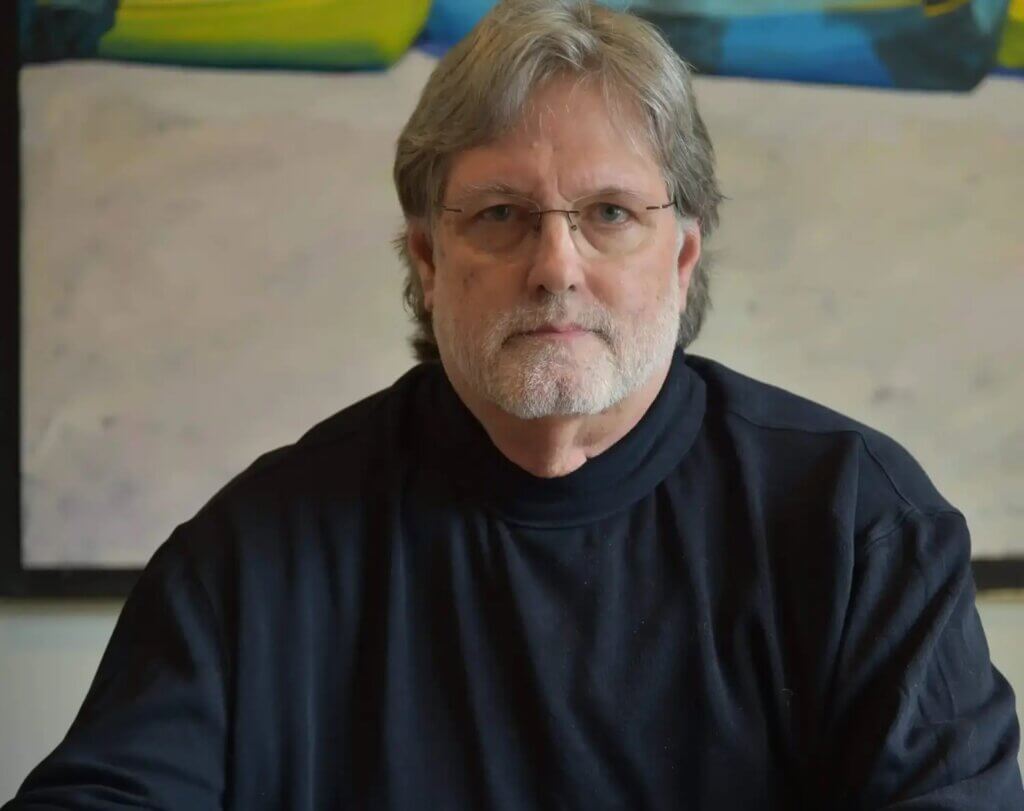
Harry Boone

His work, steeped in Mediterranean color and shaped by French modernist influences, continues to draw admiration. In Lynn 1136, the murals serve not only as visual landmarks but as a legacy of thoughtful public art—conceived with intention, created with care, and still resonating decades later.

In closing, he says about this project, “I consider my acceptance in this program to be one of the most important events in my long artistic career. It is a high honor indeed to have my work included in one of the county’s premier universities and a top-tier veterinary school.”

To learn more about Harry Boone and his work, click here to view his online portfolio.

Writer(s): Nathan Dell | pvmnews@purdue.edu

Recent Stories

Journal of Feline Medicine and Surgery Honors PVM Clinician Paulo Gomes as a Top Co-Author

Dr. Paulo Gomes, clinical associate professor of dermatology in the Purdue University College of Veterinary Medicine’s Department of Veterinary Clinical Sciences, recently was recognized for co-authoring one of the most widely read articles of 2025 in the Journal of Feline Medicine and Surgery. The publication is an online, open access, international, peer-reviewed journal.

“Paws Up” – brought to you by the PVM Wellness Committee

This week a big Paws Up goes to Gabriel Harris, who is a graduate research assistant in the Department of Basic Medical Sciences.

More Time Together

From the moment Brian met Blackie as a playful puppy at a rescue, their bond was undeniable. Over the years, Blackie became more than a pet. That is why, when Brian found Blackie unresponsive in his yard one evening, he refused to give up. Brian drove Blackie an hour and a half to the Purdue University Veterinary Hospital’s Emergency and Critical Care team.

USDA Funding Fuels Purdue Veterinary Medicine Research Seeking Answers to Costly Cattle Production Mystery

A four-year, $650,000 New Investigator Award from the USDA National Institute of Food and Agriculture (USDA-NIFA) will support research led by Dr. Viju V. Pillai, a faculty member in Purdue Veterinary Medicine’s Department of Comparative Pathobiology and pathologist at the Animal Disease Diagnostic Laboratory (ADDL), aimed at solving a persistent and costly mystery in cattle production.  Dr. Pillai’s team wants to answer the question of why so many pregnancies fail before they are even recognized? The project will focus on the earliest stages of fetal–maternal communication and on a little-understood family of proteins called trophoblast Kunitz domain proteins (TKDPs), whose functions in pregnancy remain largely unknown.

In Memory: Dr. Ronald P. Miller (PU DVM ’63)

The Purdue Veterinary Medicine community is saddened by the passing of Dr. Ronald P. Miller, of Indianapolis, a member of the College of Veterinary Medicine’s first graduating class, the Class of 1963.  Dr. Miller died February 17, 2026, at the age of 89.

In Memory – Dr. Julie Anderson (PU DVM ’78)

A Purdue Veterinary Medicine alumna and beloved veterinarian, Dr Julie Anderson, of Rockville, Indiana, will be remembered at a celebration of life open house to be hosted in her honor by West Central Veterinary Services Sunday, April 27. Dr. Anderson, a member of the Purdue DVM Class of 1978, passed away in December at the age of 71.

Popular Veterinary Nursing Symposium Features Day of Learning and Networking

Purdue Veterinary Medicine’s annual Veterinary Nursing Symposium brought more than 150 veterinary professionals to Lynn Hall recently to gain practical knowledge and insights about a diverse range of topics covering both small and large animals. Veterinary nurses (technicians and technologists), veterinary assistants and veterinary nursing (technology) students participated in the all day lifelong learning program Sunday, March 23. The attendees came from across Indiana as well as Illinois, Ohio, Kentucky, Michigan, Tennessee, and Wisconsin.

“Paws Up” – brought to you by the PVM Wellness Committee

Today we are highlighting Dr. Heather Bornheim, who is a farm animal medicine and surgery clinician in the Purdue University Veterinary Hospital.

CPB’s Aryal Lab Members Recognized at 140th Annual Indiana Academy of Science Meeting

Two members of Research Associate Professor Uma Aryal’s lab in the Department of Comparative Pathobiology recently received noteworthy recognition during the 140th Indiana Academy of Science conference hosted in Indianapolis. According to the Indiana Academy of Science, since 1885, its annual conferences have served as the only multidisciplinary scientific meetings that take place in the state. The event on March 22 attracted hundreds of senior and junior scientists from Indiana and across the Midwest.