
In Memory: Retired PVM Faculty Member Richard Borgens

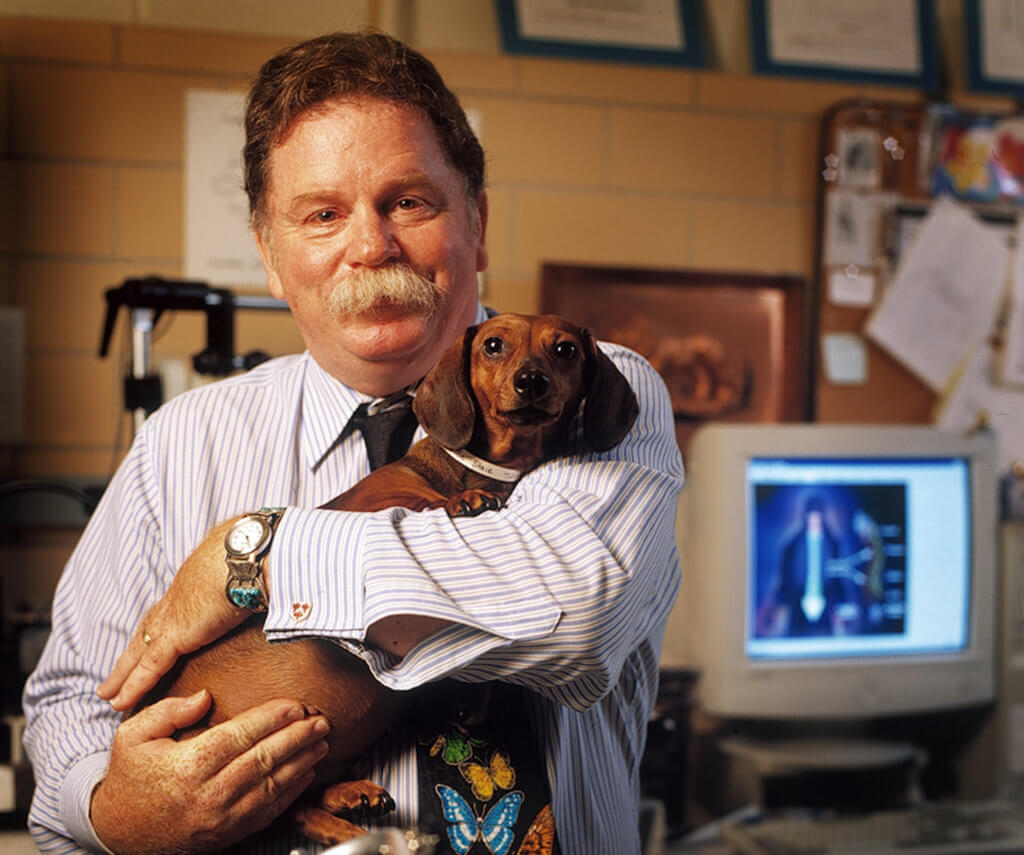
A person in professional attire holds a small dog in an indoor setting, with a computer and various documents in the background.
Richard Borgens, director of Purdue University’s Center for Paralysis Research, helps paralyzed dogs like Kady walk again with the help of treatments like polyethylene glycol (PEG) injections. In a recent study, more than half of the paralyzed dogs that received injections of the polymer within 72 hours of traumatic spinal injury were standing or walking again within weeks. (Credit: North Texan Magazine)

The Purdue University College of Veterinary Medicine received sad news last week about Dr. Richard Borgens, a retired faculty member and true pioneer in the field of paralysis research, who passed away November 25.  He was 73. 

A graduate of North Texas State University, Dr. Borgens earned his PhD in developmental biology at Purdue University in 1977.  After serving as a post-doctoral fellow at Yale University and working at the Institute for Medical research in California and the Jackson Laboratory in Maine, Dr. Borgens returned to Purdue as a faculty member in the College of Veterinary Medicine and established the Center for Paralysis Research.  In addition to serving as the center director, Dr. Borgens held a joint appointment as the Mari Hulman George Professor of Applied Neuroscience in the Department of Basic Medical Sciences and professor of biomedical engineering.  He also served as a founding board member and chief scientific officer for Andara Life Sciences, Inc.

Regarded as a preeminent researcher in spinal cord neuronal regeneration, Dr. Borgens also was instrumental in the development of Ampyra, a pharmaceutical aid for multiple sclerosis patients.  Purdue researchers developed the original concept and basic science, and conducted initial animal studies at Purdue’s Center for Paralysis Research facilities. The first clinical testing of the drug in paraplegic canines occurred on the Purdue campus in the College of Veterinary Medicine. “Dr. Borgens had a true passion and energy for the work he did in pursuit of new treatments for paralysis and neurodegenerative diseases,” said Purdue Veterinary Medicine Dean Willie Reed. In 2006, the Indiana Health Industry Forum (IHIF) presented Dr. Borgens with the Outstanding Contribution to Scientific Commercialization Award.

Beyond his role as a Purdue faculty member, Dr. Borgens was known for his love of music.  Originally trained on classical guitar, he played in many bands.  Additionally, he loved history and enjoyed collecting and restoring automobiles and antique firearms.  A tribute for Dr. Borgens was held at Lafayette’s Columbian Park on Wednesday, December 4.  Click here for more information and to leave condolences.

Writer(s): Kevin Doerr | pvmnews@purdue.edu

Recent Stories

“Paws Up” for Jennifer Danaher – brought to you by the PVM Wellness Committee

This week we express our gratitude to Jennifer Danaher, who is department secretary for Veterinary Clinical Sciences.

‘Purdue Pursuits’: A PVM angle on Purdue’s teaching and learning reading groups

Crafting meaningful and engaging course experiences has been at the top of Dielson Vieira’s mind ever since he joined the Purdue University College of Veterinary Medicine’s faculty in 2024. As a clinical assistant professor in the Department of Basic Medical Sciences, Vieira is already adept at applying innovative teaching practices to classroom environments, but that doesn’t stop him from seeking out new ideas, approaches and perspectives — insights he gains through outlets like Purdue’s teaching and learning reading groups.

Top tier biology journal publishes PVM study that unlocks secrets of a drug-resistant fungal pathogen, which causes serious infections in humans

Though the name “Candida auris” is far from a household term, public health experts know it well because the multi-drug-resistant fungal pathogen, which causes serious human infections, has been classified as an urgent threat by the U.S. Centers for Disease Control and Prevention (CDC) Antibiotic Threats Report (2019). Dr. Shankar Thangamani, Associate Professor of Microbiology and University Faculty Scholar in the Purdue University College of Veterinary Medicine’s Department of Comparative Pathobiology, is researching C. auris, aided by a 2.4 million grant from the National Institutes of Health (NIH). New research findings, just published in Nature Microbiology, show how C. auris adapts and evades the immune system.

In Print: ‘Translational Research Methods for Tauopathies’

A just-published 300-page volume edited by Jessica Fortin, Purdue assistant professor in the College of Veterinary Medicine’s Department of Basic Medical Sciences, provides a significant new resource for researchers studying a group of neurodegenerative diseases known as tauopathies. “Translational Research Methods for Tauopathies” provides detailed protocols intentionally selected to serve as a basis for research laboratories seeking to further treatments for such debilitating neurodegenerative diseases as Alzheimer’s and chronic traumatic encephalopathy (CTE).

It’s Almost Here!

Though the annual Purdue Veterinary Conference is almost upon us, there’s still time to register and take advantage of this time-honored College of Veterinary Medicine fall tradition that combines excellent continuing education with fun opportunities for reconnecting with colleagues and classmates, networking, and learning about the latest veterinary trends and products. The 2026 Purdue Veterinary Conference takes place September 23–26 on the Purdue University campus. The annual event has something for everyone, from veterinarians to veterinary technicians, faculty, staff and students.