
In Memory: Continuum Sculptor Larry Anderson

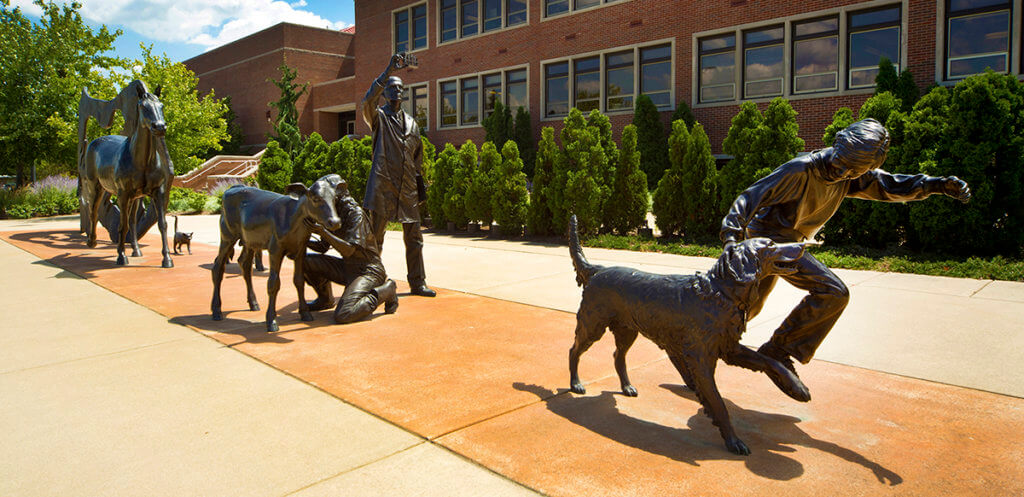
A row of bronze sculptures depicting people interacting with dogs in an outdoor setting.

The Purdue Veterinary Medicine family is saddened to learn of the passing last fall of sculptor Larry Anderson, of Bonney Lake, Wash., who created the iconic “Continuum” sculpture along Harrison Street in front of Lynn Hall.  He was 78. 
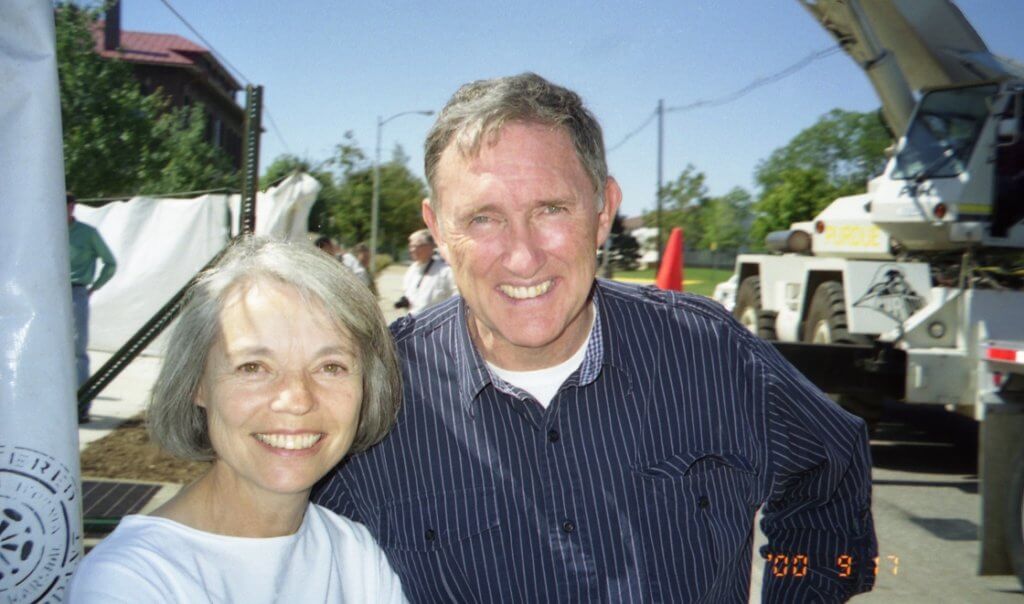
Larry Anderson pictured with his wife, Sharilyn at Purdue
Larry Anderson and his wife, Sharilyn, during their visit to Purdue at the time of the installation of Continuum.

Mr. Anderson created the design for Continuum as part of a contest held by the College of Veterinary Medicine in conjunction with the opening of the new addition to Lynn Hall in the mid-1990s.  At the time, he was well known as a Pacific Northwest sculptor who had created a number of beloved works, including one that was installed to mark the 100th anniversary of the Washington State University College of Veterinary Medicine.  Out of numerous artists who were contacted about the Purdue Veterinary Medicine sculpture contest, Mr. Anderson was one of two finalists, and Continuum was the unanimous favorite.  The work was commissioned and in 2000, it was installed and officially dedicated.  Mr. Anderson and his family joined dozens of Purdue Veterinary Medicine alumni, friends, and special guests for the dedication ceremony. 

Mr. Anderson earned his undergraduate degree in education at Central Washington University before pursuing graduate study in art at the Academy of Fine Art in Vienna, Austria in 1965 and at the University of Washington in 1966. He then completed a Master of Fine Art in painting at the Cranbrook Art Academy in Bloomfield Hills, Mich., in 1968. He worked as an art teacher in Tacoma, Wash., before launching his career as a sculptor.
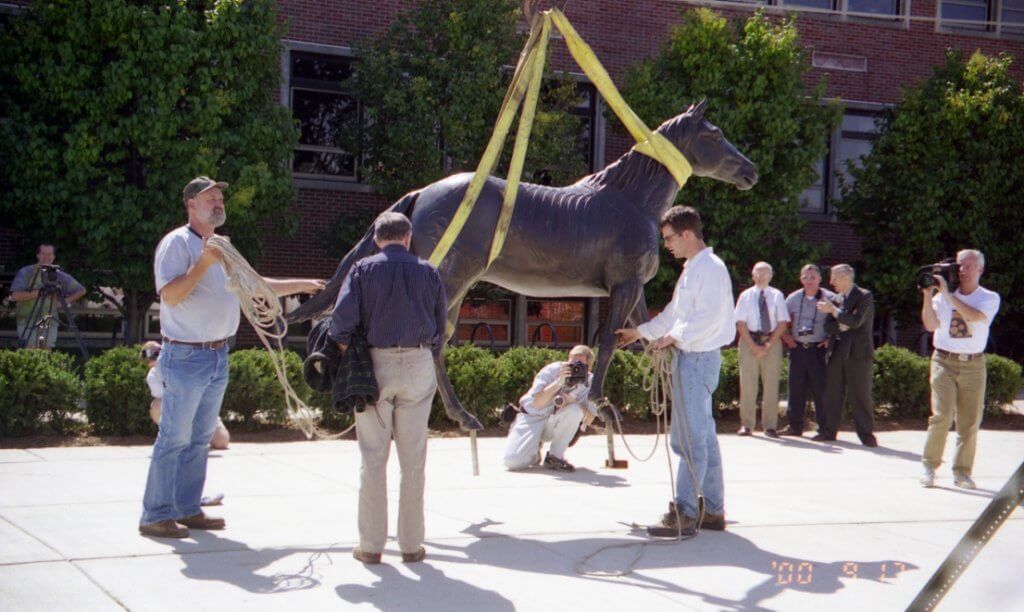
Larry Anderson pictured supervising the installation of the Continuum sculpture at Purdue
Larry Anderson supervises the Purdue crew that installed Continuum in September 2000.

Mr. Anderson’s first major works were commissioned by the City of Tacoma, which became home to many of his public sculptures, but he also completed several other major works across the U.S.  In addition to Continuum, he sculpted “Springfield’s Lincoln”, an ensemble of statues of Abe and Mary Lincoln and two of their boys in Springfield, Ill. (2004); and “Directions” at the Experimental Aircraft Association (EAA) Museum in Oshkosh, Wis. (1995). His many bronze sculptures, over 70 in all, comprise a stunning legacy of full-size figures and portrait busts.  He also completed numerous paintings and drawings, including both realistic and abstract expressionist works. 

Mr. Anderson passed away October 18 after a long illness.  He is remembered as a caring and passionate artist, with a masterful flair for stunning detail in his sculptures, coupled with an engaging personality with which he quickly won the support and admiration of any and all who had the privilege of being involved with his artwork.  Thankfully, he left a compelling legacy at Purdue in Continuum, which will keep alive the memory of an artist who was all together warm-hearted, humble, and remarkable.

Click here to view a story about his passing that was published in The News Tribune of Tacoma.  Click here to view a complete obituary.

Writer(s): Kevin Doerr | pvmnews@purdue.edu

Recent Stories

“Paws Up” for Jennifer Danaher – brought to you by the PVM Wellness Committee

This week we express our gratitude to Jennifer Danaher, who is department secretary for Veterinary Clinical Sciences.

‘Purdue Pursuits’: A PVM angle on Purdue’s teaching and learning reading groups

Crafting meaningful and engaging course experiences has been at the top of Dielson Vieira’s mind ever since he joined the Purdue University College of Veterinary Medicine’s faculty in 2024. As a clinical assistant professor in the Department of Basic Medical Sciences, Vieira is already adept at applying innovative teaching practices to classroom environments, but that doesn’t stop him from seeking out new ideas, approaches and perspectives — insights he gains through outlets like Purdue’s teaching and learning reading groups.

Top tier biology journal publishes PVM study that unlocks secrets of a drug-resistant fungal pathogen, which causes serious infections in humans

Though the name “Candida auris” is far from a household term, public health experts know it well because the multi-drug-resistant fungal pathogen, which causes serious human infections, has been classified as an urgent threat by the U.S. Centers for Disease Control and Prevention (CDC) Antibiotic Threats Report (2019). Dr. Shankar Thangamani, Associate Professor of Microbiology and University Faculty Scholar in the Purdue University College of Veterinary Medicine’s Department of Comparative Pathobiology, is researching C. auris, aided by a 2.4 million grant from the National Institutes of Health (NIH). New research findings, just published in Nature Microbiology, show how C. auris adapts and evades the immune system.

In Print: ‘Translational Research Methods for Tauopathies’

A just-published 300-page volume edited by Jessica Fortin, Purdue assistant professor in the College of Veterinary Medicine’s Department of Basic Medical Sciences, provides a significant new resource for researchers studying a group of neurodegenerative diseases known as tauopathies. “Translational Research Methods for Tauopathies” provides detailed protocols intentionally selected to serve as a basis for research laboratories seeking to further treatments for such debilitating neurodegenerative diseases as Alzheimer’s and chronic traumatic encephalopathy (CTE).

It’s Almost Here!

Though the annual Purdue Veterinary Conference is almost upon us, there’s still time to register and take advantage of this time-honored College of Veterinary Medicine fall tradition that combines excellent continuing education with fun opportunities for reconnecting with colleagues and classmates, networking, and learning about the latest veterinary trends and products. The 2026 Purdue Veterinary Conference takes place September 23–26 on the Purdue University campus. The annual event has something for everyone, from veterinarians to veterinary technicians, faculty, staff and students.