
Dr. Darryl Ragland Named as Purdue Veterinary Medicine Extension Director

New Purdue Veterinary Medicine Extension Director Darryl Ragland, DVM, PhD

Purdue Professor of Food Animal Production Medicine Darryl Ragland has been selected as the director of extension for the College of Veterinary Medicine. In that role, he will oversee the activities of the college’s extension service, which shares practical applications of Purdue research with livestock producers in Indiana and around the world, and enables Hoosier farmers to raise animals using healthy and sustainable livestock production practices.

Dr. Ragland is a longtime College of Veterinary Medicine faculty member, who earned his DVM degree at Tuskegee University before coming to Purdue to complete his residency in food animal medicine. He then continued on to earn his PhD and join the faculty in 1999. In addition to his faculty appointment, Dr. Ragland serves as head of the Production Medicine Section in the Purdue University Veterinary Hospital.

Dr. Ragland splits his time between clinical practice, teaching, and research. His research interests include antimicrobial resistance and alternatives to antimicrobials in swine production; nutrient digestibility and physiology (swine and poultry); swine lameness and locomotor diseases; and swine reproduction and physiology.

Dr. Ragland’s educational responsibilities include teaching swine production medicine and nutrition to veterinary students. He also played a key role in creating a new food animal medicine course for which he is now instructor-of-record, and has been actively involved in animal husbandry courses.

The Purdue Veterinary Medicine Extension team includes specialists in equine, beef, swine, dairy, animal welfare and veterinary toxicology.
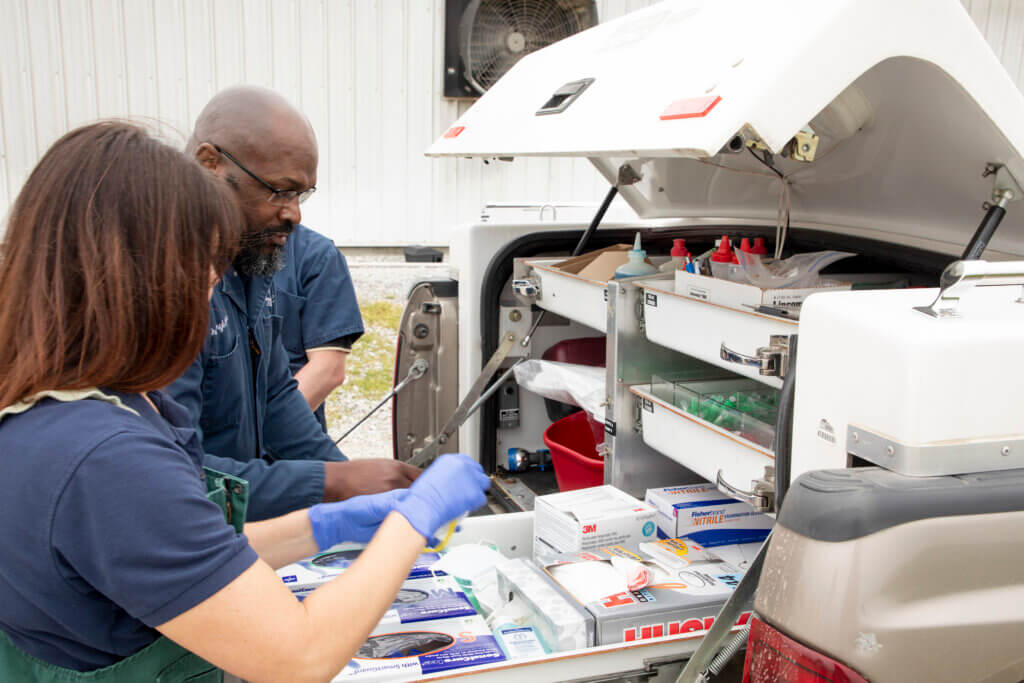

Dr. Darryl Ragland is a professor of food animal production medicine and runs the Swine Field Service of the Purdue Farm Animal Hospital

Writer(s): Kevin Doerr | pvmnews@purdue.edu

Recent Stories

“Paws Up” for Jennifer Danaher – brought to you by the PVM Wellness Committee

This week we express our gratitude to Jennifer Danaher, who is department secretary for Veterinary Clinical Sciences.

‘Purdue Pursuits’: A PVM angle on Purdue’s teaching and learning reading groups

Crafting meaningful and engaging course experiences has been at the top of Dielson Vieira’s mind ever since he joined the Purdue University College of Veterinary Medicine’s faculty in 2024. As a clinical assistant professor in the Department of Basic Medical Sciences, Vieira is already adept at applying innovative teaching practices to classroom environments, but that doesn’t stop him from seeking out new ideas, approaches and perspectives — insights he gains through outlets like Purdue’s teaching and learning reading groups.

Top tier biology journal publishes PVM study that unlocks secrets of a drug-resistant fungal pathogen, which causes serious infections in humans

Though the name “Candida auris” is far from a household term, public health experts know it well because the multi-drug-resistant fungal pathogen, which causes serious human infections, has been classified as an urgent threat by the U.S. Centers for Disease Control and Prevention (CDC) Antibiotic Threats Report (2019). Dr. Shankar Thangamani, Associate Professor of Microbiology and University Faculty Scholar in the Purdue University College of Veterinary Medicine’s Department of Comparative Pathobiology, is researching C. auris, aided by a 2.4 million grant from the National Institutes of Health (NIH). New research findings, just published in Nature Microbiology, show how C. auris adapts and evades the immune system.

In Print: ‘Translational Research Methods for Tauopathies’

A just-published 300-page volume edited by Jessica Fortin, Purdue assistant professor in the College of Veterinary Medicine’s Department of Basic Medical Sciences, provides a significant new resource for researchers studying a group of neurodegenerative diseases known as tauopathies. “Translational Research Methods for Tauopathies” provides detailed protocols intentionally selected to serve as a basis for research laboratories seeking to further treatments for such debilitating neurodegenerative diseases as Alzheimer’s and chronic traumatic encephalopathy (CTE).

It’s Almost Here!

Though the annual Purdue Veterinary Conference is almost upon us, there’s still time to register and take advantage of this time-honored College of Veterinary Medicine fall tradition that combines excellent continuing education with fun opportunities for reconnecting with colleagues and classmates, networking, and learning about the latest veterinary trends and products. The 2026 Purdue Veterinary Conference takes place September 23–26 on the Purdue University campus. The annual event has something for everyone, from veterinarians to veterinary technicians, faculty, staff and students.