
Distance Learning Program Ensures It’s Never Too Late to Open the Door to Veterinary Nursing

One of the cornerstones of the Veterinary Nursing Distance Learning Program in the Purdue University College of Veterinary Medicine is the flexibility that keeps the door open to a veterinary nursing career for non-traditional students.  Perhaps no one can testify to that better than Karen “Coco” Schefmeyer.  When the 63-year-old enrolled in the distance learning program, she brought a wealth of real world experience to the virtual classroom, and she doesn’t miss a beat as she works toward earning her associate’s degree in veterinary nursing.
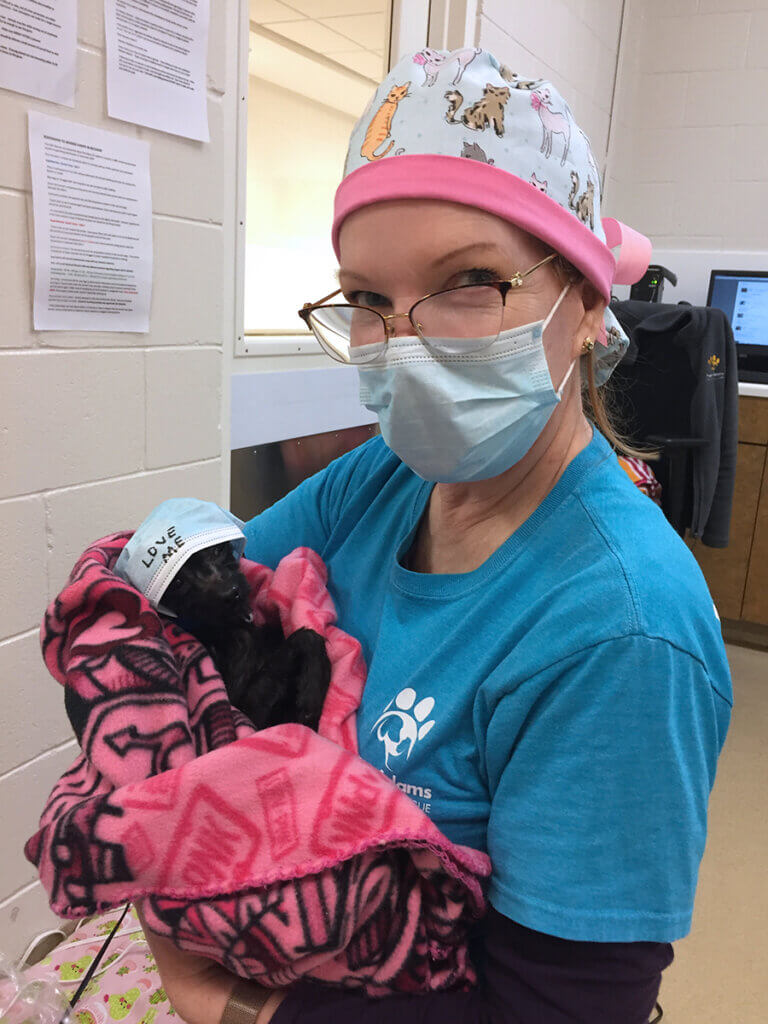
Coco resides in the South Bend area of northern Indiana and describes herself as a proud country resident who lives eight miles from the nearest grocery store. The story of her attraction to veterinary medicine has a familiar ring to it because she said she always had an interest in animals.  Throughout her life she also has been surrounded by veterinarians who have inspired her in many ways.

Growing up on a farm, Coco saw many veterinarians who visited to treat the livestock.  In most cases, these practitioners gave Coco first-hand exposure to veterinary medicine. She specifically recalls how one of them – a Purdue graduate – had her help hold the animals while he administered vaccines. These interactions fostered her interest in studying veterinary medicine.

When asked what inspired her to go back to school, albeit virtually, while in her early 60s, Coco said, “I’m looking at my bucket list and it’s about the quality of my remaining time. I have some things I want to do and I’m going to do them.”

Coco’s interest in veterinary medicine was heightened when she volunteered at a spay and neuter clinic called Peggy Adams Animal Rescue League in Palm Beach, Fla. She enjoyed her time there, which encouraged her to pursue any educational opportunities she could find.

At age 59, Coco earned a Certificate in Veterinary Assistance at Palm Beach State College in Florida. Then she opted to enroll in the Purdue Veterinary Nursing Distance Learning Program to earn the degree she did not have the opportunity to pursue when she initially began her college career years earlier. “It’s like I’m finally getting to live my dreams from my younger years,” Coco said.

Coco had originally intended to attend Purdue University, but she said she could not get into the university’s programs because her high school had not offered chemistry. So instead, she followed her interest in writing and studied journalism at Indiana State University. Her education included internships with the Indianapolis Star and the South Bend Tribune. After graduating, she worked for the Associated Press.  She described the work as an excellent opportunity, but said it did not fulfill all of her career wishes.

After moving to Los Angeles, Calif., Coco earned a master’s in professional writing from The University of Southern California. Through the graduate degree program she learned about a much broader array of writing – everything from writing menus to manuals. She then accepted secretarial positions at Columbia Pictures and Warner Brothers Studios and at one point even worked as a secretary for comedian Richard Pryor.

“Throughout our lives we reinvent ourselves,” Coco explained. For her, journalism is in the rear-view mirror and she is now onto another chapter, which is to become a veterinary nurse. 

Coco describes her Purdue distance learning experience as fantastic. “I chose Purdue for the excellent instruction, but stayed for the incredible people. I have a wonderful academic advisor and professors who have helped me every step of the way.”  Coco said her favorite course is pharmacology because it involves all of the aspects of physiology and then throws chemicals, formulas, and molecules into the mix.

Coco already is finding her veterinary studies helpful in taking care of her animals, which include several cats, only two of which reside in her house. She is part of a program called Trap Neuter Return, or TNR for short. Typically, barn and street cats are not spayed or neutered and Coco sets traps for them so she can take them to be neutered and microchipped. Afterward, if they cannot be adopted, she returns them to the field.

In her free time, Coco enjoys sewing and gardening. She also has made several scrub caps for her friends in the medical field.  As if that’s not enough, she even helps her husband with his commercial real estate business, assisting with the problem solving aspect of the business by helping him find roofing and plumbing issues in the properties he leases. After spending a few minutes visiting with Coco, you realize it’s no wonder she boldly forged ahead to begin a new career in her 60s.  And you have no doubt she will succeed as someone who embodies the true Boilermaker spirit of persistently pursuing the next giant leap.

Interested in the Veterinary Nursing Distance Learning Program?
Learn more

Writer(s): Jonathan Martz, PVM Communications Intern | pvmnews@purdue.edu

Recent Stories

Purdue Veterinary Medicine’s Connection with Wildlife Rescue in Guatemala Highlighted during International Education Week

Hidden amid the dense forests near the shores of Lake Petén Itzá, the ARCAS Wildlife Rescue Center is one of Central America’s most active sanctuaries for endangered and trafficked wildlife. In addition to their conservation efforts, ARCAS (Asociación de Rescate y Conservación de Vida Silvestre) offers unparalleled hands-on experience for veterinary and biology students from around the world. The Purdue University College of Veterinary Medicine has proudly collaborated with ARCAS for many years, and International Education Week this week (November 16-22) provided the perfect opportunity to showcase this invaluable educational partnership.

Immersive Mixed Reality Experience Helps Purdue Veterinary Students Learn Cardiac Physiology

First year Doctor of Veterinary Medicine students at the Purdue University College of Veterinary Medicine recently stepped into a new era of learning — an immersive Mixed Reality (MR) experience at Purdue’s Envision Center. This cutting-edge session allowed students to interact with a dynamic, 3D representation of the heart, deepening their understanding of cardiac physiology in ways traditional methods cannot match.

Feathered Fame: Purdue Veterinary Medicine Research Featured on Journal Cover

The Department of Veterinary Clinical Sciences (VCS) at Purdue University is proud to announce that a recent study from its anesthesiology team has been selected as the cover feature for Veterinary Sciences (MDPI), Volume 12, Issue 11. Chosen from among 82 articles, the publication highlights the College of Veterinary Medicine’s growing impact in avian clinical research.

“Paws Up” – brought to you by the PVM Wellness Committee

Time to shine a spotlight on some “paws-itively” amazing work by one of our newest Purdue Veterinary Medicine staff members, Jennifer Hartman, VCS Curriculum Technologist in the Department of Veterinary Clinical Sciences.

“Paws Up” – brought to you by the PVM Wellness Committee

Today we are highlighting Rebecca Hoffman, BS, RVT, who is a veterinary technologist with the Bovine Field Service.

Learning Specialist Joins PVM Student Success Center Team

Purdue Veterinary Medicine’s Student Success Center is pleased to welcome Kelsey Luse Spille, who joined the team Monday, November 4, as a learning specialist.  In her new role, she will be supporting students with their academic needs while also serving as a member of the Veterinary Education Support Team (VEST), which assists faculty in developing inclusive teaching practices.

Purdue College of Veterinary Medicine Hosts Reception to Welcome New Dean Bret Marsh

Faculty, staff and students gathered at a reception in the Veterinary Medical Library Friday, November 8, to help extend a warm welcome the new dean of the Purdue University College of Veterinary Medicine, Dr. Bret Marsh.  The event marked the conclusion of the first week on the job for Dr. Marsh, who just started in the role Monday, November 4, after wrapping-up 30 years of service as Indiana State Veterinarian – the state’s top-ranking animal health leader.

Awareness Week to Shine Spotlight on Antimicrobial Resistance Next Week

Antimicrobial resistance (AMR) is a growing, significant One Health issue across the world. The WHO estimates that AMR was directly responsible for 1.27 million global deaths and contributed to 4.95 million deaths, with additional significant economic costs. AMR affects all countries and all income groups, and to tackle this urgent problem, researchers, producers, and practitioners from all areas must address the critical shortage of new antimicrobial drugs, and the use of antimicrobial drugs in medicine, farming, and industry. The week of November 18-24 is US Antibiotic Awareness Week and World AMR Awareness Week, and the College of Veterinary Medicine is taking advantage of these national and global campaigns to raise awareness about AMR and antimicrobial stewardship, and to highlight some of the research and practices being conducted at the college to address AMR.

PVM Faculty Honored for Research Success with Purdue Seed for Success Acorn Awards

When Purdue University’s Office of Research honored the accomplishments and innovative ideas of a host of researchers this week, several Purdue Veterinary Medicine scholars were among those recognized. At a ceremony Wednesday, November 14, in the Purdue Memorial Union North and South Ballrooms, the annual Seed for Success Acorn Awards were presented to Purdue Principal Investigators (PIs) and co-PIs who secured research awards of $1 million or more for a single proposal in fiscal year 2024.

Unlocking the Mysteries of the Brain

Despite more than six decades of research in the field of neuroscience, many functions of the brain — the most complex organ in the human body — remain a mystery. Recent research conducted in the Purdue University College of Veterinary Medicine and the Bindley Bioscience Center revealed that scientists are one step closer to understanding the process that activates and deactivates specific proteins within our cells. This breakthrough could one day lead to enhanced treatments that may slow down or perhaps reverse the advance of neurogenerative diseases such as Alzheimer’s, Parkinson’s and multiple sclerosis.