Calving School Provides Learning Opportunities for Indiana Farmers

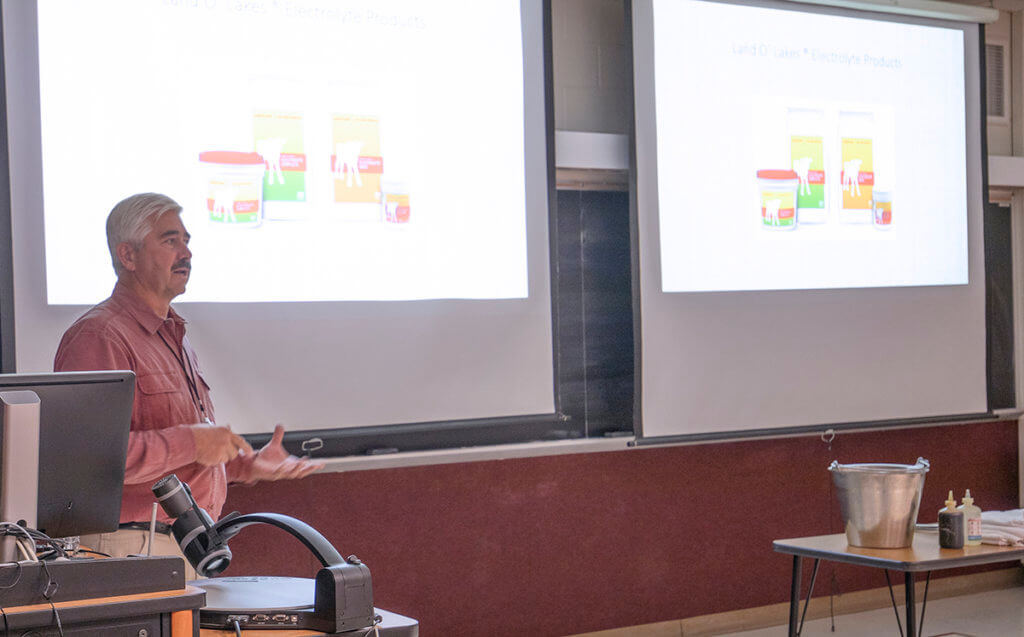
Ralph speaks to a classroom of attendees
Ralph Gill, calf technical sales and business manager at Land O’Lakes, presented a talk on colostrum in the neonate as part of the first Purdue Calving School hosted by the Purdue University College of Veterinary Medicine.

Purdue Veterinary Medicine recently hosted the Purdue Calving School, a new opportunity for area beef and dairy producers to learn more about managing their herds at calving time.  Attendees came from across Indiana and Kentucky for the event, which was held at Lynn Hall the weekend before Thanksgiving.

The Calving School, a first for the College of Veterinary Medicine, featured presentations by Dr. Jennifer Koziol, clinical assistant professor of production medicine; Dr. Rafael Neves, assistant professor of food animal production medicine; and Dr. Jon Townsend, clinical assistant professor of dairy production medicine and director of extension programs. Additionally, Ralph Gill, calf technical sales and business manager for Land O’Lakes, which sponsored the event, talked about the importance of colostrum delivery in neonatal calves. 

The Calving School originally was planned as a one-day event in Lynn Hall on Saturday, November 23, for a maximum of 30 attendees, but community interest was so great that the College added a second session on the following day (Sunday, November 24).  Over both days, a total of nearly 60 attended.

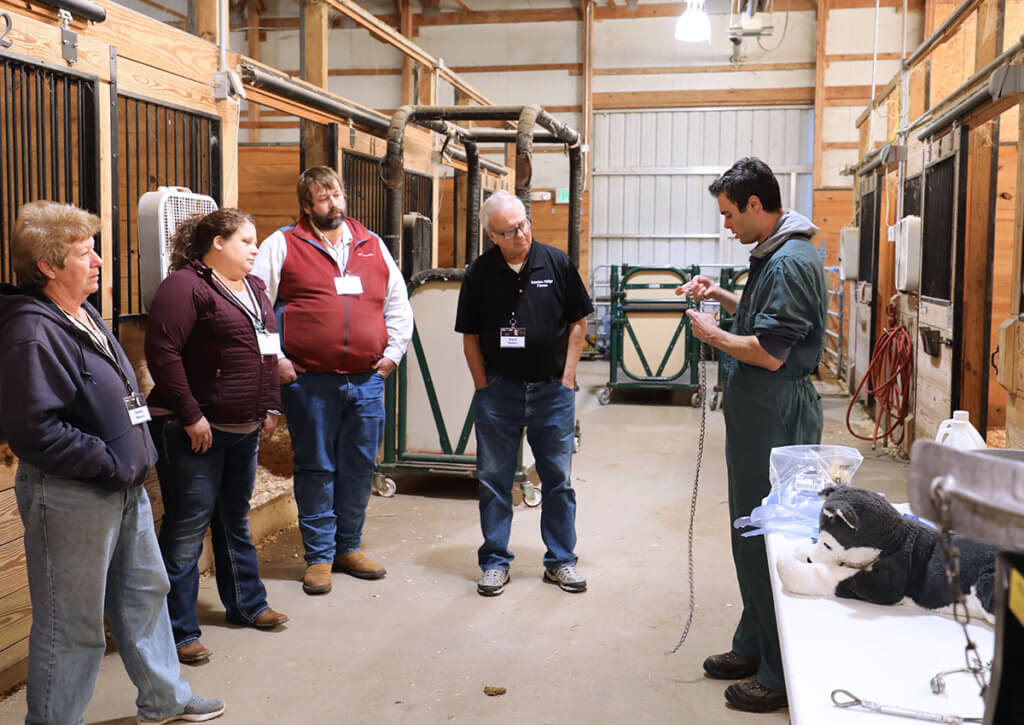
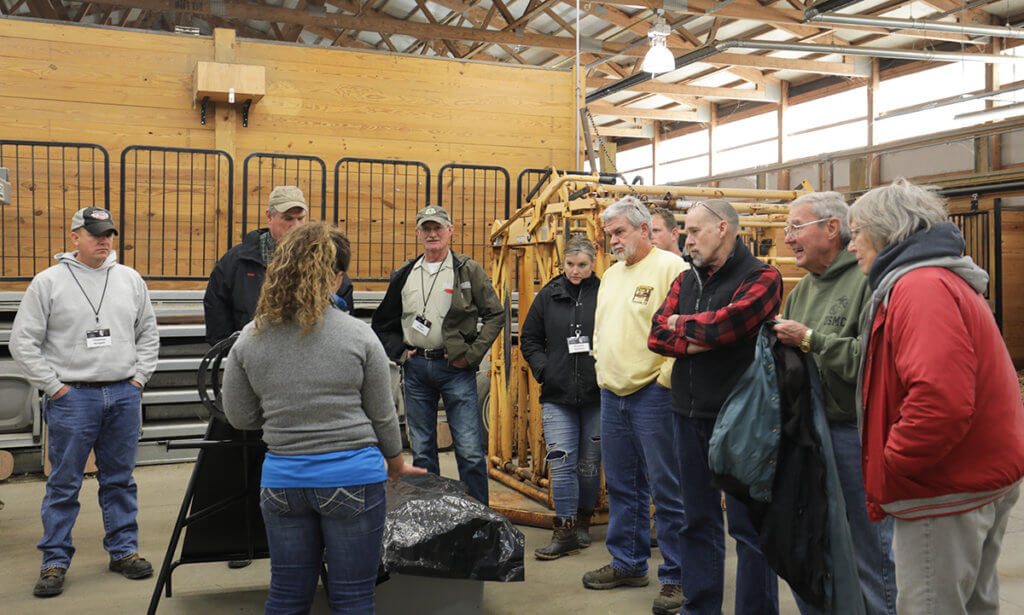
On each day, the program began with lectures covering various topics, including how to successfully deliver a calf, when to call your veterinarian, and postpartum problems in the cow and calf. Then attendees relocated to the Equine Health Science Annex, behind Lynn Hall, to participate in hands-on activities. Demonstrations included how to use an esophageal feeder, how to properly assess and handle calving dystocia situations, and what items to have in your calving toolbox. 

The success of the program precipitated plans to make the Purdue Calving School an annual event. 
Writer(s): Maya Sanaba, PVM Communications Intern, and Andrea Brown | pvmnews@purdue.edu

Recent Stories

“Paws Up” for Jennifer Danaher – brought to you by the PVM Wellness Committee

This week we express our gratitude to Jennifer Danaher, who is department secretary for Veterinary Clinical Sciences.

‘Purdue Pursuits’: A PVM angle on Purdue’s teaching and learning reading groups

Crafting meaningful and engaging course experiences has been at the top of Dielson Vieira’s mind ever since he joined the Purdue University College of Veterinary Medicine’s faculty in 2024. As a clinical assistant professor in the Department of Basic Medical Sciences, Vieira is already adept at applying innovative teaching practices to classroom environments, but that doesn’t stop him from seeking out new ideas, approaches and perspectives — insights he gains through outlets like Purdue’s teaching and learning reading groups.

Top tier biology journal publishes PVM study that unlocks secrets of a drug-resistant fungal pathogen, which causes serious infections in humans

Though the name “Candida auris” is far from a household term, public health experts know it well because the multi-drug-resistant fungal pathogen, which causes serious human infections, has been classified as an urgent threat by the U.S. Centers for Disease Control and Prevention (CDC) Antibiotic Threats Report (2019). Dr. Shankar Thangamani, Associate Professor of Microbiology and University Faculty Scholar in the Purdue University College of Veterinary Medicine’s Department of Comparative Pathobiology, is researching C. auris, aided by a 2.4 million grant from the National Institutes of Health (NIH). New research findings, just published in Nature Microbiology, show how C. auris adapts and evades the immune system.

In Print: ‘Translational Research Methods for Tauopathies’

A just-published 300-page volume edited by Jessica Fortin, Purdue assistant professor in the College of Veterinary Medicine’s Department of Basic Medical Sciences, provides a significant new resource for researchers studying a group of neurodegenerative diseases known as tauopathies. “Translational Research Methods for Tauopathies” provides detailed protocols intentionally selected to serve as a basis for research laboratories seeking to further treatments for such debilitating neurodegenerative diseases as Alzheimer’s and chronic traumatic encephalopathy (CTE).

It’s Almost Here!

Though the annual Purdue Veterinary Conference is almost upon us, there’s still time to register and take advantage of this time-honored College of Veterinary Medicine fall tradition that combines excellent continuing education with fun opportunities for reconnecting with colleagues and classmates, networking, and learning about the latest veterinary trends and products. The 2026 Purdue Veterinary Conference takes place September 23–26 on the Purdue University campus. The annual event has something for everyone, from veterinarians to veterinary technicians, faculty, staff and students.