
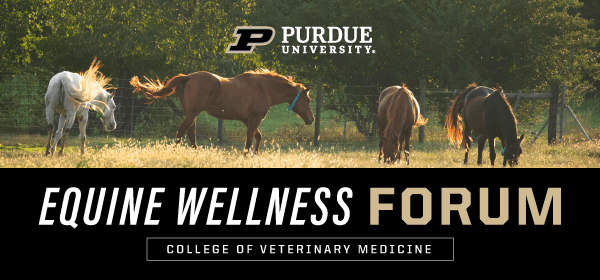
The Purdue University College of Veterinary Medicine’s annual event designed to inform horse owners and equine industry professionals about horse health issues galloped into new territory this year by going virtual. Normally held as a day-long in person program, the Equine Wellness Forum was conducted virtually, and spanned several days, with presentations given over the Zoom platform on topics ranging from basic preventative healthcare to the latest medical advancements.
The first session was held on Saturday, February 6 and began with a virtual walkthrough of the new Purdue University Veterinary Hospital facilities now under construction. Participants were able to watch drone footage of the construction site as Purdue Veterinary Medicine Dean Willie Reed provided narration. The rest of the program that day featured four speakers beginning with a faculty member who has achieved legendary status as a long-time clinician in the Large Animal Hospital, Professor of Large Animal Surgery Stephen Adams.
Dr. Adams’ lecture, entitled “40 years of Equine Surgery,” was extra special because he will be retiring this summer after a long history of helping clients with their horses at Purdue, providing life-saving treatments to patients, and improving the overall well-being of both horses and riders. In his talk, Dr. Adams spoke about how horses are living much longer today, many even living over 35 years. Their increased life-span is due to a myriad of factors, including geriatric diets and better nutrition as well as improved surgical therapies. Newer technologies have made it possible for horses to remain standing while undergoing diagnostic procedures such as ultrasonography and endoscopy.
Another lecture featured Dr. Erin Wilson of Nutrena, who spoke about her findings related to customizing horse diets. Her lecture included healthy types of grains and grass to feed horses, and the proper mixture for each. Forum attendees also were treated to presentations by Dr. Amanda Farr, clinical assistant professor, and Dr. Sarah Waxman, visiting assistant professor, with the Purdue University Veterinary Hospital Equine Field Service, who spoke on the topics of “Horse-proofing the Barn” and “Neck and Back Pain in the Horse,” respectively.
Because the program was conducted virtually, additional lectures were presented during subsequent weeks, including talks on “Laminitis: What’s New?” by Dr. Tim Lescun, associate professor of large animal surgery; “Sinus and Guttural Pouch Disease,” by Dr. Jan Hawkins, professor/section head of large animal surgery; “Muscle Disease,” by Dr. Stacy Tinkler, clinical associate professor of large animal internal medicine; and “When the Filters Fail: Kidney and Liver Disease,” by Dr. Sandra Taylor, associate professor of large animal internal medicine.
Veterinary medical professionals were able to earn continuing education credits for their participation, but most of the attendees were horse owners looking to expand their knowledge. A total of about 120 people registered to participate in the virtual Equine Wellness Forum in its live on-line format. Additionally, most of the videos that were posted from the Forum as of March 14 had been viewed 30-40 times. All of the lectures on the initial Saturday and during the subsequent weeks were recorded and can be accessed by attendees for a limited time. “Given that it was not possible to safely hold the event in person this year, we were excited to have the opportunity to still provide this valuable information and education for the equine industry virtually,” said PVM’s Director of Lifelong Learning Ben Shepard. “The presenters did a fantastic job and the sessions went off without a hitch. We are thankful for everyone who registered to participate, thereby making this first virtual Equine Wellness Forum a success.”
