
ADDL Provides Pivotal Testing for Presidentially Pardoned Turkeys at Holiday Time

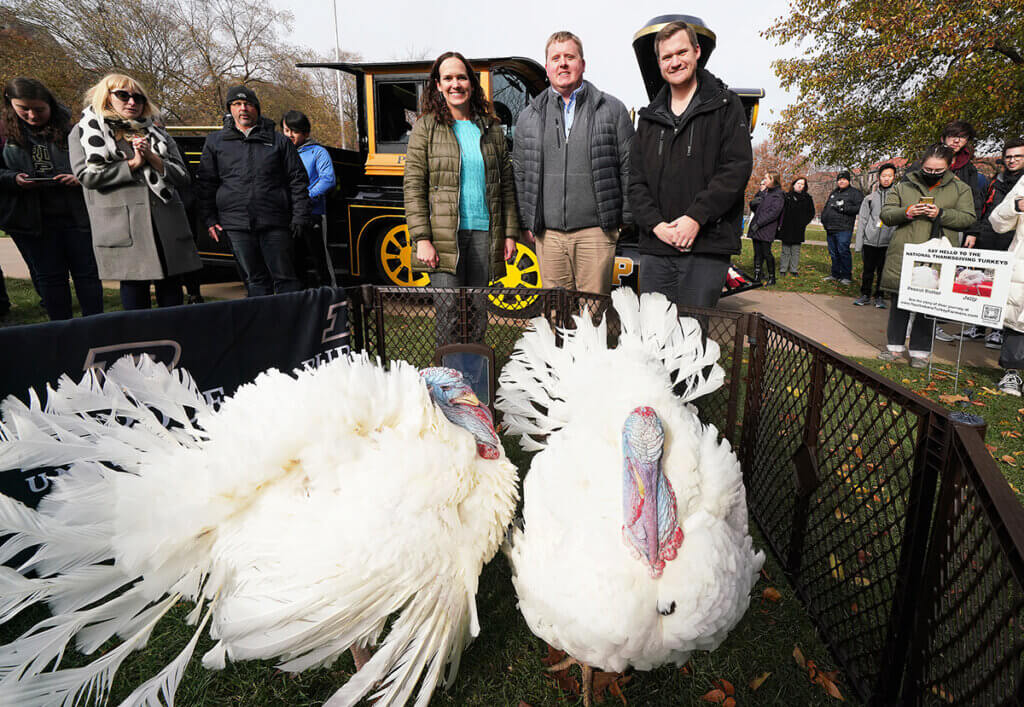
Drs. Hendrix, Bowen, and Lossie stand behind the two turkeys as a crowd gathers around
Peanut Butter and Jelly, the Broad Breasted White turkeys pardoned by President Joe Biden, are the center of attention as Drs. Kenitra Hendrix, Craig Bowen and Geoffrey Lossie of the ADDL get in on a photo op during an official welcoming for the turkeys on Purdue’s Memorial Mall November 29 (Photo by Tom Campbell).

When the turkeys that had received the official presidential pardon at the White House before Thanksgiving arrived at Purdue University to settle in to their new post-pardon residence this week, they had the Animal Disease Diagnostic Laboratory (ADDL) to thank for being able to safely travel to the pardoning ceremony.  The two turkeys, named Peanut Butter and Jelly, posed for photo ops Monday (November 29) on Purdue University’s Memorial Mall in front of the Boilermaker Special.

Purdue University’s Department of Animal Sciences in the College of Agriculture is providing a home and care for the National Thanksgiving Turkeys following the National Thanksgiving Turkey Presentation at the White House. The turkeys will live at Purdue’s Animal Science Research and Education Center, where they will reside in a separate enclosed indoor setting with access to a shaded grassy area.

There’s also another Purdue angle to the story that ties in directly with the College of Veterinary Medicine. “The ADDL performed the required testing for the Presidential Turkeys to travel out of state,” said Dr. Kenitra Hendrix, ADDL director and clinical associate professor of veterinary diagnostic microbiology in the Department of Comparative Pathobiology.  The turkeys were raised under the supervision of Phil Seger, 2021 National Turkey Federation chairman, and by southern Indiana turkey producer Andrea Welp, in cooperation with Farbest Farms.

“We are very pleased to be the diagnostic lab of the 2021 Presidential Turkeys,” said Dr. Craig Bowen, assistant director of the ADDL. “The ADDL plays a vital role in protecting the health and safety of Indiana’s significant poultry industry, and so the testing is something we do all the time to support poultry producers like Farbest Farms.” 
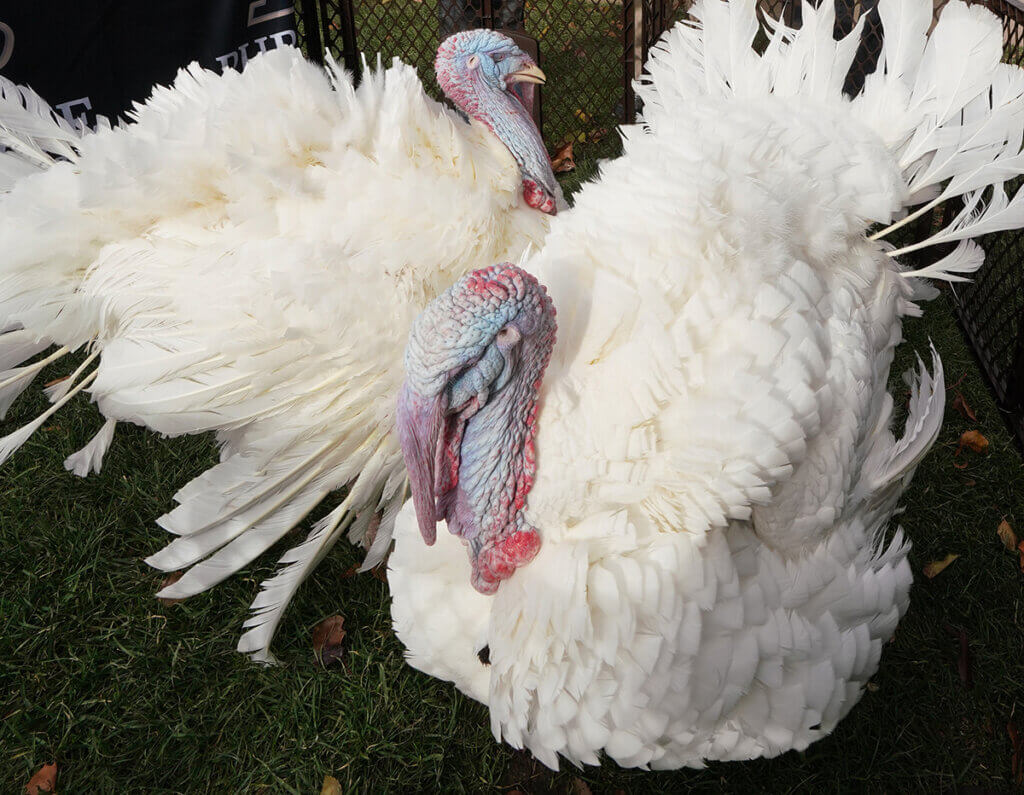
turkeys pictured standing together in the grass
Peanut Butter and Jelly, the 2021 Presidential Turkeys, will reside at the Purdue University Animal Science Research and Education Center.

Dr. Geoffrey Lossie, avian diagnostician at the ADDL and clinical assistant professor of pathology in the College of Veterinary Medicine, said the tests performed included the Avian Influenza PCR (polymerase chain reaction) test and testing for Newcastle Disease, a contagious viral disease affecting the respiratory, nervous and digestive systems of birds and poultry. “We were honored to be able to perform these important tests for these special Thanksgiving birds and give them the clean bill of health they needed to be able to receive their presidential pardon,” Dr. Lossie said.

Indiana is the fourth largest turkey producing state in the nation and ranks first in duck production and second in egg production. The poultry industry contributes more than $12 billion in total economic activity to Indiana and employs more than 12,000 people.

“I think it’s great that there’s a strong connection between Purdue University and the National Thanksgiving Turkey Presentation at the White House, given the prominence of Indiana’s poultry industry,” said Dr. Hendrix.  “Purdue’s involvement in this tradition shines a spotlight on the importance of the testing we do to ensure the health and safety of the flocks of Indiana’s poultry producers.”

Purdue Agriculture’s Department of Animal Sciences includes a nationally recognized poultry program, with experts in nutrition, health, education, behavioral neuroendocrinology, management, behavior, and animal welfare. “Although turkeys are an important American cultural tradition, most people do not know much about turkey production and management, so this is an amazing chance for us to increase awareness and knowledge of turkeys’ behavior, personalities, and welfare,” said Dr. Marisa Erasmus, assistant professor of animal sciences. Another focus will be educating students on more in-depth poultry care. “We will be highlighting them in some of our teaching programs and when we have events, such as the annual Spring Fest,” Dr. Erasmus said.

At the welcome home event for the two presidentially pardoned Broad Breasted White turkeys, Purdue students, staff, and faculty enjoyed getting photos with the University’s newest resident celebrities.

Writer(s): Jillian Ellison, Purdue University College of Agriculture, and Kevin Doerr | pvmnews@purdue.edu

Recent Stories

Contraceptive vaccine reduces fertility in animals to address wildlife overpopulation

A Purdue University contraceptive vaccine seeks to address animal overpopulation by markedly reducing fertility in feral horses, deer, swine and other animals. Dr. Harm HogenEsch, distinguished professor of immunopathology in Purdue University’s College of Veterinary Medicine, and Dr. Raluca Ostafe, director of Purdue University’s Molecular Evolution Protein Engineering and Production Facility, both members of the Purdue Institute for Inflammation, Immunology and Infectious Disease, have designed the vaccine based on the IZUMO1 mammalian sperm protein. It induces a robust and long-lasting immune response and infertility in female mammals.

“Paws Up” – brought to you by the PVM Wellness Committee

This week Dr. Kristy Faulkner, a specialty intern in neurology, is being appreciated for supporting students’ morale and being a “baker extraordinaire,” taking extra steps in sharing her beautifully decorated cupcakes with the Small Animal Internal Medicine team.

Coppoc One Health Lecture Brings Co-leader of Innovative Dog Aging Project to PVM

“One Health at Home: Dogs as Sentinels of Environmental Exposure” is the title of the 2026 Coppoc One Health Lecture presented by Dr. Audrey Ruple, co-principal investigator for the largest animal-health research initiative to date – the Dog Aging Project.  Dr. Ruple, the Dorothy A. and Richard G. Metcalf Professor of Veterinary Medical Informatics at the Virginia-Maryland College of Veterinary Medicine at Virginia Tech, gave her talk February 26 in Lynn 1136. The lecture was free and open to the public.

Three More Years: How Specialized Care Helped Extend One Dog’s Life

When Ella, a pittie beagle mix, was diagnosed with bladder cancer at age 11, Jennifer Turner knew she wanted to make every decision count. What she did not yet know was that a cross country drive to Purdue University would give her three more years with the dog she described as her constant companion.

“Paws Up” – brought to you by the PVM Wellness Committee

This week we feel grateful for Anita Wolf, RVT, who is a veterinary technician in Intermediate Care in the Brunner Small Animal Hospital facility.

In Memory – Dr. Janet Weiss (PU DVM ’91)

The Purdue Veterinary community is saddened by the recent passing of Dr. Janet Weiss, an alumna who served as a dedicated veterinarian in Northwest Indiana. A resident of La Porte, Indiana, Dr. Weiss passed away February 20, 2025. She was 61.

Upcoming PVM Veterinary Nursing Symposium Features Hands-On Learning

Veterinary professionals in the field of veterinary nursing have a special opportunity to expand their expertise and earn continuing education (CE) at Purdue Veterinary Medicine’s Annual Veterinary Nursing Symposium. The one day continuing education program will be held at Lynn Hall on the Purdue campus March 23, 2025.

Zebra Foal Gets Lifesaving Help at Purdue University Equine Hospital

It’s not surprising to see a foal receiving emergency care at the Purdue University Equine Hospital during foaling season. The hospital’s team of expert clinicians and veterinary nurses are used to coming to the rescue when foals need special help to survive. But it was a surprise to see a foal named Marty arrive at the hospital’s Intensive Care Unit in February, because Marty is a zebra, and the hospital is in Indiana.