
Purdue University College of Veterinary Medicine’s This is How We “Role” ® program has received the 2020 Inspiring Programs in STEM Award from INSIGHT Into Diversity magazine, the largest and oldest diversity and inclusion publication in higher education. The national award for colleges and universities recognizes programs that are making a difference for all underrepresented groups in the fields of science, technology, engineering, and mathematics (STEM).
Inspiring Programs in STEM Award winners were selected by INSIGHT Into Diversity based on efforts to inspire and encourage a new generation of young people to consider careers in STEM through mentoring, teaching, research, and successful programs and initiatives. The This is How We “Role” program received the award because of its long-term goal of diversifying the veterinarian-scientist workforce, which is currently over 90% White. The college is featured, along with 73 other recipients, in the September 2020 issue of INSIGHT Into Diversity magazine.
Purdue Veterinary Medicine Dean Willie Reed said receiving this award is especially meaningful for the college. “One of our college’s priorities is to inspire young people from diverse backgrounds to pursue rewarding careers in veterinary medicine,” Dean Reed said. “This is How We ‘Role’ provides a highly engaging approach to catching the interest and imagination of children, with the hope of opening their eyes to the possibility of becoming future veterinarians and veterinary nurses. Supported by a talented team of collaborators, this program has great potential to bring greater diversity to the veterinary medical profession, and in doing so, to enhance the profession’s success in meeting the needs of both animals and people.”
The program is supported by the Science Education Partnership Award (SEPA) program at the National Institute of General Medical Sciences of the National Institutes of Health. The program focuses on developing a sustainable, easily replicable model for bringing veterinary STEM resources to children.
Led by the College of Veterinary Medicine, the project team, including experts at Purdue, elementary school teachers, a children’s book illustrator, and the Kingston Bay Group, an education consulting agency, developed a 56-lesson, low-cost, culturally responsive, and engaging STEM curriculum to expose students in kindergarten through fourth grade to careers in veterinary medicine and biomedical research.
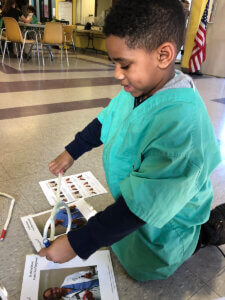
The fun and interactive science and math curriculum is delivered by veterinarians and veterinary medical student role models to help children learn about basic veterinary science, the breadth of careers in the veterinary profession, and how veterinary professionals can prevent and treat health conditions such as diabetes, cancer, and asthma that impact both people and their animals.
Purdue University’s Evaluation and Learning Research Center evaluates program impact on veterinary medical student role models and participating children. The evaluation focuses on changes in the children’s attitudes toward careers in veterinary medicine, knowledge of veterinary science, and their perceptions of themselves and their capability to achieve success. The program’s effect on the veterinary student role models is evaluated by measuring their likelihood to continue community service in the future and their ability to interact effectively with future clients.
Purdue Veterinary Medicine enjoys a long-term, mutually beneficial collaboration with Hanna Community Center in Lafayette, Ind., where the This is How We “Role” curriculum is delivered through after-school programs and summer camps for children under 12 years of age, 90% of whom are from low income families. Hanna’s mission is to provide a gathering place, celebrate cultural differences, and provide social services that improve the quality of life.
The college has provided resources for the establishment of This is How We “Role” chapters at 20 of the 32 U.S. veterinary colleges. Each chapter consists of veterinary medical students and faculty who deliver the curriculum to disadvantaged elementary school students in their communities through partnerships with community organizations.
“We are very excited to be able to expand the program by providing role models for children across the country who are considering a future in veterinary medicine,” said Dr. Sandy San Miguel, associate dean for engagement at the College of Veterinary Medicine and principal investigator for the This is How We “Role” grant.
Each partner institution is provided with a comprehensive guide for program implementation; online professional development training for delivering the program in a culturally responsive, age-appropriate manner; lesson materials including instructions, handouts, and activity sheets; and tools for assessing the program’s impact both on the elementary school students and veterinary student role models.
“We know that many STEM programs are not always recognized for their success, dedication, and mentorship for underrepresented students,” says Lenore Pearlstein, owner and publisher of INSIGHT Into Diversity magazine. “We want to honor the schools and organizations that have created programs that inspire and encourage young people who may currently be in or are interested in a future career in STEM. We are proud to honor these programs as role models to other institutions of higher education and beyond.”
This is the second time the This is How We “Role” program has won the award.
