
Coppoc One Health Lecture Raises Awareness about Effects of Zoonotic Pathogen Spillover

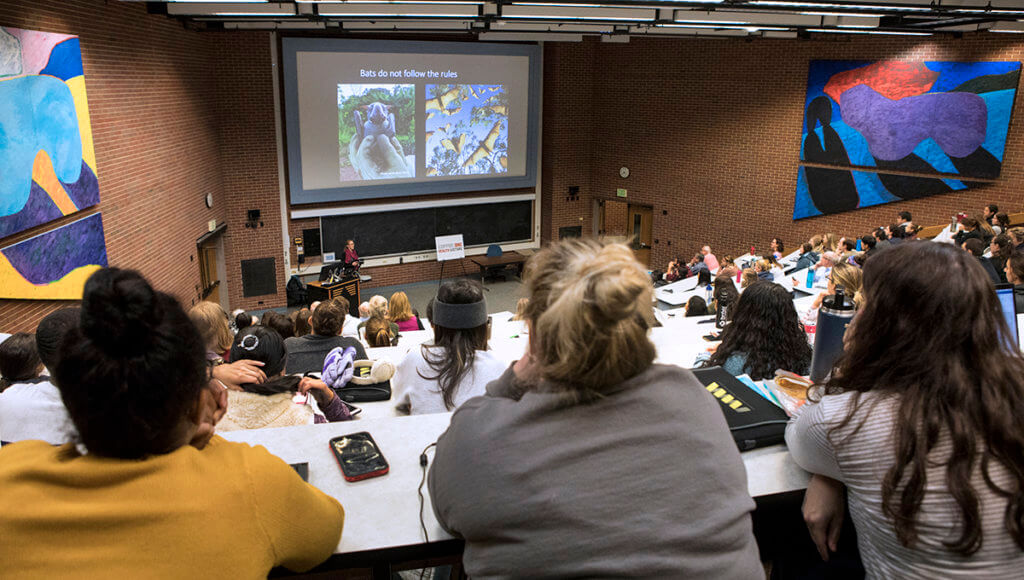
Lecture attendees fill the seats in Lynn Hall Room 1136 as Dr. Plowright presents
The Coppoc One Health Lecture in Lynn Hall, featuring Dr. Raina Plowright, who has extensive experience as an infectious disease ecologist, epidemiologist, and wildlife veterinarian, attracted an audience of PVM faculty, staff, and students as well as guests from across the Purdue campus.

The sixth annual Coppoc One Health Lecture brought Dr. Raina Plowright to Lynn Hall on Thursday, November 7, to address the issue of pathogen spillover and its One Health implications.  Raina Plowright, BVSc, PhD, is an assistant professor in the Department of Microbiology and Immunology at Montana State University, and has extensive experience as an infectious disease ecologist, epidemiologist, and wildlife veterinarian.  Her lecture titled “Pathogen Spillover: Lessons Learned from Emerging Bat Viruses” focused on how spillover happens, why it is important from a One Health perspective, and how taking a deeper dive into the root cause can help prevent additional spillover events. 

According to Dr. Plowright, viruses that originate in bats may be the most notorious for spilling over from wildlife into domestic animals and humans.  Understanding how these infections filter through ecological systems to cause disease in humans is of great importance to public health. 

In her lecture, Dr. Plowright described clusters of Hendra virus in bats that posed risks to horses in Australia.  Hendra is a virus that infects large fruit bats, known as flying foxes.  Occasionally the virus can spread from these bats to horses.  The infection is believed to be transmitted when horses eat feedstuffs recently contaminated by flying fox urine, saliva, or birthing products, such as the placenta and amniotic fluid.  Infected horses can then spread the virus to humans through contact with bodily fluids. 
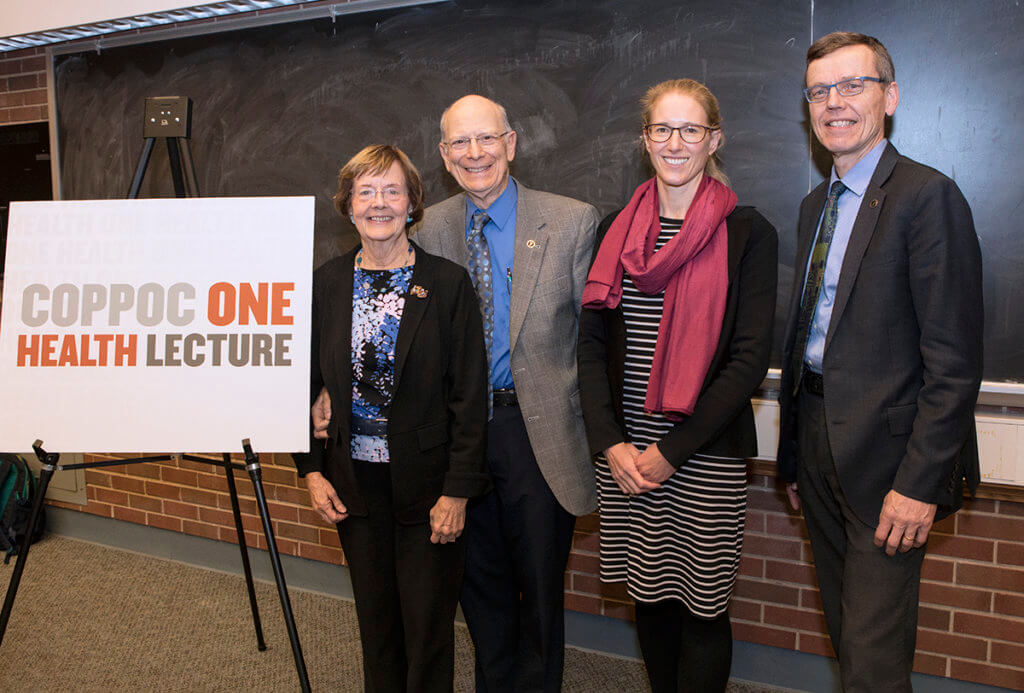
Dr. Coppoc and Harriet stand beside Dr. Plowright and Dr. HogenEsch alongside a sign that reads Coppoc One Health Lecture
Associate Dean for Research Harm HogenEsch with (right-left) Dr. Raina Plowright, who gave the Coppoc One Health Lecture, and Dr. Gordon Coppoc and his wife, Harriet, in whose honor the annual lectureship is named.

In Australia, shortages in food sources and habitat loss have forced bats to change their roosting behaviors, leading to more interactions with horses and humans.  The stress of the ecological impact results in increased viral shedding, which ultimately causes additional concerns for pathogen spillover events.  Dr. Plowright not only explained those pathogenic concerns, but also concluded her lecture by discussing the related social and economic impacts.  These spillover events have caused controversy over vaccination recommendations for horses, land development, climate change, and the added expenses for communities facing increased fruit bat populations.

Dr. Plowright worked as a veterinarian on five continents before receiving an Australian Fulbright Fellowship to complete her PhD in ecology and master’s degree in epidemiology at the University of California, Davis. She then accepted a position as a David H. Smith Fellow in Conservation Research at the Center for Infectious Disease Dynamics at Pennsylvania State University before joining the faculty at Montana State University. Her research focuses on the dynamics of zoonoses in wildlife, the conservation implications of diseases in wildlife, the transmission of pathogens across species barriers, and links between environmental change and disease emergence.  

Named in honor of Dr. Gordon Coppoc, a Purdue professor emeritus of veterinary pharmacology, and his wife, Harriet, the Coppoc One Health Lecture was established as an annual campus-wide lectureship that highlights the important linkages between veterinary and human medicine.  Dr. Coppoc was a longtime faculty member and former head of the Department of Basic Medical Sciences in the Purdue University College of Veterinary Medicine.  He also served as director of the Indiana University School of Medicine ̶ West Lafayette and associate dean of the Indiana University School of Medicine before retiring in December 2014.

Following Dr. Plowright’s lecture in Lynn 1136, a reception was held in the Veterinary Medical library. 

Writer(s): Andrea Brown and Kevin Doerr | pvmnews@purdue.edu

Recent Stories

PVM Professor Emeritus Jan Hawkins Receives Prestigious Award from ACVS

The American College of Veterinary Surgeons (ACVS) and the ACVS Foundation have announced the recipients of several prestigious awards, and one of the awardees is Purdue Veterinary Medicine Professor Emeritus Jan Hawkins, DVM, DACVS.  The ACVS Board of Regents selected Dr. Hawkins as the recipient of the Al and Carolyn Schiller Distinguished Service Award in recognition of his exceptional contributions to ACVS through decades of dedicated volunteer leadership and service.

Retreat brings together Veterinary Technology team members 

Members of the Purdue Veterinary Technology Distance Learning (VTDL) Program team recently traveled to Purdue’s West Lafayette campus for an in-person retreat where they could work together and explore new opportunities for teaching, learning, and student success. The two day retreat focused on strengthening collaboration between the program's remote and on-campus teams, and represented a significant milestone for the program.

Annual Purdue Veterinary Conference draws veterinary professionals from across the country for learning and fun

The 2026 edition of the annual Purdue Veterinary Conference attracted attendees from around the U.S. for three days of educational sessions covering an array of topics.  With the overall theme of “One Health: Modern Veterinary Medicine,” the conference September 23-26 on the Purdue University campus drew more than 450 veterinarians and veterinary technicians, plus faculty, staff and students. Sessions taught by a total of 65 speakers, including many Purdue Veterinary Medicine clinicians and veterinary technicians/technologists, enabled conference-goers to earn up to 23 continuing education credit hours.

Significant Gift from Jordan Smelski Foundation will fuel Purdue Veterinary Medicine research on deadly brain eating amoeba

A researcher in the Purdue University College of Veterinary Medicine’s Department of Comparative Pathobiology has received a generous gift of more than $100,000 from the Jordan Smelski Foundation for Amoeba Awareness and Mr. Steve Smelski to support research of the deadly amoeba Naegleria fowleri. Christopher Rice, PhD, assistant professor of parasitology and principal investigator of the Rice Research Group, leads a research team seeking to discover and repurpose drugs against primary amoebic meningoencephalitis (PAM), a rare but typically fatal infection caused by Naegleria fowleri.

Purdue veterinary student receives Sir John D. Spurling Scholarship awarded by AKC Humane Fund

The AKC® Humane Fund, Inc.℠ has announced the 2026 recipients of the Sir John D. Spurling Scholarship, celebrating the human-canine bond, and one of the recipients is Purdue veterinary student Tiffany Chang of the Class of 2027. Chang is one of only five students chosen for the scholarships.