
Purdue Veterinary Medicine Equine Specialist Researches Better Treatments for Sepsis in Horses Using Innovative, Multimodal Approach

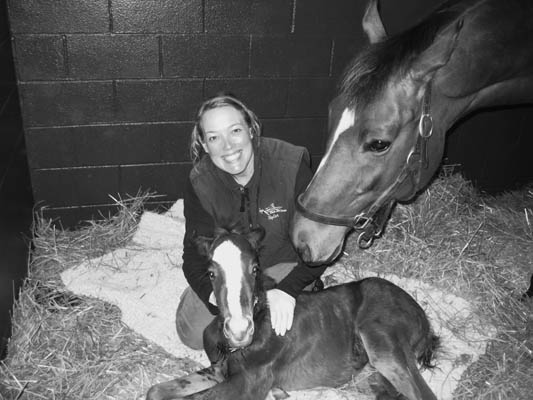
Dr. Sandra Taylor, associate professor of large animal internal medicine in the Purdue University College of Veterinary Medicine, with a newborn foal.
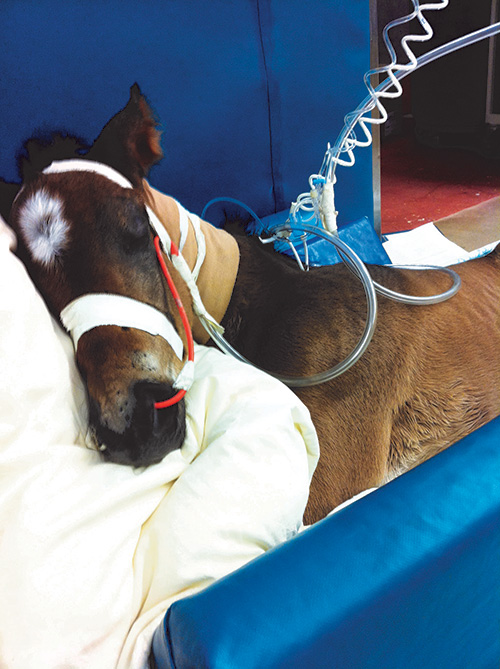
A foal undergoes treatment for sepsis at the Purdue University Large Animal Hospital.

Sepsis is a common cause of illness and death in both humans and animals worldwide, and occurs when infection leads to overwhelming, whole-body inflammation. In the majority of cases, infections resolve quickly by the use of antimicrobial drugs such as antibiotics, but widespread inflammation can lead to shock, organ failure, and death. Developing new therapies that stem the harmful cascade of inflammatory events is vital to improving survival in septic patients.

Dr. Sandra Taylor, associate professor of large animal internal medicine in the Purdue University College of Veterinary Medicine, is conducting research aimed at improving treatments for sepsis in horses. Newborn foals and other large animal species are particularly susceptible to sepsis when colostrum (the mother’s first milk) is not ingested within a few hours of birth. Colostrum contains protective antibodies that are critical in preventing ingested bacteria from entering the blood stream and causing sepsis.  Adult horses also suffer from sepsis, which can occur in cases of severe pneumonia, colitis, or uterine infection.

Dr. Taylor’s love for animals, particularly horses, led her to pursue a career in veterinary medicine. “While investigating an equine model of HIV during graduate school, I developed a passion for research,” Dr. Taylor said. “I am especially interested in research that can be applied to both animals and humans.” Equine studies can be good examples of that kind of comparative research, according to Dr. Taylor.
A foal undergoes treatment for sepsis at the Purdue University Large Animal Hospital.

Dr. Sandra Taylor, associate professor of large animal internal medicine in the Purdue University College of Veterinary Medicine, with a newborn foal.

Specifically, Dr. Taylor has studied the anti-inflammatory effects of ketorolac tromethamine (KT) in the horse, and has found that this non-steroidal anti-inflammatory drug (NSAID) decreased inflammation in equine blood that had been stimulated with gram negative bacteria. She is currently investigating the analgesic properties of KT, phenylbutazone (Bute), and flunixin meglumine (Banamine®) in the horse. She hopes that KT will be a superior NSAID in treating both sepsis and pain in horses.

Dr. Taylor is also investigating the safety and efficacy of using stem cells to treat sepsis. Stem cells have been shown in her laboratory to elicit anti-inflammatory effects in bacteria-stimulated equine white blood cells, and in rodent models (mice and rats). Dr. Taylor has isolated and grown stem cells from horse blood, and is currently in the process of characterizing the cells prior to confirming the safety of intravenous administration. The next step will be to test the ability of stem cells to improve survival in septic horses.

Writer(s): Aparna Desai | pvmnews@purdue.edu

Recent Stories

Purdue Equine Hospital Team Comes to Aid of Horse Injured in Severe Storm in Michigan

For a horse named Sassy, Purdue Veterinary Medicine’s Brunner Equine Hospital proved to be the right place at the right time to recover from a scary accident that happened during a severe storm in Michigan two weeks ago. According to Dr. Danielle Cucuzella, Purdue visiting assistant professor of large animal surgery, the Quarter Horse named Sassy was seriously hurt during near 100 mile-per-hour winds where she lived in Saint Louis, Michigan.

“Paws Up!” for 4th-year DVM students Colton and Kendall – brought to you by the PVM Wellness Committee

This week, we celebrate the caring and competence of two members of the new senior class of DVM students for their noteworthy service in the Purdue University Veterinary Hospital.

College of Veterinary Medicine Graduates Honored at Two Ceremonies During Purdue’s 2026 Commencement Weekend

A change in Purdue University’s traditional commencement weekend schedule resulted in two ceremonies recognizing graduates of the College of Veterinary Medicine in May.  This year, veterinary technology graduates were honored at aceremony that was separate from the commencement program for the DVM graduates.  That’s because the university recognized all doctoral degree candidates in a single ceremony on Saturday, May 16. As a result, the veterinary technology degree recipients were honored Thursday, May 14, at one of several ceremonies for undergraduate degree candidates. Following that ceremony, the college hosted its traditional oath ceremony for the 2026 graduates of the Purdue Veterinary Technology program in the Purdue Memorial Union North Ballroom.

White Coat Ceremony Celebrates Third-year Veterinary Students’ Transition to Clinical Year

The Purdue Memorial Union ballrooms provided a classic setting for an annual event that has become a cherished tradition of the Purdue University College of Veterinary Medicine. Members of the DVM Class of 2027 gathered with family, friends, faculty and staff on the evening of April 18 for the annual White Coat Ceremony that signals the transition of the third year veterinary students from the classroom to the clinics.

Popular Purdue Veterinary Medicine Bone Marrow Workshop Goes on the Road to Mexico

An annual program hosted by two bone marrow experts with Purdue University College of Veterinary Medicine ties, once again attracted strong attendance but in a new international location. This year, Drs. Joanne B. Messick and Rose E. Raskin were invited to Mexico City to present the Annual Bone Marrow Workshop at the Universidad Nacional Autónoma de México (UNAM).

“Paws Up” for Dr. Madeleine Swindell – brought to you by the PVM Wellness Committee

Today we share appreciation for Dr. Madeleine Swindell, who is a Purdue Veterinary Hospital Small Animal Rotating Intern.

Awards Ceremony Honors Outstanding Purdue Veterinary Medicine Staff

Applause and periodic shouts of “Bravo” punctuated the Purdue University College of Veterinary Medicine’s annual spring Outstanding Staff and Bravo Awards Ceremony. The program held in Lynn Hall on May 13 honored some two dozen staff members for meritorious accomplishments.