Purdue launches new online veterinary clinical pathology program in partnership with alumni-founded Laboratory Retrievers, LLC

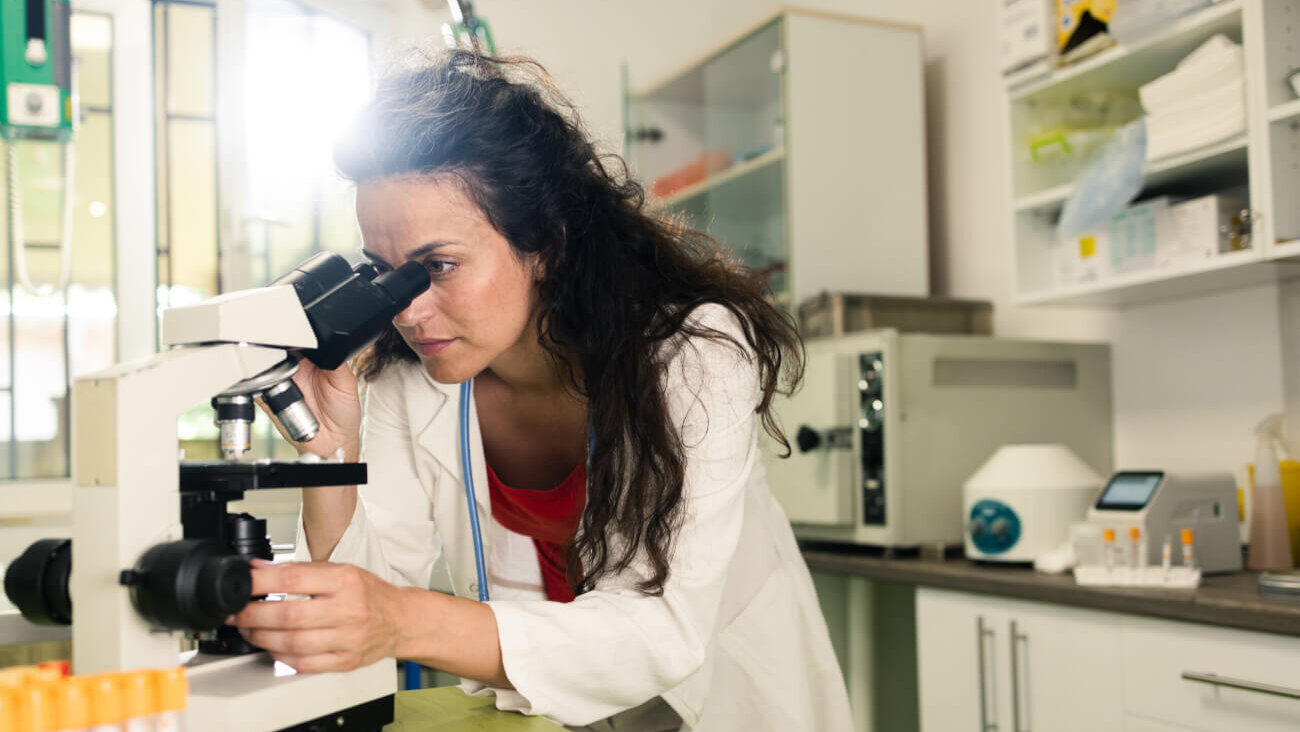
A woman with dark hair is wearing a white laboratory coat and looking into a microscope

Companion animals — dogs and cats — are excellent communicators, expressing a nuanced system of nonverbal cues and vocalizations that can help their human owners understand what they want and need. When it comes to feeling unwell, however, dogs and cats have an instinctual tendency to hide feelings of pain and weakness, making it difficult for humans to understand important warning signs.

That’s where Laboratory Retrievers, LLC, comes in. This team of experts, who are Purdue Veterinary Medicine alumni, seeks to promote better care for companion animals by advancing veterinary clinical pathology, the science of using blood and other tissue samples to objectively diagnose disease. One of the Laboratory Retrievers’ main objectives is to give more opportunities for veterinary professionals to practice clinical pathology skills, and, through a new partnership with Purdue University, the group seeks to do just that. 

Purdue’s new Laboratory Retrievers continuing education program is an online learning experience for veterinary professionals, created by Laboratory Retrievers, LLC, and Purdue University’s College of Veterinary Medicine. The program uses interactive modules and case studies to prepare veterinary professionals to confidently interpret CBC (Complete Blood Count) data, analyze cytograms and recognize blood cell morphologic abnormalities in minutes.

In 2026’s course, participants work through a series of four self-paced modules, with the option to attend weekly one-hour live sessions led by the program’s expert instructors. The program is delivered 100% online, and participants can even use their computers as virtual microscopes for blood cell morphologic assessments. The program’s goal is to provide maximum flexibility while maintaining a highly interactive educational experience through a combination of online case studies and interactive sessions.

The Laboratory Retrievers, LLC, are Al Rebar, DVM, PhD, DACVP; Dennis DeNicola, DVM, PhD, DACVP; and Fred Metzger, DVM, MRCVS, DABVP. Together, they have over 100 years of experience in veterinary clinical pathology and clinical practice. Rebar is a diplomate of the American College of Veterinary Pathologists, and he served as a veterinary clinical pathology faculty member in the Department of Comparative Pathobiology (CPB) at Purdue for 40 years. He also served as a department head and dean of the College of Veterinary Medicine. DeNicola is also a diplomate of the American College of Veterinary Pathologists, and he was a Purdue CPB faculty member for 21 years. During his tenure, he directed the teaching hospital Clinical Pathology Laboratory and was the primary clinical pathology educator for veterinary students, interns and residents. Metzger is a diplomate of the American Board of Veterinary Practitioners, adjunct professor at The Pennsylvania State University and founder of the VCA Metzger Animal Hospital in State College, Pennsylvania. All three of the Laboratory Retrievers have been recognized as distinguished alumni of Purdue’s College of Veterinary Medicine.

According to Rebar, the Laboratory Retriever’s partnership developed as a result of many years of academic mentorship and professional collaboration. Rebar taught both DeNicola and Metzger, and he also mentored DeNicola during his PhD training and influenced Metzger when he was in the early stages of his career. Rebar, DeNicola and Metzger have continued to collaborate extensively. After decades of working together, the three experts have a professional and academic chemistry that is hard to recreate.

“Our shared history has resulted in a rare teaching chemistry that makes complex clinical pathology approachable, engaging and unintimidating for learners at every stage,” said Rebar.

All three retrievers, as they like to call themselves, also bring their own expertise to the partnership. Rebar takes a systematic approach to laboratory data, emphasizing discipline and question-driven inquiry. DeNicola has deep expertise in laboratory methodology, quality control, instrumentation and interpretation. Metzger focuses on practical insights and clinical relevance.

Considering that the retrievers have a long-time connection to Purdue, this new partnership with the College of Veterinary Medicine is also about giving back. Purdue helped the retrievers start their careers and make an impact on veterinary medicine. Now, the group wants to give back to the College of Veterinary Medicine and enhance its clinical pathology legacy by donating a portion of profits from the course back to the college.

The first module for Purdue’s online Laboratory Retrievers continuing education program just started at the beginning of March. Students can sign up for modules individually or register for all four at a discounted rate. Learn more on the program’s webpage.

Writer(s): RM Barton, Purdue University Online | pvmnews@purdue.edu

Recent Stories

Fourth Purdue AMR Conference Promotes Collaboration to Address Global Health Threat of Antimicrobial Resistance through PVM’s One Health Initiative. 

Purdue University served as the place where local, national and international experts came together in-person and online recently for concentrated sharing of research, expertise and insight targeting the threat of multi-drug-resistant infections. The fourth annual AMR Conference February 25-26, 2026, held in Stewart Center, attracted more than 100 attendees from across the U.S. and six other countries.

Presentation of Research Poster Prizes Wraps up Antimicrobial Resistance Conference 

Purdue University’s fourth Antimicrobial Resistance Conference concluded February 26 with remarks from Purdue Vice President for Health Affairs and Jeannie and Jim Chaney Dean of Pharmacy Eric Barker, PhD, who also announced the winners of the conference’s research poster session.  The poster contest, which attracted more than 20 entries, was divided into categories for undergraduate and graduate students.

“Paws Up” – brought to you by the PVM Wellness Committee

Today we are glad to highlight one of our own committee members. Charlene Evans, Toxicology Laboratory Supervisor in the Reed Animal Disease and Diagnostic Laboratory, is a wonderful champion for mental health and wellbeing on the PVM Wellness Committee and within the ADDL community.

Purdue Professor of Large Animal Surgery Named Veterinary Clinical Sciences Department Head

Dr. Timothy Lescun, a board-certified large animal surgeon, has been appointed head of the Department of Veterinary Clinical Sciences in the Purdue university College of Veterinary Medicine.

Purdue Veterinary Medicine Engages with Swine Health Leaders at AASV

The Purdue University College of Veterinary Medicine was well-represented at the 2026 American Association of Swine Veterinarians (AASV) Annual Meeting, which provided important continuing education and networking opportunities for swine practitioners. The conference in Las Vegas February 28 through March 3, 2026, also provided the opportunity for the college to engage with alumni and partners who are influencing the future of animal agriculture.

Boilers, Ballgowns, Boilermaker Pride and PVM!

With a fun twist on classic title, the 2026 Purdue Boilermaker Ball provided a meaningful evening of celebrating Purdue University’s distinguished heritage and traditions, and the Purdue University College of Veterinary Medicine was proud to be part of the event. Dubbed “A Midwinter Night’s Dream,” the festive function February 28 at the Indianapolis Marriott Downtown proved to be one enchanted evening! PVM alumni and donors were among the guests for the creative black-tie event, and enjoyed the opportunity to visit and share the common commitment to veterinary medicine, animal health, and the mission of the College of Veterinary Medicine.

Purdue Alumni Honored with IVMA Awards for Achievement, Volunteer Service and Contributions to Profession

The Indiana Veterinary Medical Association (IVMA) recognized several Purdue Veterinary Medicine alumni with awards and honors at the association’s 2026 Crossroads Veterinary Conference.  The annual meeting in Noblesville, Indiana, was held February 5-7 and featured scientific and practice management sessions for veterinary professionals as well as an exhibit hall. As part of the conference, the IVMA hosted its membership meeting February 5, when awards and honors were presented.

Keeping Your Pets Safe from Highly Pathogenic Avian Influenza (HPAI)

The Purdue Veterinary Hospital has not detected Highly Pathogenic Avian Influenza (HPAI) in its practices but is providing important information to help pet and livestock owners stay informed. HPAI affects various species, including birds, cats, dogs, and livestock, and can spread through contact with infected animals or raw food. To reduce risk, avoid feeding raw meat or unpasteurized dairy to pets, limit wildlife exposure, and use protective gear when handling animals. Owners of feline and avian patients will be asked screening questions during appointments.

Purdue Engineering Hosts PVM Canine Educators for ‘Canines, Cookies, and Calm’ During Mental Health Action Week

Purdue Veterinary Medicine’s beloved Canine Educators found themselves amidst a throng of engineering students last Friday, March 7, in the Herman & Heddy Kurz Atrum of Armstrong Hall, where they were the center of attention during an event on the final day of Purdue’s Mental Health Action Week (MHAW). Named “Canines, Cookies, and Calm,” the event hosted by the College of Engineering fostered smiles, laughter, and endless thanks from a total of some 300 engineering students.

“Paws Up” – brought to you by the PVM Wellness Committee

March is National Social Work Month! It’s a perfect time to recognize our very own Veterinary Hospital Social Worker, Jennifer Dehn, LSW, MSW.