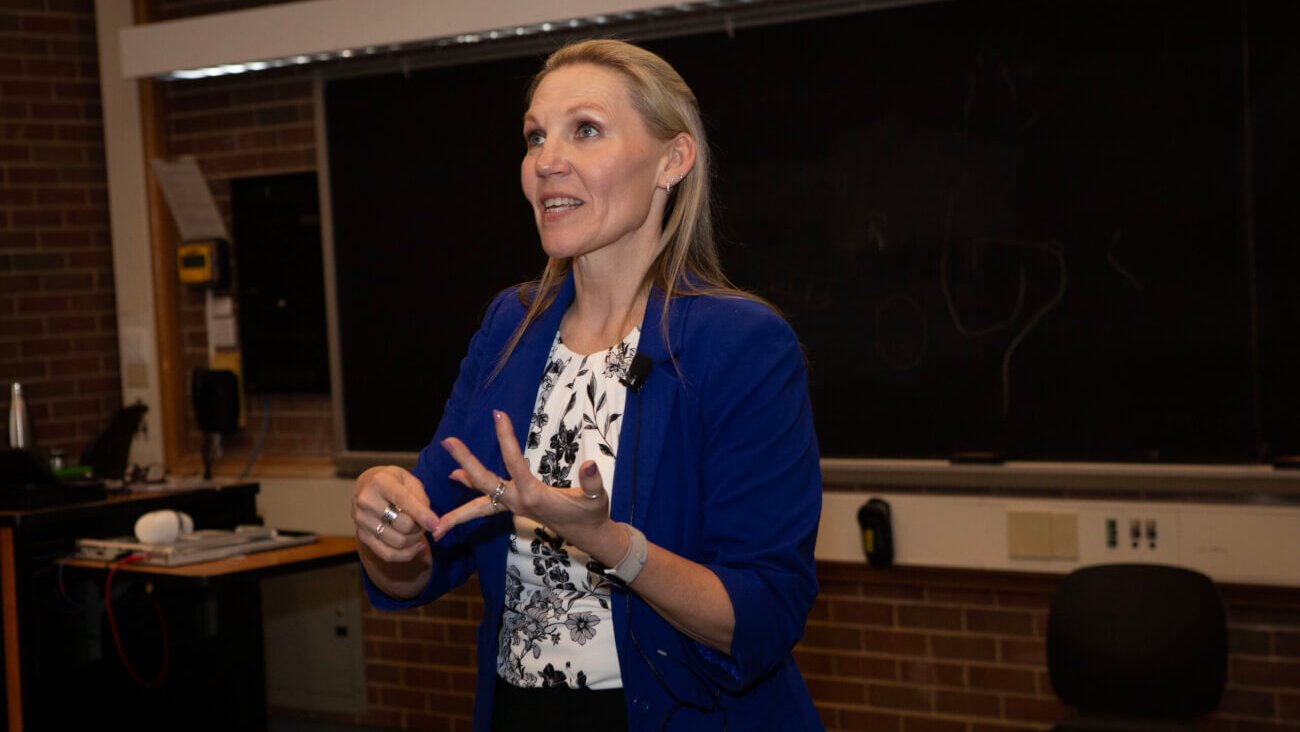
“One Health at Home: Dogs as Sentinels of Environmental Exposure” is the title of the 2026 Coppoc One Health Lecture presented by Dr. Audrey Ruple, co-principal investigator for the largest animal-health research initiative to date – the Dog Aging Project. Dr. Ruple, the Dorothy A. and Richard G. Metcalf Professor of Veterinary Medical Informatics at the Virginia-Maryland College of Veterinary Medicine at Virginia Tech, gave her talk February 26 in Lynn 1136. The lecture was free and open to the public.
Dr. Ruple is a veterinary epidemiologist and quantitative scientist who works to integrate animal, human and environmental health through a One Health lens. Specifically, her research focuses on leveraging large scale, longitudinal and informatics-driven data to advance understanding of aging, disease risk and comparative oncology. She is recognized internationally for her contributions to veterinary big data, clinical research guidelines, and interdisciplinary collaboration.
Dr. Ruple earned her DVM, master’s and PhD degrees from Colorado State University. Board-certified by the American College of Veterinary Preventive Medicine and a member of the Royal College of Veterinary Surgeons, Dr. Ruple has been inducted into Sigma Xi, the Scientific Research Honor Society, the Delta Omega Honorary Society in Public Health, and is a Fellow of the National Academies of Practice. She joined Virginia Tech in 2021 as an associate professor of quantitative epidemiology with tenure, focusing on informatics and its application to veterinary medicine.
Dr. Ruple explains that, since companion animals share our homes, our environments, and many of the same exposures that shape human health across the life course, they offer a unique and underutilized opportunity to study how genetic, environmental, and social factors interact to influence disease risk, resilience, and longevity in real-world settings. She says that, while age is a major risk factor for many chronic conditions in humans and animals alike, it is increasingly clear that lifetime environmental exposures, ranging from diet and chemical contaminants to social and built environments, play a critical role in shaping health trajectories long before people reach old age. Therefore, she advocates for companion dogs as a powerful model for investigating these relationships, in ways that promote both the health of humans and animals.
Dr. Ruple points out that canine companions vary widely in size, morphology, behavior, and disease susceptibility, and yet live in close proximity to humans and experience many of the same environmental hazards. At the same time, veterinary medicine provides a rich clinical infrastructure that allows for detailed characterization of health outcomes, including disease onset, progression, and cause of death. Dr. Ruple says together, these features position dogs as sentinels for environmental risk and as translational models for understanding how shared exposures influence health in both species.
During her presentation, Dr. Ruple described the structure, design, and emerging findings of the Dog Aging Project, which is a large-scale longitudinal study of companion dogs across the United States. Although initially motivated by questions related to aging, the project has evolved into a comprehensive platform for studying the effects of genetics, environment, and lifestyle on health outcomes across the lifespan. Dr. Ruple highlighted how this open-science resource is being used to investigate environmental hazards, chronic disease risk, and health disparities, and shared its broader implications for One Health and environmental epidemiology. The project already has generated multiple peer-reviewed publications, with ongoing opportunities for collaboration and data reuse across disciplines.
In addition to being a co-principal investigator of the Dog Aging Project, Dr. Ruple is a founding member of Fetch Forward, a pioneering veterinary insurance data analytics initiative. She has published extensively on informatics and veterinary big data, including notable contributions to the journals Nature and Science. Dr. Ruple also is the lead author on the PetSORT initiative, the first reporting guidelines for clinical trials involving owned cats and dogs.
The Coppoc One Health Lecture is named in honor of Dr. Gordon Coppoc, Purdue professor emeritus of veterinary pharmacology, and his wife, Harriet. Dr. Coppoc is the former head of PVM’s Department of Basic Medical Sciences and also served as director of the Indiana University School of Medicine – West Lafayette and associate dean of the Indiana University School of Medicine before retiring in 2014.
The annual Coppoc One Health Lecture aligns with the Purdue One Health Strategic Initiative that focuses on tackling complex challenges with real-world impact at the intersection of human, animal and plant health.