
Surgical Equipment Donation Enhances Learning for Purdue Veterinary Students

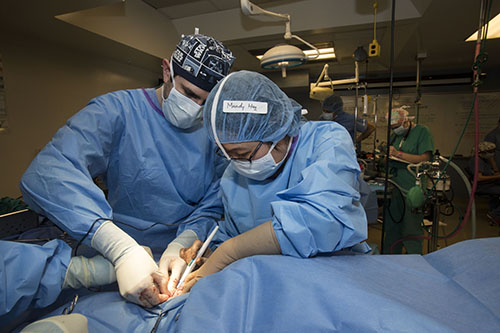
Purdue veterinary student Mandy Haq, of the DVM Class of 2019, uses an electrosurgical unit recently donated by Logansport Memorial Hospital, as she is helped by Dr. Kenneth Brand, a surgery resident, during the Junior Surgery lab.
Purdue veterinary student Mandy Haq, of the DVM Class of 2019, uses an electrosurgical unit recently donated by Logansport Memorial Hospital, as she is helped by Dr. Kenneth Brand, a surgery resident, during the Junior Surgery Lab.

Thanks to a connection between Purdue Veterinary Medicine’s Veterinary Teaching Hospital (VTH) and an orthopedic surgeon at Logansport Memorial Hospital in Logansport, Ind., third-year Purdue veterinary students now have more opportunities to learn first-hand about using electrosurgical equipment in surgery. The Purdue University College of Veterinary Medicine recently took possession of several electrosurgical units that were donated by the Logansport Memorial Hospital.

The story dates back to January 2017, when Dr. James Davis brought his dog Storm, a sweet 12-year-old Labrador Retriever, to the VTH for treatment of laryngeal paralysis. That’s when he met Dr. Sarah Malek, PVM assistant professor of small animal surgery. Dr. Malek performed the surgical procedure to correct the problem and Storm recovered successfully. During the course of the treatment and the visits to the VTH, Dr. Davis became interested in the correlation between veterinary orthopedic surgery and the work he does as a human orthopedic surgeon at Logansport Memorial Hospital.
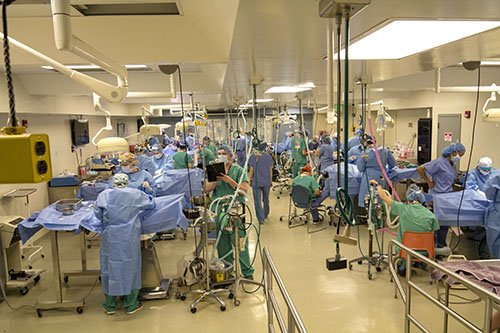
Third-year Purdue veterinary students work under the guidance of faculty and residents in the Junior Surgery lab, performing neuter surgeries needed to make shelter animals more adoptable.
Third-year Purdue veterinary students work under the guidance of faculty and residents in the Junior Surgery Lab, performing neuter surgeries needed to make shelter animals more adoptable.

Dr. Malek said over time, the connection between Dr. Davis and the Purdue University College of Veterinary Medicine has grown, given Dr. Davis’ interest and experience in training surgery residents in the past. “As both an orthopedic surgeon and a true animal lover, Dr. Davis has a genuine interest in our college’s educational programs,” said Dr. Malek. “He and I are currently working on creating learning opportunities for our surgery residents to be able to observe orthopedic surgeries in a human hospital setting in conjunction with their training at Purdue in small animal orthopedic surgery.”

Dr. Davis’ interest in the College’s teaching programs also recently resulted in donation of a large batch of bandaging and casting materials that will be used for the third-year veterinary students to learn and practice bandaging and casting skills in the small animal surgery laboratories. In addition, he made possible another contribution to the College when he offered the donation of electrosurgical units that were in excellent condition, but no longer needed at Logansport Memorial. “The Logansport hospital was replacing the units with new models, and that’s when Dr. Davis asked if I would have any use for the units in our labs,” Dr. Malek explained. “I had mentioned during our past conversations how we are always looking for a way to complete our collection of electrosurgical units in the surgery laboratories where our students can get hands-on experience using this technology.”
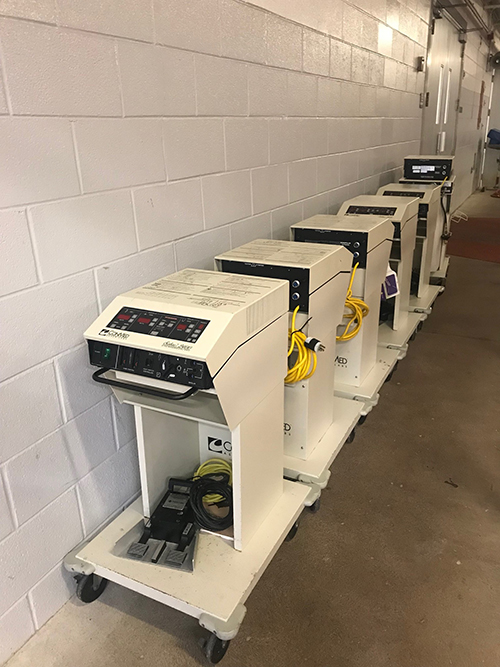
These six ConMed Sabre 2400 Electrosurgical Units were donated to the College of Veterinary Medicine for use in the small animal surgery laboratories through the efforts of Dr. James Davis at Logansport Memorial Hospital. The hospital was replacing the units with brand new equipment.

Thanks to Dr. Davis facilitating the transportation in early January, a total of six units were delivered and are now operational in the Junior Surgery Lab. Dr. Malek said the lab already had a number of electrosurgical units, but more were needed to meet the demand, given the number of student groups that operate during the labs, and in the past cost had been a limiting factor in trying to add more units. The newly donated units are compatible with the hand pieces already being used at Purdue, and are currently being utilized in the Junior Surgery Lab as the students perform spay and neuter surgeries free of charge for shelter dogs and cats that need the procedures in order to be successfully put up for adoption.

“Electrosurgery is an essential part of cutting tissue, controlling and preventing bleeding during procedures in both human and animal surgeries,” Dr. Malek explained. “It’s important for our students to have exposure to this equipment as over time the technology and equipment have become very user-friendly, safe for patients and cost effective for even non-referral practices. By having more opportunities to become familiar and experienced with this tool, our students will be better-prepared to enter veterinary practice.”

Dr. Malek also said that in the VTH, students participating in clinical rotations have only limited opportunities to use the electrosurgical units on their own. “We so appreciate Dr. Davis’ thoughtfulness and generosity in making this donation possible and furthering the learning opportunities for our students at Purdue.”

Writer(s): Kevin Doerr | pvmnews@purdue.edu

Recent Stories

“Paws Up” – brought to you by the PVM Wellness Committee

This week, we are proud to recognize Lorraine Fox, who is a business assistant with the Veterinary Medicine Procurement Center.

PVM Interview Days Move College Closer to Admitting the DVM Class of 2030

After a total of three afternoons dedicated to conducting in-person interviews with 226 prospective veterinary students, the Purdue University College of Veterinary Medicine is close to completing the process of admitting 84 members of the incoming first-year DVM class – the Class of 2030.  The students invited for the interview days were selected from a total pool of 1,930 applicants from across the country as well as countries abroad.

Experts to Gather at Purdue for Conference Addressing the Public Health Threat of Antimicrobial Resistance

The ongoing challenges posed by multi-drug resistant infections will be the focus of a multidisciplinary conference taking place in three weeks at Purdue University.  The Fourth Annual Conference on Antimicrobial Resistance is set for February 25–26, 2026 at Purdue’s Stewart Center in West Lafayette. Registration is still open for the event, which will bring together scientists and scholars from human and veterinary medicine, public health, research, and industry to address the determinants, dynamics and deterrence of drug resistance.

PVM’s Upcoming Coppoc One Health Lecture to Focus on Dogs as Sentinels of Environmental Exposure

The Purdue University College of Veterinary Medicine brings a leading One Health scholar to campus each year to address vital health issues from a One Health perspective as part of the Coppoc One Health Lecture series.  This year’s presentation, scheduled for February 26 in Lynn Hall Room 2026, is on the engaging topic, “One Health at Home: Dogs as Sentinels of Environmental Exposure.” The speaker will be Audrey Ruple, DVM, MS, PhD, DACVPM, MRCVS, the Dorothy A. and Richard G. Metcalf Professor of Veterinary Medical Informatics at the Virginia-Maryland College of Veterinary Medicine at Virginia Tech.

“Paws Up” – brought to you by the PVM Wellness Committee

Today we are happy to acknowledge our Student Success Center Team.

One Health: A ‘digital twin’ model for predicting cancer outcomes

The striking similarities between invasive bladder cancer in dogs and humans have fueled research advances for more than three decades. Most of that work has looked at separate aspects of the disease — risk factors, early detection, symptoms, treatment and gene expression. But a new project at Purdue University that combines many types of available data in a “digital twin” model of bladder cancer may prove powerful enough to predict patient outcomes, starting with the probability of metastasis.

Purdue Professor Emeritus Bill Blevins Wins Lifetime Achievement Award at ACVR Annual Meeting

The American College of Veterinary Radiology (ACVR) gave its esteemed Lifetime Achievement Award for 2024 to Purdue Professor Emeritus Bill Blevins, who is well known to countless Purdue Veterinary Medicine alumni for the expertise he taught them about all things Diagnostic Imaging during his long Purdue career.